
Table of Contents
ToggleOverview: Growing Demand for High-Precision Deep Hole Components
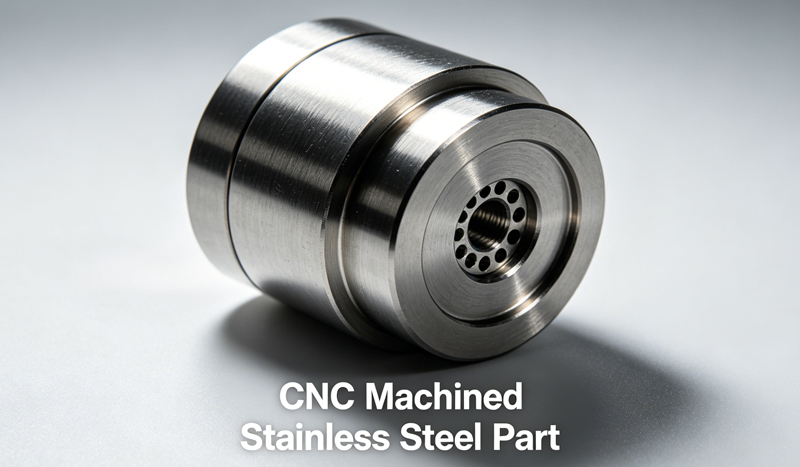
With the rapid advancement of high-end manufacturing in aerospace, hydraulic systems, medical devices, energy equipment, and marine engineering, stainless steel deep hole components are becoming increasingly critical in modern precision assemblies.
Stainless steels such as 304, 316L, and duplex grades are widely used due to their corrosion resistance, strength, and durability. However, these same properties make deep hole CNC machining significantly more complex, especially as industries demand higher depth-to-diameter ratios, tighter tolerances, and superior internal surface quality.
As a result, deep hole machining has evolved from a specialized process into a core manufacturing capability—and one of the main bottlenecks in precision stainless steel production.
Key Technical Challenges in Deep Hole Stainless Steel CNC Machining
1. Severe Tool Wear and Heat Accumulation
Stainless steel has low thermal conductivity, which prevents cutting heat from dissipating efficiently during machining. In deep hole environments, heat becomes trapped inside narrow cavities, causing extreme temperature concentration at the cutting edge.
This leads to:
Rapid tool wear and edge failure
Tool tip chipping and abrasive degradation
Frequent tool replacement in continuous production
In addition, stainless steel’s work-hardening effect further accelerates tool degradation. Once a hardened layer forms inside the hole wall, it continuously increases cutting resistance, creating a cycle of accelerated wear.
2. Chip Evacuation and Cutting Instability
Deep hole machining severely restricts chip removal. Stainless steel produces long, tough, and elastic chips that tend to tangle inside the hole.
This results in:
Chip congestion and re-cutting
Increased friction and heat generation
Surface scratches and dimensional deviation
Interrupted cutting stability
As hole depth increases, maintaining smooth chip evacuation becomes one of the most difficult challenges in CNC deep drilling.
3. Dimensional Accuracy and Geometric Tolerance Control
High-end stainless steel components often require micron-level precision, including strict control of:
Straightness
Roundness
Cylindricity
Diameter consistency
However, in deep hole machining, long drill tools are prone to:
Elastic deflection
Vibration and chatter
Radial force imbalance
These issues lead to spiral marks, surface waviness, and inconsistent bore geometry—especially in depth-to-diameter ratios exceeding 20:1.
4. Surface Quality and Hidden Structural Defects
During deep hole machining, excessive heat and friction can generate a plastic deformation layer on the inner wall of stainless steel parts. This layer often contains:
Micro-cracks
Burr formation
Tool marks
Residual stress concentration
Although not always visible immediately, these defects can significantly reduce fatigue resistance, corrosion resistance, and long-term service reliability—especially in high-pressure or corrosive environments.
5. Batch Production Consistency and Intelligent Control Limitations
In many machining environments, deep hole CNC processes still rely heavily on operator experience for parameter tuning, including:
Spindle speed
Feed rate
Coolant pressure
Tool compensation
This leads to inconsistent results in mass production. Minor variations in tool wear, machine vibration, or temperature conditions can significantly affect final quality.
Furthermore, many CNC systems still lack real-time monitoring capabilities for deep hole conditions such as:
Chip blockage
Tool wear progression
Internal vibration behavior
This limits the ability to maintain stable, large-scale production.
Industry Solutions and Technology Optimization Trends
To address these challenges, the CNC machining industry is actively adopting advanced technologies and process improvements:
High-performance coated carbide tools for stainless steel machining
High-pressure coolant and chip evacuation systems
Gun drilling and BTA deep hole drilling technologies
Vibration-damping tool holders and rigid machine setups
Multi-axis CNC synchronization for improved stability
In-process sensing and real-time monitoring systems
Data-driven process optimization and adaptive control systems
These technologies significantly improve machining stability, tool life, and dimensional consistency in deep hole applications.
Future Development: Toward Intelligent Deep Hole Manufacturing
The future of stainless steel deep hole CNC machining is shifting toward intelligent, data-driven manufacturing systems. Instead of relying solely on operator experience, modern production will increasingly depend on:
Real-time process monitoring
AI-based parameter optimization
Predictive tool wear analysis
Closed-loop machining control
This transformation will help manufacturers achieve higher precision, better consistency, and improved production efficiency in complex deep hole components.
Conclusion
Deep hole machining of stainless steel parts represents one of the most technically demanding areas in modern CNC manufacturing. Challenges such as tool wear, chip evacuation, precision control, surface integrity, and batch consistency continue to push traditional machining methods to their limits.
However, with the integration of advanced tooling, high-pressure cooling systems, and intelligent CNC technologies, the industry is steadily moving toward more stable, efficient, and high-precision deep hole manufacturing capabilities.
For manufacturers serving aerospace, medical, hydraulic, and energy industries, mastering these technologies is becoming a key competitive advantage in the global market.



The discussion on chip evacuation and heat buildup in deep-hole stainless steel machining highlights two issues that often have a bigger impact on part quality than many people expect. It would be interesting to see how real-time process monitoring and adaptive machining strategies affect tolerance control and consistency during longer production runs.