
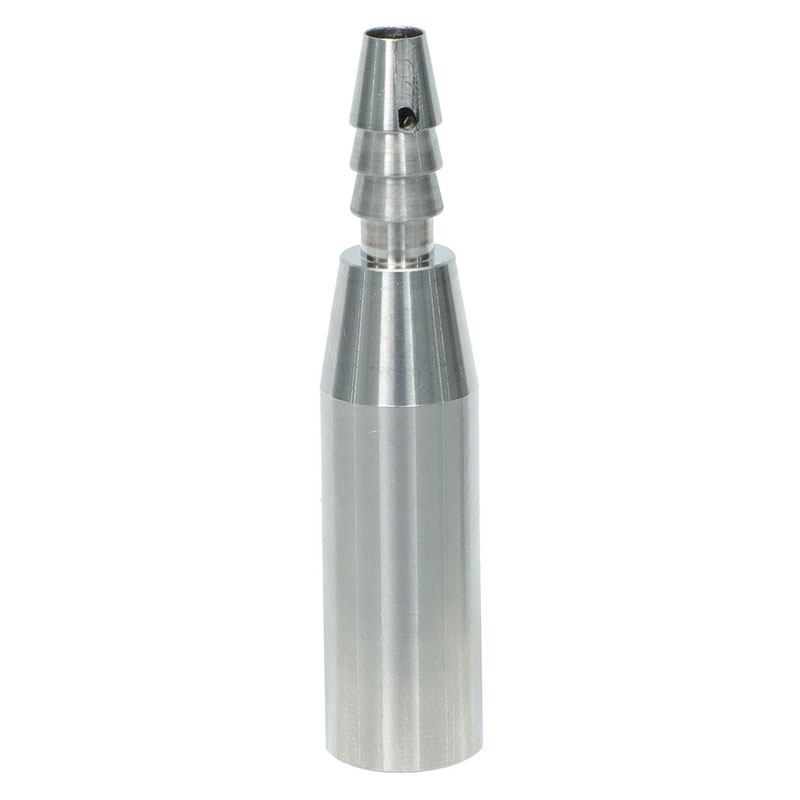
CNC Machined Aluminum Hose Barb Connector with Cross Hole for Medical Beauty
Description
Product Overview
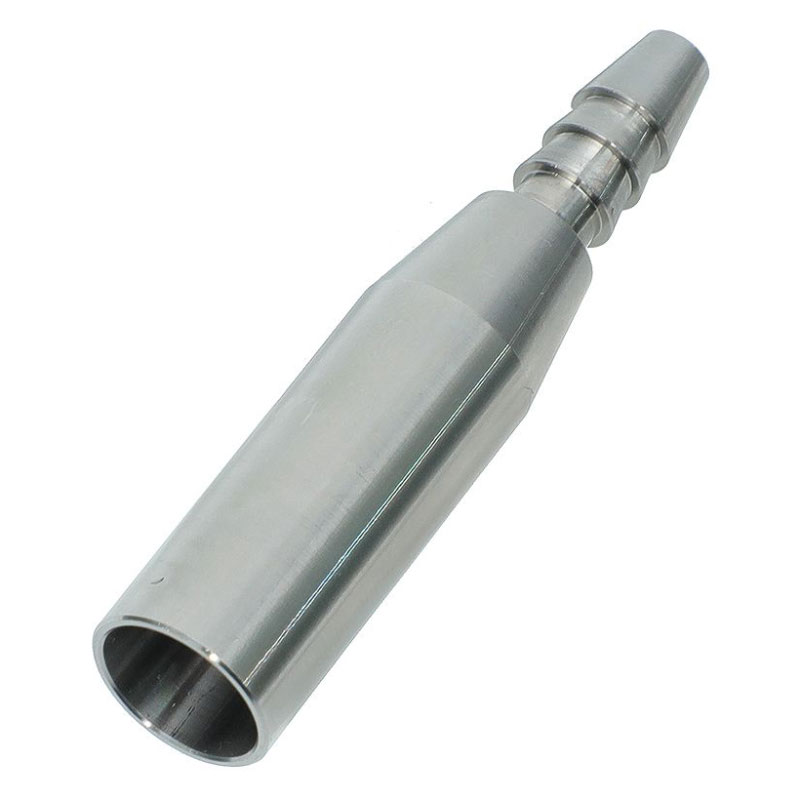
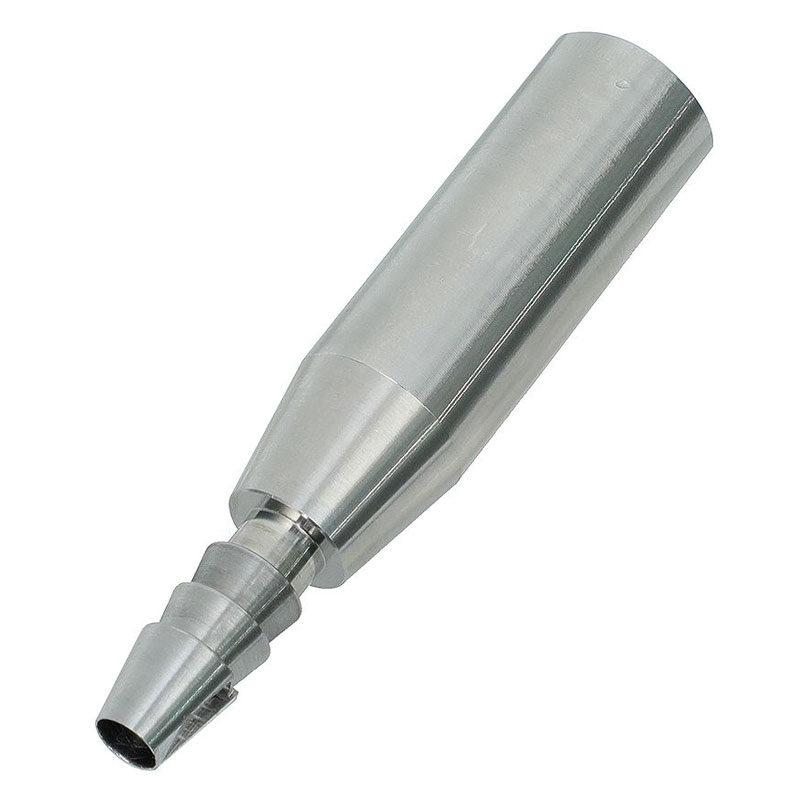
This custom CNC machined aluminum connector is engineered specifically for fluid and pneumatic transmission in handheld medical and beauty devices. Unlike standard pipe fittings, it features an integrated, one-piece construction combining a multi-stage hose barb, a side cross hole for precise fluid/air exhaust, and an enlarged hollow handle sleeve. Precision turned from solid aluminum alloy, it ensures a lightweight, corrosion-proof, and ergonomic user experience.
CNC Machining Services Specification Table
We offer comprehensive and flexible CNC turning and milling services to meet exact dimensional and functional requirements for your fluid connection components.
| Parameter | Technical Capabilities & Options |
|---|---|
| Manufacturing Process | CNC Turning, CNC Milling, Deep Hole Boring, Cross Drilling |
| Applicable Materials | Aluminum (6061/6063), Stainless Steel (304/316L), Brass, Copper |
| Standard Tolerance | ±0.01 mm (0.0004 inches) for critical diameters |
| Concentricity | Within 0.02 mm for inner bore vs. outer barb alignment |
| Surface Roughness (Ra) | Standard Ra 1.6μm (finish turning); Custom Ra 0.8μm (polished) available |
| Surface Finishing Options | Natural Aluminum, Clear/Sandblasted Anodizing, Hard Anodizing, Electropolishing, Passivation |
| Machining Equipment | 5-axis CNC Lathes, Multi-tasking Turn-Mill Centers (Swiss type available) |
| Max Machining Diameter | Up to 50mm (customizable) |
| MOQ (Minimum Order Quantity) | 1 Piece (Prototypes) to Mass Production (2000+ pcs) |
| Lead Time | 5-7 working days for samples; 15-25 days for bulk production |
| Quality Control | 100% dimensional inspection, CMM verification, pneumatic leak testing |
Material Analysis: Why 6061 Aluminum Alloy?
For this specific application (Medical Beauty Handheld Equipment), we strongly recommend 6061-T6 Aluminum Alloy.
- Lightweight: Only one-third the density of stainless steel, significantly reducing hand fatigue during long-term operation by the user.
- Excellent Machinability: 6061 is highly suitable for precise CNC turning, allowing the sharp side holes and complex internal deep bores to be machined smoothly without tearing the material.
- Corrosion Resistance: It naturally forms a protective oxide layer and readily accepts anodizing, which gives it a sleek, non-stick, and fingerprint-resistant finish essential for medical aesthetics.
Alternative: If the part requires high sterilization resistance, we can migrate to 304 or 316L Stainless Steel, which provides superior chemical resistance.
Application Scenarios
This universal fluid connector is widely used as an end-coupling component in various industries:
- Medical & Aesthetic Equipment: Used as the fluid/oxygen dispensing handle in oxygen infusion guns, facial hydro-peeling devices, and water jet pumps.
- Industrial Pneumatics & Automation: Acts as a vacuum or positive pressure adapter for air-actuated tools, pneumatic cylinders, and automated fluid routing.
- Laboratory & Analytical Instruments: A reliable micro-fluidic connector for chemical analyzers and sample dispensing systems.
Tolerance Capabilities & Precision Control
Achieving the precise function of this part relies heavily on tight tolerances:
- Critical Diameters (Outer Barbs and Internal Bore): Held to ±0.01mm. This ensures a friction-fit locking with the soft tube and a seamless, leak-free interface with the main device body.
- Cross Hole Positional Accuracy: The side hole location is aligned to ±0.05mm. This precision prevents airflow blockage or asymmetric fluid spray.
- Concentricity: The outer multi-stage barbs and the inner bore are strictly concentric to minimize vibration when the fluid flows through at high speed.
Manufacturing Challenges & Our Solutions
Despite its seemingly simple geometric shape, producing this part with a 3-stage barb, a cross hole, and a deep hollow shaft presents three distinct engineering hurdles:
| Challenge | Our CNC Engineering Solution |
|---|---|
| 1. Cross Hole Deburring Drilling the side hole into the tapered barb produces sharp internal burrs. | We use live tooling milling combined with specialized micro-deburring brushes to ensure the internal fluid passage is completely smooth, preventing particle contamination in medical fluids. |
| 2. Deep Hole Boring (High L/D ratio) The long hollow bottom sleeve requires a length-to-diameter ratio exceeding 3:1. | We utilize high-precision deep-hole boring tools paired with high-pressure coolant to avoid drill wander, ensuring the internal wall thickness is perfectly uniform. |
| 3. Thin-Wall Machining Deformation Thin walls at the neck/tapered transition are prone to deformation under clamping force. | We use soft jaws and custom fixtures to evenly distribute the clamping force, preventing geometric distortion. |
Frequently Asked Questions (FAQ)
Q1: Can I customize the diameter and number of the barbs?
A1: Absolutely. We offer full custom CNC machining services. The 3-stage barb is the standard design, but we can adjust the diameters, the barb’s taper angle, and even add a 4th or 5th stage based on your specific soft tube’s inner diameter (ID).
Q2: Is the cross hole necessary for the connector to work?
A2: The cross hole is typically designed for purposes like air exhaust, flow bypass, or inserting a locking pin. If your application only requires a straight-through flow without exhausting, we can easily machine it as a solid-tip version without the cross hole upon your request.
Q3: What is your standard MOQ for this custom component?
A3: Our factory specializes in agile CNC prototyping and mass production. We have no strict MOQ for your first sample order—1 piece is welcome to test your design. Mass production typically starts from 500-1000 pieces, but we are highly negotiable.
Q4: How do I ensure the soft hose will not disconnect under high pressure?
A4: The multi-stage barb design naturally grips the inner wall of the silicone or PU hose. We recommend using a standard hose clamp or cable tie around the barb’s waist for extreme pressure applications, ensuring zero pull-out risks.
Q5: Does this part require a specific surface treatment for medical use?
A5: Yes. For medical and beauty applications, we recommend Clear/Matte Anodizing (Type II) or Electropolishing. These processes seal the aluminum, making it easy to disinfect, resistant to skin contact oils, and providing a premium, professional aesthetic.
Additional information
| material |
|---|

Reviews
There are no reviews yet.