
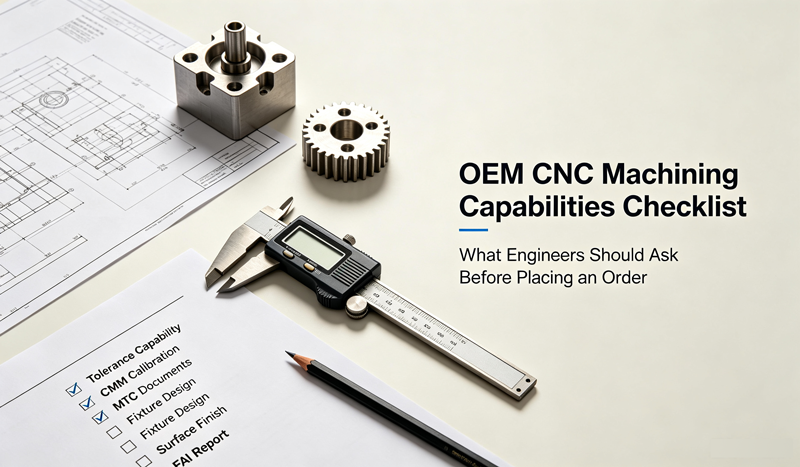
Why You Need This Checklist
For mechanical, hardware, and product engineers, partnering with an OEM CNC machining supplier is never a simple “place and pay” transaction. A seemingly qualified manufacturer may fail to meet critical tolerance requirements, deliver inconsistent surface finishes, lack material traceability, or miss tight lead times—all of which can trigger prototype delays, assembly failures, mass production reworks, and costly project budget losses.
Most engineering teams only review supplier quotations and basic machining qualifications before ordering, ignoring hidden capability gaps that only emerge after production. To eliminate technical risks, stabilize part quality, and align supplier capacity with project demands, this article provides a comprehensive checklist covering equipment, materials, engineering, quality, post‑processing, delivery, and industry experience—along with the critical questions you must ask at each step.
📌 Related Resource: Explore our full range of OEM CNC machining services to see how we handle complex projects from prototype to production.
Table of Contents
Toggle1. Machine Capability & Precision Verification
Precision is the foundation of qualified CNC OEM parts. Many suppliers claim “high‑precision machining” in their promotions, but their actual equipment configuration and process stability often fail to meet complex part requirements. Engineers must verify hardware capabilities with hard data, not just nominal specs.
Key Questions to Ask:
- What types of CNC machines will be used for this project (3‑axis, 4‑axis, or full 5‑axis simultaneous machining)? What is the maximum machining travel and single‑setup processing range?
- What is the stable dimensional tolerance range of your equipment? Can you consistently maintain ±0.01mm or tighter for critical features, and provide valid Cpk (Process Capability Index) ≥ 1.33 data for mass production?
- Are your machines and measuring devices regularly calibrated? Can you provide recent calibration certificates for your CMM, micrometers, and other inspection tools?
- How do you handle special challenges like thin‑wall deformation, deep‑cavity machining, and high‑aspect‑ratio hole drilling?
🔧 For a closer look at our machine fleet, visit our CNC machining facility & equipment page.
🚨 Red Flag: The supplier cannot provide calibration records or is vague about Cpk, insisting only on “we guarantee the tolerance.”
2. Material Qualification & Full Traceability
Material mismatch is one of the most common and most overlooked OEM CNC machining risks. Even if dimensional accuracy is perfect, unqualified material grades, improper heat treatment, or missing batch traceability will render parts unusable—especially in medical, automotive, aerospace, and industrial automation applications.
Key Questions to Ask:
- What material brands, grades, and batch numbers will be used? Can you provide a MTC (Material Test Certificate) or MTR (Material Test Report) for each batch, conforming to ASTM, AMS, or ISO standards?
- Do you support custom material specifications for special alloys (Inconel, titanium) and engineering plastics (PEEK, PEI)?
- Do you have an incoming quality control (IQC) process? Are non‑conforming raw materials strictly rejected before production?
- Can you provide a complete traceability record from raw material batch → machine → operator → inspection data, for quick root‑cause analysis in case of quality issues?
📄 Download our CNC machining materials guide for detailed comparisons of aluminum, stainless steel, titanium, and plastics.
🚨 Red Flag: The supplier says “we can buy the material but the certificate costs extra,” or cannot show any lot‑tracking system.
3. Engineering Support & DFM (Design for Manufacturability)
A great supplier does not just machine parts to print—they proactively review your design, flag manufacturability issues, and suggest cost‑effective improvements. Additionally, their engineering change management process directly affects how design revisions are executed on the shop floor.
Key Questions to Ask:
- Do you perform a formal DFM review and provide written feedback before quoting? Will you suggest optimizations for unreasonable features (e.g., too‑small internal radii, deep narrow slots, unnecessary tight tolerances)?
- How do you interpret and execute GD&T (Geometric Dimensioning and Tolerancing) per ASME Y14.5 or ISO GPS? Do you have dedicated engineers for complex callouts like true position, profile, and runout?
- When my drawing revision changes, how do you ensure the old version is not used on the shop floor? How is the Engineering Change Notice (ECN) communicated to operators and verified?
- For multi‑setup parts, how do you design fixturing to minimise cumulative positioning errors?
🚨 Red Flag: The supplier does not ask any technical questions before quoting, or claims “we can make anything from your drawing.”
4. Quality Management & Inspection Capability
Quality is not achieved by final inspection alone—it is built through process control. Engineers must verify that the supplier has the right inspection equipment, standardised procedures, and a clear non‑conformance handling process.
Key Questions to Ask:
- Do you have in‑house CMM (Coordinate Measuring Machine), surface roughness testers, height gauges, hardness testers, and are all instruments within current calibration?
- Does your inspection process include First Article Inspection (FAI/FAIR), in‑process checks, and final inspection? Can you provide a full dimensional FAIR report and CMM report for each batch?
- For production orders, do you perform Cp/Cpk statistical process control to demonstrate long‑term stability?
- How do you handle non‑conforming parts (rework, scrap, or concession)? What is your compensation policy for delivery delays caused by quality issues?
- Can you supply Certificate of Conformance (COC), FAIR reports, surface roughness data, and material certificates with each shipment, and archive them for future traceability?
✅ Learn more about our quality assurance protocols and ISO certifications.
🚨 Red Flag: There is no separate quality department, or the supplier says “our machines are so precise that we don’t need much inspection.”
5. Surface Finishing & Secondary Operations
CNC machining is rarely the final step. Anodising, passivation, plating, blasting, polishing—these post‑processes affect part function and aesthetics. The supplier’s ability to handle them in‑house or with controlled subcontractors impacts total cost and lead time.
Key Questions to Ask:
- What surface finishing processes do you support (e.g., anodising Type II/III, passivation, electroless nickel plating, powder coating, bead blasting, polishing)? Can you meet the specified Ra roughness value?
- Are these post‑processes performed in‑house or outsourced? If outsourced, how do you control the quality and delivery of subcontractors? Do you perform regular audits?
- Do you have experience with special requirements such as medical‑grade passivation or high‑precision mirror finishing?
- How do you manage dimensional changes caused by surface treatment (e.g., anodising thickness)? Do you leave machining allowances or perform subsequent grinding?
🎨 See our full list of post-processing and surface finishing capabilities.
6. Production Flexibility, Lead Time & Batch Stability
Different projects demand different volumes: a few prototype units, several hundred for pilot runs, or tens of thousands for mass production. The supplier must be able to match your stage and scale seamlessly.
Key Questions to Ask:
- Do you have a minimum order quantity (MOQ) for prototypes and for production orders? Are you willing to support small‑batch development?
- What are the typical lead times for prototypes and for mass production? Can you accelerate for urgent orders?
- How do you ensure consistency between prototype parts and production parts, so that “first‑article approval” translates to reliable mass production?
- Do you have redundant machines and workforce to support capacity ramps in later project stages?
7. Industry Certifications & Vertical Experience
General CNC capability does not replace industry‑specific compliance. Medical, aerospace, automotive, and semiconductor sectors require additional standards (AS9100D, IATF 16949, ISO 13485) and special process controls.
Key Questions to Ask:
- What quality management certifications do you hold (ISO 9001 as a minimum, plus industry‑specific ones)? Provide certificate numbers and issuing bodies.
- Do you have proven experience in our target industry (e.g., medical implants, aerospace structural parts, automotive powertrain)? Can you share anonymised case studies or customer references?
- Do you maintain special process documentation such as FMEA and Control Plans for regulated applications?
✈️ Explore our industry‑specific solutions for aerospace, medical, and automotive applications.
Final Pre‑Order Checklist – 10 Quick Verification Points
Before issuing any purchase order, ensure each of the following items is clearly answered and documented:
| # | Verification Item | Status |
|---|---|---|
| 1 | Machine type (3/4/5‑axis), travel, stable tolerance, and Cpk data | ☐ |
| 2 | Material certificates (MTC/MTR) and full batch traceability system | ☐ |
| 3 | DFM report and engineering change management process | ☐ |
| 4 | GD&T interpretation capability and fixturing strategy | ☐ |
| 5 | In‑house CMM and ability to provide FAIR reports | ☐ |
| 6 | Non‑conformance handling procedure and compensation policy | ☐ |
| 7 | Surface finishing options and subcontractor quality control | ☐ |
| 8 | Lead times, MOQ, and batch‑to‑batch consistency plan | ☐ |
| 9 | Industry certifications and relevant case experience | ☐ |
| 10 | Long‑term partnership support (design iterations, cost optimisation, continuous improvement) | ☐ |
Conclusion
OEM CNC machining quality is determined by a supplier’s comprehensive capabilities, not by the lowest unit price. By using this systematic checklist—covering equipment, materials, engineering, quality, post‑processing, production flexibility, and industry experience—engineers and procurement teams can identify a true long‑term manufacturing partner rather than just a machine shop. This due diligence reduces trial‑and‑error costs, ensures batch‑to‑batch consistency, and lays a solid foundation for product iteration and mass production.
🚀 Ready to partner with a qualified OEM CNC machining supplier? Contact our engineering team for a free DFM review and competitive quote, or browse our project case studies to see real‑world results.
Use this checklist as your supplier audit tool before placing any OEM CNC order. A few extra questions today can save months of rework tomorrow.


