
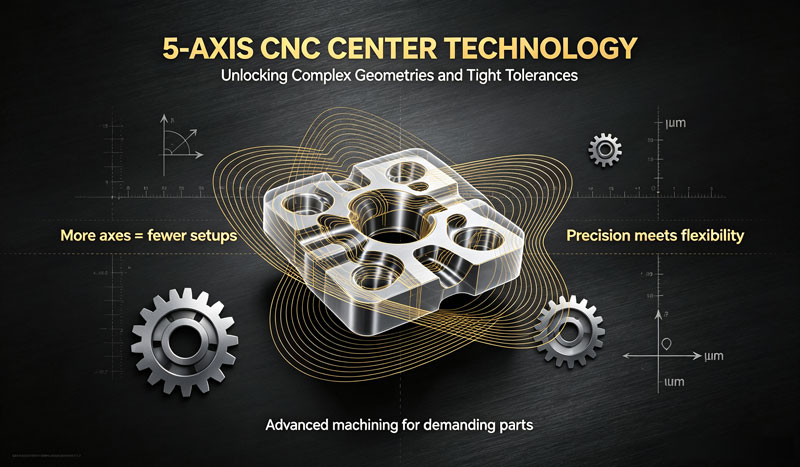
In the era of advanced precision manufacturing, industrial innovation is increasingly defined by two core demands: intricate component geometries and ultra‑precise dimensional tolerances. Traditional 3‑axis CNC machining, confined to linear movements along X, Y, and Z, struggles to address deep cavities, undercuts, continuous free‑form surfaces, and multi‑angle features that are now commonplace in aerospace, medical, automotive, and energy sectors. The 5‑axis CNC machining center has broken these shackles by integrating three linear axes with two rotational axes, enabling omni‑directional, high‑efficiency, and high‑precision machining. This technology not only unlocks the manufacture of previously impossible geometries but also delivers consistent tight tolerances, making it a cornerstone of modern high‑end manufacturing.
Table of Contents
Toggle1. Core Working Principle and Machine Configurations
A 5‑axis CNC center upgrades the traditional 3‑axis linear motion system by adding two independent rotational axes (commonly A/B or A/C combinations). This allows either the cutting tool or the workpiece to rotate and tilt freely during processing, achieving arbitrary spatial positioning and attitude adjustment.
The technology operates in two primary modes:
- 3+2‑axis positioning (indexed) machining: The two rotational axes are fixed at a specific angle after positioning, and cutting is performed via the three linear axes. This is suitable for regular multi‑surface parts and angled holes.
- Full 5‑axis simultaneous machining: All five axes move in a coordinated, continuous manner, enabling the tool to follow complex curved surfaces in real time while maintaining an optimal cutting posture. This mode is essential for ultra‑complex geometries like impellers, blisks, and organic‑shaped implants.
All modern 5‑axis centers are equipped with RTCP (Rotational Tool Center Point) control, which dynamically compensates for the linear displacement caused by rotary movements. This ensures that the tool tip remains exactly on the programmed path, regardless of how the rotary axes move. Machines without RTCP are often referred to as “pseudo‑5‑axis” and suffer from poor accuracy and reprogramming burdens.
Common Machine Configurations
| Configuration | Description | Best Suited For |
|---|---|---|
| Trunnion table (dual‑rotary table) | Workpiece tilts and rotates on a built‑in table | Small‑to‑medium precision parts, molds, aerospace components |
| Swivel head (dual‑rotary head) | Spindle head rotates around the workpiece | Large, heavy workpieces (e.g., structural airframe parts) |
| Hybrid (head + table) | Combines table rotation and spindle tilting | Maximum flexibility, advanced multi‑faceted parts |
2. Unlocking Complex Geometries – Breaking Shape Limitations
The foremost advantage of 5‑axis technology is its ability to machine geometries that are impossible or prohibitively inefficient on 3‑axis equipment.
2.1 Single Setup, Multi‑Face and Full‑Contour Machining
Traditional processing of undercuts, deep narrow cavities, twisted surfaces, and spatial intersecting features often requires multiple clampings and repeated alignments. Each re‑clamping introduces mechanical and operator errors, disrupts surface integrity, and prevents one‑piece molding for integrated complex components.
A 5‑axis center completes machining of five (or even all) faces in a single setup. By rotating or tilting the tool/workpiece, it easily reaches hidden areas and accurately machines aerodynamic curves, impeller blade passages, complex mold profiles, and micro‑scale spatial features. This eliminates the need for splicing and secondary operations, removing surface seams and structural defects. Consequently, designers are free to create lighter, more integrated, and higher‑performance parts, driving product innovation.
2.2 Continuous Tool Attitude Optimisation
During full 5‑axis simultaneous machining, the tool orientation is continuously adjusted to maintain an optimal cutting angle relative to the workpiece surface. This results in:
- Smoother surface finishes (lower scallop height)
- Reduced tool marks and vibration
- Improved tool life
- Ability to machine steep walls, deep cavities, and overhanging features without re‑fixturing
3. Empowering Ultra‑Tight Tolerances – Eliminating Cumulative Errors
In precision manufacturing, tolerance accuracy directly determines mechanical performance, assembly fit, and service life. The precision bottleneck of 3‑axis machining arises mainly from repeated clamping: each re‑clamping introduces mechanical, fixture, and human errors, which accumulate across operations and make it difficult to meet micron‑level requirements.
3.1 Single‑Setup Error Reduction
5‑axis CNC technology fundamentally solves this problem by completing the entire process under one unified coordinate system. This avoids dimensional deviations and positional inaccuracies caused by multiple repositionings. Advanced 5‑axis centers can stably achieve positioning accuracies of ±0.003 mm and repeatability of ±0.002 mm, with machining tolerances consistently held between ±0.005 mm and ±0.020 mm – and even tighter for high‑end machines.
| Performance Metric | Typical 3‑Axis | Typical 5‑Axis |
|---|---|---|
| Positioning accuracy | ±0.010 – ±0.020 mm | ±0.003 – ±0.010 mm |
| Machining tolerance | ±0.020 – ±0.050 mm | ±0.005 – ±0.020 mm |
| Surface finish (Ra) | 0.8 – 3.2 μm | 0.4 – 1.6 μm |
| Number of setups | Multiple (2–6) | Usually 1 |
| Cumulative error risk | High | Negligible |
3.2 Dynamic Compensation for Stability
In addition, the real‑time adjustable tool attitude keeps the cutting edge at the optimal angle, reducing wear and vibration. Modern 5‑axis systems also incorporate thermal deformation compensation, tool‑wear monitoring, and in‑process probing to offset tiny errors during high‑speed operation. This ensures batch‑to‑batch consistency – a critical advantage over traditional equipment.
Research has shown that compared with 3‑axis machining, 5‑axis simultaneous contouring can reduce machining errors and surface roughness to one‑third to one‑sixth of the values obtained on 3‑axis machines, while achieving profile accuracy for aero‑engine blisks within ±8.9 μm.
4. Key Application Fields
4.1 Aerospace
Aerospace components demand lightweight, high‑strength materials (titanium, Inconel, aluminium alloys) and complex aerodynamic surfaces. Typical parts include turbine blades, blisks, engine casings, structural brackets, and landing‑gear components. 5‑axis machining ensures the aerodynamic profile and structural integrity required for flight safety and fuel efficiency.
4.2 Medical Devices
Orthopaedic implants (hip and knee joints, bone screws, spinal fixators), surgical instruments, and dental components require patient‑specific organic shapes and mirror‑like surface finishes. 5‑axis technology produces these bionic contours in a single setup, achieving the micron‑level accuracy and biocompatible surfaces essential for successful implantation.
4.3 Automotive and New Energy Vehicles
High‑performance engine parts, transmission housings, turbocharger impellers, and electric‑motor casings benefit from 5‑axis machining. The technology also enables rapid prototyping of complex castings and die‑cast molds. In the NEV sector, battery‑module cores and hydrogen‑fuel‑cell components are increasingly manufactured on 5‑axis centers to meet stringent dimensional and cooling‑channel requirements.
4.4 Die and Mold Manufacturing
For injection molds, stamping dies, and forming tools, 5‑axis machining directly produces deep cavities, complex cores, and intricate cooling channels with minimal hand polishing. This shortens lead times and improves tool life and part quality.
4.5 Energy and Heavy Equipment
Large pump casings, valve bodies, compressor impellers, and hydraulic components – often made from superalloys – are machined efficiently on 5‑axis gantry or swivel‑head machines, reducing the number of operations and improving reliability.
5. Material Compatibility and Process Considerations
5‑axis CNC centers can process a wide range of engineering materials, each with its own challenges:
| Material | Advantages | Machining Challenges | Typical Applications |
|---|---|---|---|
| Aluminium alloys | Lightweight, good machinability, high strength‑to‑weight | Soft, prone to built‑up edge | Aerospace structures, automotive, electronics |
| Stainless steel | Corrosion‑resistant, durable | Work‑hardening, high cutting forces | Medical devices, fluid controls, industrial |
| Titanium alloys | High strength, low weight, heat‑resistant | Poor thermal conductivity, high tool wear | Aerospace, implants |
| Inconel & superalloys | Extreme heat and creep resistance | Very difficult to machine, requires specialized tooling | Turbine components, energy equipment |
Successful 5‑axis machining of these materials demands optimised cutting speeds, feed rates, tool geometries, and coolant strategies – often guided by advanced CAM simulation.
6. Manufacturing Challenges and Solutions
Despite its power, 5‑axis machining presents significant challenges that require advanced expertise:
- Complex programming: 5‑axis CAM requires careful tool‑orientation planning, collision avoidance, and machine‑kinematic simulation. Software like PowerMill, hyperMILL, and Mastercam provide dedicated 5‑axis strategies.
- Calibration and accuracy control: Rotary axes must be regularly calibrated using laser interferometers, ball‑bars, and CMM inspection. Thermal compensation and in‑process probing are essential for maintaining micron‑level tolerances over long runs.
- Tool selection and wear management: Improper parameters lead to chatter, poor finish, and short tool life. Optimisation of cutting data and use of advanced coated carbide or ceramic tools is critical.
- Interference detection: With five axes in motion, the tool, holder, and workpiece can collide. Advanced simulation and automatic collision avoidance are built into modern CAM systems.
7. Future Trends
The evolution of 5‑axis CNC technology is accelerating, driven by digitalisation and material innovation:
- Intelligent machining: AI‑based parameter optimisation, real‑time vibration suppression, and digital‑twin monitoring are becoming standard, enabling unmanned and adaptive production.
- Hybrid processes: Integration with additive manufacturing (laser cladding), turning, and grinding on a single platform expands capability beyond pure milling.
- Higher precision: Positioning accuracy is pushing toward ≤0.003 mm and repeatability toward ≤0.0015 mm, opening applications in optics and ultra‑precision engineering.
- Localisation and cost reduction: Domestic manufacturers are making progress in CNC systems, direct‑drive rotary tables, and high‑speed spindles, lowering the barrier to adoption.
- Smart factory connectivity: 5‑axis machines are increasingly integrated with MES, IIoT, and cloud‑based analytics for full traceability and predictive maintenance.
Conclusion
5‑Axis CNC Center Technology has fundamentally transformed precision manufacturing by unlocking the production of complex geometries and ultra‑tight tolerances that are unattainable with conventional 3‑axis methods. Through simultaneous multi‑axis movement, single‑setup processing, real‑time error compensation, and dynamic tool‑attitude control, it delivers superior accuracy, surface quality, and productivity. Whether for aerospace blisks, medical implants, automotive prototypes, or energy‑sector components, 5‑axis machining has become the indispensable backbone of high‑value‑added manufacturing. As intelligent and hybrid technologies continue to advance, 5‑axis CNC centers will remain at the forefront of industrial innovation, empowering engineers to design and produce the next generation of high‑performance products with unprecedented freedom and reliability.


Pingback: Why Companies Outsource OEM CNC Machining Instead Of Building In-House Manufacturing | XINQIDA
Pingback: Beyond CNC Milling And Turning: Exploring Advanced CNC Services For Custom Metal Parts | XINQIDA