
Precision CNC Machined Split Lock Nut for Spindle Bearing and Ball Screw Assembly
Description
Overview | The Ultimate Anti-Vibration Fastening Solution
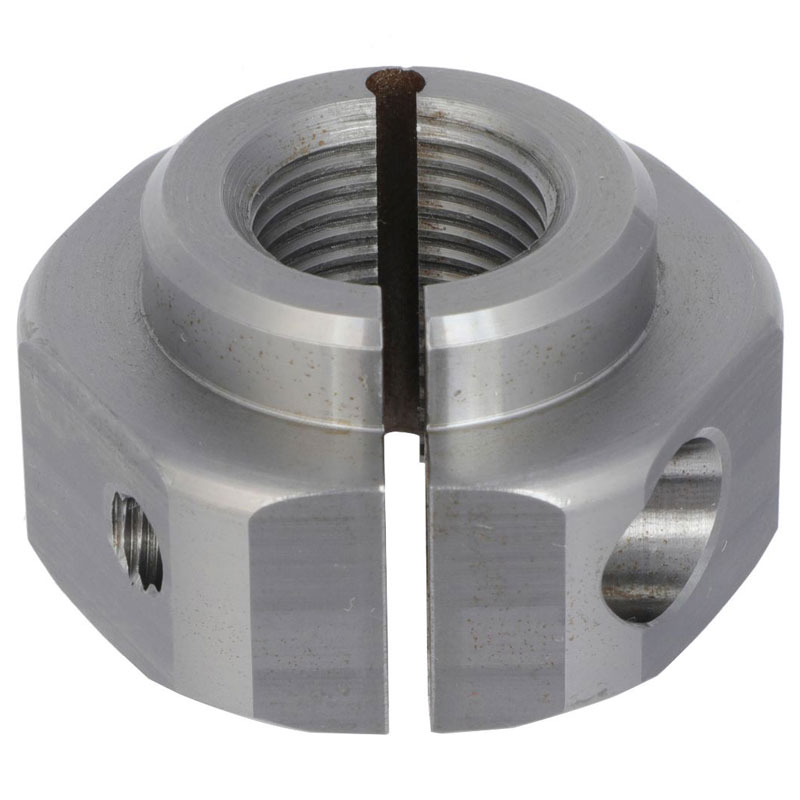
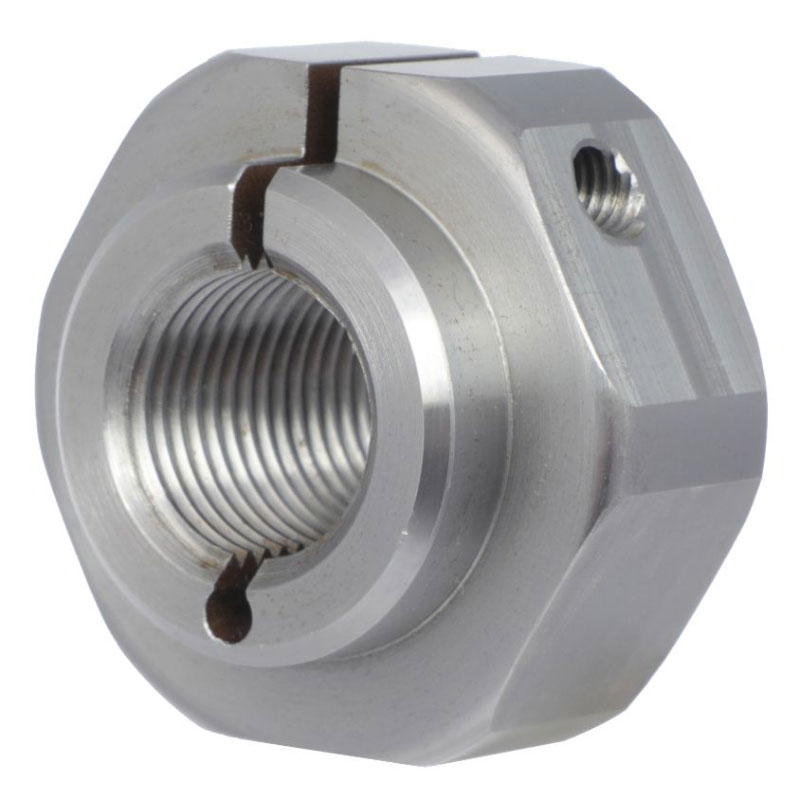
This CNC machined split lock nut (also known as a slotted clamping nut) is a premium mechanical fastener specifically engineered for high-precision rotary applications. Unlike standard hex nuts, its unique axial slot design works in tandem with a side-mounted set screw to create a radial clamping force. This ensures that the internal threads firmly grip the external shaft, completely eliminating radial play and preventing loosening under extreme vibrations.
Our customized split lock nuts are manufactured using advanced CNC machining services, making them the ideal choice for locking spindle bearings, precision ball screws, and robotic joints where micro-level axial positioning and anti-rotation reliability are non-negotiable.
CNC Machining Services & Technical Parameters
We offer fully customized CNC turning and milling services. The following table outlines our standard manufacturing capabilities for this precision component.
| Parameter / Item | Specification & Capability |
|---|---|
| Processing Type | CNC Turning (OD, Face, Step), CNC Milling (Hexagon), Drilling, Tapping, Precision Slotting |
| Material Options (Standard) | Carbon Steel: #45 Steel, 42CrMo (SCM440) Stainless Steel: SS304, SS316 Alloy/Aluminum: 7075 Aluminum (For lightweight, fast-rotating parts) |
| Thread Standard | Metric Coarse/Fine (M10 – M100+), UNF, UNC. Precision threads up to Class 4H/6H (ISO) or 2A/3A (ANSI). |
| Surface Roughness | Bearing mating faces: Ra 0.8 – 1.6μm. External surfaces: Ra 3.2μm (As machined). |
| Manufacturing Tolerances | Concentricity / Runout: ≤ 0.01mm (10 microns) Slot Width Accuracy: ± 0.05mm Set Screw Hole Position: ± 0.05mm |
| Slotting Method | Slow Wire EDM (Preferred) – ensures perfectly parallel, stress-free slots to prevent deformation; or Super-thin slitting saw milling. |
| Heat Treatment | Induction hardening / Quenching and Tempering to HRC 28-35 (for high-strength alloy steel) to enhance wear resistance and torque capacity. |
| Surface Finish (Optional) | Zinc plating, Black Oxide, Electroless Nickel, or Passivation (for SS). |
| Delivery & Packaging | Anti-rust oil treatment, double-layer bubble wrap, and wooden crates/cartons for aerospace and industrial-grade shipping. |
Material Analysis: Choosing the Right Alloy for Your Application
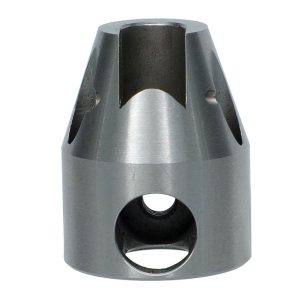
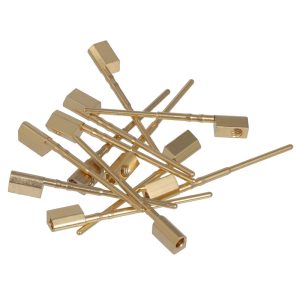
Based on the image characteristics (raw or passivated metal finish), we recommend the following materials depending on your operating environment:
-
Alloy Steel (e.g., 42CrMo / SCM440): Best for High-Strength Spindles.
-
Provides exceptional tensile strength and fatigue resistance. Essential for high-speed machine tool spindles where the nut must endure significant axial preload. We recommend surface hardening to extend the thread lifespan.
-
-
Stainless Steel (SS304 / SS316): Best for Corrosive or Cleanroom Environments.
-
While softer than hardened alloy steel, it offers excellent resistance to oxidation, moisture, and chemicals. Great for hydraulic cylinders, food-grade packaging lines, or semiconductor precision platforms.
-
-
Aluminum Alloy (7075): Best for Lightweight Robotics & Aerospace.
-
Ideal for low-load, high-speed applications in robotic joints (RV reducers) where reducing rotational inertia is critical, though torque capacity is limited.
-
Industry Applications & Use Cases
This CNC machined shaft clamping nut fits a broad range of precision industries. Its primary function is axial bearing preload and shaft retention.
-
Precision CNC Machine Tools (Primary Application)
-
Application: Spindle bearing preload in machining centers and CNC lathes.
-
Why it’s used: Provides a perfectly perpendicular clamping force against the inner ring of angular contact bearings, minimizing thermal growth errors and ensuring a 0.01mm rotational accuracy.
-
-
Industrial Automation & Linear Motion
-
Application: Locking ball screw assemblies and servo motor output shafts.
-
Why it’s used: Prevents axial backlash caused by the constant reversing motion of linear actuators, effectively replacing the traditional “lock nut + tab washer” design.
-
-
Advanced Robotics and Joints
-
Application: Output shaft locking in RV gearboxes and harmonic drives.
-
Why it’s used: The split slot design offers excellent stability against the variable shock loads encountered by robotic arms during pick-and-place operations.
-
Precision Tolerances & Capabilities
We hold tight tolerance capabilities essential for this part:
-
Bearing Mounting Face Perpendicularity: ≤ 0.005mm TIR (Total Indicator Reading). This ensures the nut applies force evenly to the bearing race, preventing bearing skewing.
-
Internal Thread Pitch Diameter Tolerance: 4H (Precision Grade). This allows for a precise fit on the shaft threads, leaving just enough clearance for the slot to compress effectively.
-
Set Screw Hole Positioning: Strictly controlled to align with the slot centerline; allowing the set screw to drive the slot closed perfectly without binding.
Manufacturing Challenges & Technical Solutions
Producing a perfect split lock nut via CNC machining services poses several engineering hurdles. Here is how we overcome them:
-
Challenge 1: Thread Deformation During Slotting.
-
The Problem: If you machine the slot after the thread is cut, the internal thread will spring back and become oval, leading to uneven thread engagement.
-
Our Solution: We utilize Slow Wire EDM for slotting. It imposes zero mechanical cutting force, preserving the perfect concentricity of the internal thread.
-
-
Challenge 2: Minimal Stress Risers at the Slot Base.
-
The Problem: Sharp corners at the end of the axial slot are failure points under high-frequency vibration, leading to metal fatigue and cracking.
-
Our Solution: We machine a distinct “stress-relief hole” at the bottom of the slot (visible in standard precision designs) to distribute mechanical stress and extend service life.
-
-
Challenge 3: Uniform Tightening Torque.
-
The Problem: The nut must grip firmly without overtightening, which could crack the slot.
-
Our Solution: Customizing the set screw depth and using a properly hardened material ensures the slot provides an elastic, self-adjusting clamping force without permanent deformation.
-
FAQ (Frequently Asked Questions)
Q1: What is the difference between a standard lock nut and a split lock nut?
A standard hexagonal nut relies purely on friction to hold in place. A split lock nut (clamping nut) uses a mechanical slot and a side set screw to actively compress the nut’s diameter onto the shaft threads, physically locking it in place even under extreme vibration.
Q2: Can this split clamping nut be reused?
Yes, it is designed for multiple uses. However, you must ensure the side set screw is fully retracted before uninstalling. If the slot has been over-stretched (caused by overtightening the set screw), it may lose elasticity. We recommend replacing it if visual deformation is observed.
Q3: How do I choose the correct thread size for my spindle?
Measure the outer diameter (OD) and thread pitch of your machine spindle. For high-precision spindles, fine pitch threads (e.g., M30x1.5 or M40x1.5) are preferred over coarse threads, as they provide finer axial adjustment and greater locking resistance.
Q4: Do you provide OEM/ODM services for non-standard sizes?
Absolutely. As a specialized custom CNC machining parts supplier, we do not restrict ourselves to standard catalogs. We can produce any size (from M10 to M100+), any hex thickness, and apply your brand’s specific side-hole placement and surface finishing requirements.
Q5: Can I add a “Locktite” or Nyloc insert to this nut?
We do not recommend a Nyloc insert. The Nyloc ring would be destroyed by the axial slit. Instead, we suggest applying a medium-strength thread-locking fluid (like Loctite 242) to the set screw itself as a secondary fail-safe, while the split slot provides the primary holding force.
Why Choose Our CNC Machining Services?
We combine ISO 9001-certified manufacturing with advanced CNC turning and 5-axis milling centers. For every split clamping lock nut we produce, we provide:
-
CMM (Coordinate Measuring Machine) inspection reports to guarantee thread tolerance.
-
Material Certificates to guarantee alloy traceability.
-
Fast Engineering Feedback to assist with prototyping and mass production.
-
100% Visual and Dimensional Inspection before shipping.
Contact our engineers today to get a customized quote for your spindle lock nut requirements! (Include your CAD drawing or desired thread size for a 24-hour rapid quote).
Additional information
| material |
|---|

Reviews
There are no reviews yet.