Table of Contents
ToggleIntroduction
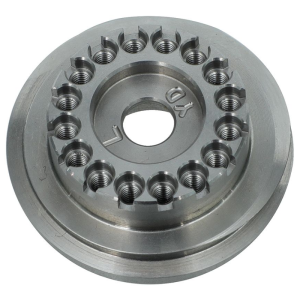
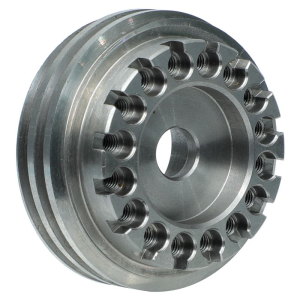
CNC machined flanges are precision-engineered components used to connect pipes, valves, pumps, cylinders, and other industrial equipment in fluid, gas, hydraulic, and mechanical systems. Compared with traditional cast or forged flanges, CNC machining delivers higher dimensional accuracy, tighter tolerances, superior sealing performance, and better consistency for demanding industrial applications.
Modern CNC flange machining combines CNC turning, milling, drilling, threading, and multi-axis machining technologies to manufacture standard and custom flanges with highly accurate bolt patterns, precision bores, smooth sealing surfaces, and complex geometries. These precision machined flanges are widely used in oil & gas, petrochemical, power generation, aerospace, marine, hydraulic, semiconductor, and automation industries.
Depending on their connection method, structural design, and application environment, CNC machined flanges can be divided into several major types. Each flange type has unique machining characteristics, pressure capabilities, sealing performance, and industrial applications.
1. Weld Neck Flanges (WN Flanges)
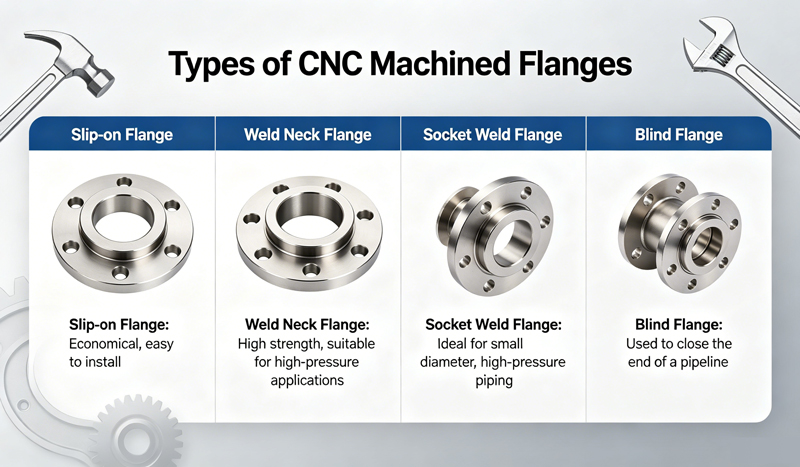
Weld neck flanges are among the most widely used high-pressure CNC machined flanges. They feature a long tapered neck that gradually transfers stress from the flange to the pipe, significantly improving fatigue resistance and structural stability.
Key Features
Excellent performance under high pressure and high temperature
Superior structural rigidity
Smooth fluid flow transition
Reduced stress concentration
High sealing reliability
CNC Machining Characteristics
CNC machining is critical for producing accurate weld neck flanges. Typical machining operations include:
Precision bore machining
Tapered neck turning
Weld bevel machining
Bolt circle drilling
Flange facing
Concentric bore control
Ring Type Joint (RTJ) groove machining
The sealing face flatness and bore concentricity directly affect welding quality and long-term sealing performance.
Common Applications
Oil & gas pipelines
Petrochemical plants
High-pressure hydraulic systems
Thermal power stations
Offshore engineering
Common Materials
Carbon steel
Duplex stainless steel
Alloy steel
2. Slip-On Flanges (SO Flanges)
Slip-on flanges are designed with a straight bore that allows the pipe to slide into the flange before welding. They are one of the most economical CNC machined flange types for low and medium-pressure piping systems.
Advantages
Lower manufacturing cost
Easier installation and alignment
Faster assembly
Suitable for large-diameter piping systems
CNC Machining Features
CNC machining processes include:
Precision inner diameter boring
Bolt hole drilling
Raised face machining
Flat face machining
Burr-free edge finishing
Surface facing
Because of their simpler structure, slip-on flanges typically require less machining time than weld neck flanges.
Typical Applications
Water treatment systems
Industrial ventilation
Low-pressure pipelines
Cooling systems
General fluid transfer systems
3. Socket Weld Flanges (SW Flanges)
Socket weld flanges contain a precision-machined recessed socket where the pipe is inserted before external welding. They are commonly used for small-diameter, high-pressure piping systems.
Structural Characteristics
The socket positioning structure improves pipe alignment accuracy and reduces installation offset. Since the weld is located outside the fluid channel, internal turbulence and corrosion risks are minimized.
CNC Machining Processes
High-precision CNC machining is required for:
Socket bore machining
Counterbore machining
Precision depth control
Tight concentricity control
O-ring groove machining
Multi-axis hole drilling
Advantages
Excellent leakage resistance
Strong connection rigidity
Better sealing performance than threaded flanges
Compact structure for limited spaces
Common Industries
Hydraulic systems
Chemical processing
Instrumentation tubing
High-pressure fluid equipment
4. Threaded Flanges (TH Flanges)
Threaded flanges, also called screwed flanges, use internal threads instead of welding for pipe connection. CNC thread machining ensures accurate thread pitch, profile, and fit tolerance.
Main Benefits
No welding required
Easy installation and removal
Suitable for maintenance-intensive systems
Ideal for hazardous environments where welding is restricted
CNC Machining Features
Threaded flange machining commonly includes:
CNC thread turning
NPT thread machining
BSPT thread machining
Internal threading
Precision bore turning
Surface finish control
Accurate thread concentricity is critical to prevent leakage and ensure stable pipe engagement.
Typical Applications
Fire protection systems
Low-pressure pipelines
Gas distribution systems
Small industrial equipment
5. Blind Flanges (BL Flanges)
Blind flanges are solid CNC machined flanges without a center bore. They are primarily used to seal the ends of pipelines, valves, and pressure vessel openings.
Functional Advantages
Excellent pressure resistance
Reliable sealing capability
Easy future pipeline expansion
Convenient system maintenance
CNC Machining Requirements
Blind flanges require high machining precision because they often withstand full system pressure. Important CNC operations include:
Precision face milling
Mirror finish sealing surface machining
Tight flatness control
Bolt circle drilling
Deep facing operations
RTJ groove machining
Common Uses
Pipeline pressure testing
Equipment isolation
Pressure vessel sealing
Maintenance shutdown systems
6. Lap Joint Flanges (LJ Flanges)
Lap joint flanges consist of a loose backing flange combined with a stub end. The flange ring can rotate freely around the pipe, greatly simplifying bolt alignment during installation.
Key Advantages
Easier bolt alignment
Faster installation
Convenient maintenance and disassembly
Reduced material cost
In corrosive systems, the stub end may use stainless steel while the backing flange uses carbon steel, lowering overall manufacturing cost.
CNC Machining Features
Important CNC machining operations include:
Precision flange facing
Inner arc machining
Bolt hole indexing
Surface flatness machining
Burr-free machining
Typical Industries
Chemical processing
Corrosion-resistant piping systems
Municipal engineering
Food processing equipment
7. Ring Type Joint Flanges (RTJ Flanges)
Ring Type Joint flanges are specially designed for extremely high-pressure and high-temperature applications. Unlike standard raised face flanges, RTJ flanges use a precision-machined metal groove and metal ring gasket to create a metal-to-metal seal.
Why RTJ Flanges Matter
RTJ flanges provide superior sealing reliability under extreme working conditions where conventional gasket systems may fail.
CNC Machining Complexity
RTJ flange machining requires extremely high precision for:
RTJ groove dimensions
Groove surface finish
Concentricity
Sealing face flatness
Bolt hole alignment
Even minor machining deviations can affect sealing integrity under high pressure.
Typical Applications
Offshore drilling systems
API pipeline systems
Petrochemical plants
High-pressure valves
Refinery equipment
8. Special Custom CNC Machined Flanges
Modern CNC machining allows manufacturers to produce highly customized flange designs for specialized industrial applications.
Common Custom Features
Custom CNC machined flanges may include:
Deep bores
Angled holes
Cross holes
Multi-axis hole patterns
Sealing grooves
O-ring grooves
Thin wall structures
Lightweight pockets
Undercuts
Precision threaded bores
Complex geometries
Advanced CNC Capabilities
Using 4-axis and 5-axis CNC machining centers, manufacturers can achieve:
Tight tolerances up to ±0.005 mm
High concentricity
Mirror finish sealing surfaces
Complex multi-surface machining
Burr-free precision machining
Industries Using Custom Flanges
Aerospace
Semiconductor equipment
Robotics
Medical devices
Automation systems
High-performance hydraulic systems
Common Materials Used for CNC Machined Flanges
Stainless Steel Flanges
Common grades:
SS304
SS316
Duplex stainless steel
Advantages:
Excellent corrosion resistance
High strength
Long service life
Carbon Steel Flanges
Benefits:
Lower cost
Good machinability
High structural strength
Widely used in industrial piping systems.
Aluminum Flanges
Advantages:
Lightweight
Excellent machinability
Good thermal conductivity
Often used in aerospace and automation equipment.
Brass and Copper Alloy Flanges
Suitable for:
Pneumatic systems
Marine equipment
Precision fluid systems
Key CNC Machining Processes for Flange Manufacturing
CNC Turning
Used for:
Outer diameter machining
Precision bore turning
Facing operations
Thread machining
CNC Milling
Used for:
Bolt hole drilling
Cross hole machining
Pocket milling
Groove machining
Multi-Axis CNC Machining
Ideal for:
Angled hole machining
Complex flange geometries
Multi-surface machining
Aerospace flange components
Surface Finishing
Common finishing methods include:
Polishing
Sandblasting
Passivation
Electropolishing
Anodizing
How to Choose the Right CNC Machined Flange
Selecting the correct flange depends on multiple engineering factors.
Pressure and Temperature
Weld neck flanges and RTJ flanges are preferred for high-pressure systems.
Slip-on flanges are suitable for lower-pressure applications.
Corrosion Resistance
Stainless steel and duplex stainless steel are ideal for corrosive environments.
Installation Requirements
Threaded and lap joint flanges simplify installation and maintenance.
Precision and Sealing Requirements
Applications requiring tight sealing and high dimensional accuracy often require:
Precision bore machining
Mirror finish sealing faces
Tight tolerance CNC machining
High concentricity control
Conclusion
CNC machined flanges are critical components in modern industrial systems, providing reliable pipe connection, sealing performance, and structural integrity across a wide range of applications. From weld neck flanges for high-pressure pipelines to custom multi-axis machined flanges for aerospace and hydraulic systems, CNC machining enables superior precision, consistent quality, and flexible customization.
As industrial systems continue evolving toward higher pressure, tighter tolerances, and more complex geometries, advanced CNC flange machining plays an increasingly important role in ensuring long-term reliability, operational safety, and high-performance fluid system operation.