Background Heading

Stainless Steel CNC Machining Services

10 Common Machining Stainless Steel Problems

Poor Chip Control

High Cutting Force

Poor Surface Finish

High Cutting Temperature

Dimensional Inaccuracy

 Chatter & Vibration

Low Machining Efficiency

Material Grade Sensitivity

OEM-Precision-Custom-Stainless-Steel-CNC-Machining-Parts-Circular-Mounting-Flange-Plate

Common Stainless Steel Grades for CNC Machining

Grade Category Machinability Corrosion Resistance Typical Applications
303 Austenitic ★★★★★ ★★★☆☆ Shafts, threaded parts, fittings, precision turned components
304 / 304L Austenitic ★★★★☆ ★★★★☆ General machinery, food equipment, flanges, brackets, structural parts
316 / 316L Austenitic ★★★☆☆ ★★★★★ Medical devices, marine equipment, chemical processing, valves
410 Martensitic ★★★★☆ ★★★☆☆ Pump shafts, valves, industrial components
416 Martensitic ★★★★★ ★★☆☆☆ High-speed CNC turning, gears, precision shafts
420 Martensitic ★★★☆☆ ★★★☆☆ Wear-resistant parts, surgical instruments, molds
430 Ferritic ★★★★☆ ★★★☆☆ Automotive trim, appliance components, decorative parts
440B / 440C Martensitic ★★☆☆☆ ★★★★☆ Bearings, cutting tools, hydraulic components, precision wear parts
17-4 PH (630) Precipitation Hardening ★★★☆☆ ★★★★☆ Aerospace, robotics, semiconductor equipment, high-strength structural parts
2205 Duplex Duplex ★★☆☆☆ ★★★★★ Offshore equipment, oil & gas, chemical systems
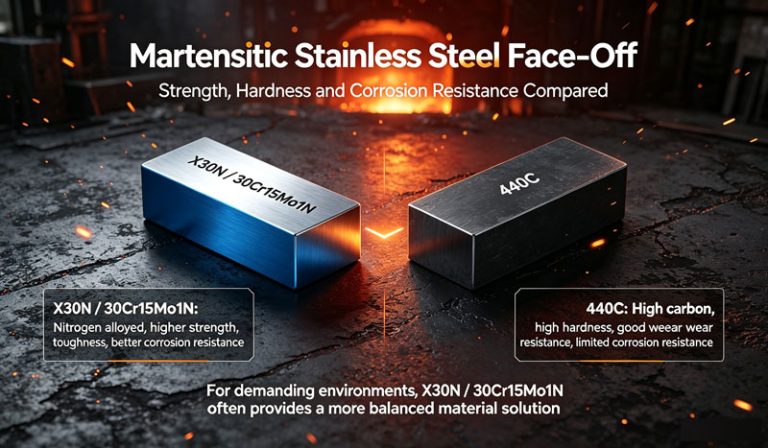
X30N (30Cr15Mo1N) High-Nitrogen Martensitic ★★☆☆☆ ★★★★☆ Premium wear-resistant precision parts, high-performance mechanical assemblies

Stainless Steel Heat Treatment Services

Heat treatment improves the mechanical properties and dimensional stability of stainless steel CNC machined components. Depending on the stainless steel grade and application requirements, different heat treatment processes can be applied to achieve higher strength, hardness, wear resistance and service reliability.

Heat Treatment Process Applicable Stainless Families Core Temperature & Cooling Hardness After Treatment Main Function Common Parts
Stress Relief Annealing All grades(304/316/17-4PH/2205/440C) 300–600℃, slow air cool Usually unchanged
≈150–220 HB (depending on grade)
Release residual stress from CNC cutting, prevent thin-wall deformation & cracking; reduce work hardening Thin housing, long shafts, welded brackets, robot structural parts
Solution Treatment Austenitic (304/316L), Duplex (2205), 17-4PH pre-treatment 1020–1150℃, rapid water quench Soft condition
304/316L: ≈150–200 HB
17-4PH: ≈300 HB
Dissolve carbide, recover full corrosion resistance, soften material for machining; balance ferrite/austenite for duplex steel Marine valve, chemical equipment, semiconductor cavity, offshore fittings
Bright Annealing 304/316/430 decorative & medical parts Controlled atmosphere furnace, H₂ shielding Similar to annealed condition
≈150–220 HB
No oxidation scale, mirror base surface, skip pickling Food machinery components, medical housings, decorative trim
Quench & Temper Martensitic:410/416/420/440B/440C/X30N Quench 980–1080℃ oil/water cool; temper 180–550℃ 410: HRC 35–45
420: HRC 45–55
440C: HRC 58–60
Boost hardness, improve wear resistance, balance toughness and strength Bearing, cutting inserts, pump shaft, surgical tool, precision wear parts
Precipitation Aging 17-4 PH (630), 15-5PH Solution first + aging 480–620℃ (H900/H1025/H1150) H900: HRC 40–47
H1025: HRC 32–38
H1150: HRC 28–35
Ultra-high tensile strength, maintain good corrosion resistance Aerospace fasteners, robotic joint, high-strength semiconductor fixtures
Vacuum Heat Treatment All precision grades (medical/aerospace) Vacuum sealed furnace Depends on material & process
Typically ±1–2 HRC consistency
Zero surface oxidation, minimal deformation, consistent hardness 5-axis precision parts , miniature medical implants, high-tolerance mold inserts