
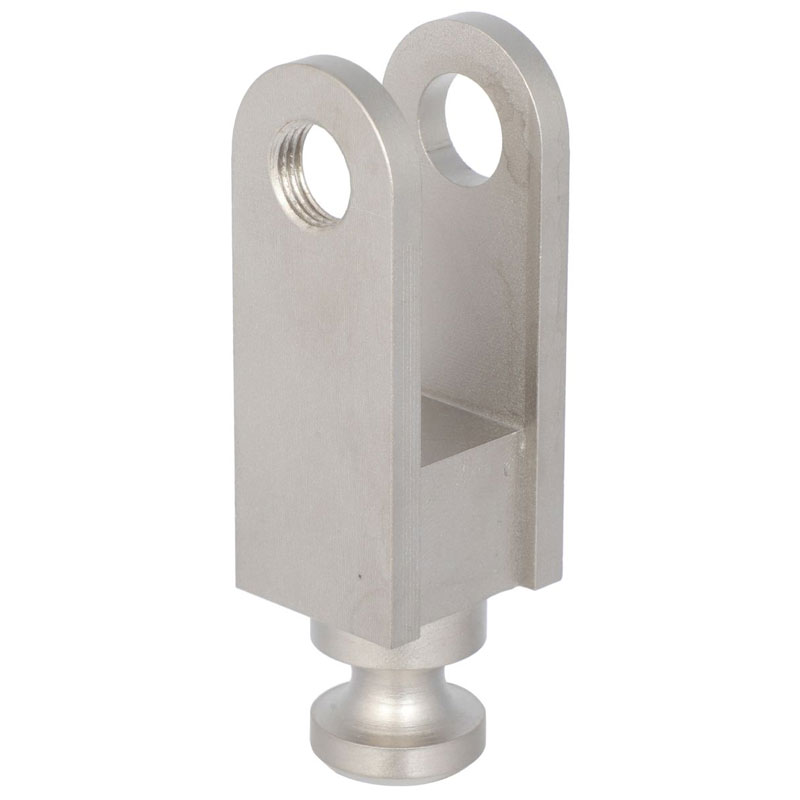
Precision High-Strength Alloy Steel U-Clevis Linkage Connector for Automated Fixtures and Mold Slide Mechanisms
Description
Product Overview
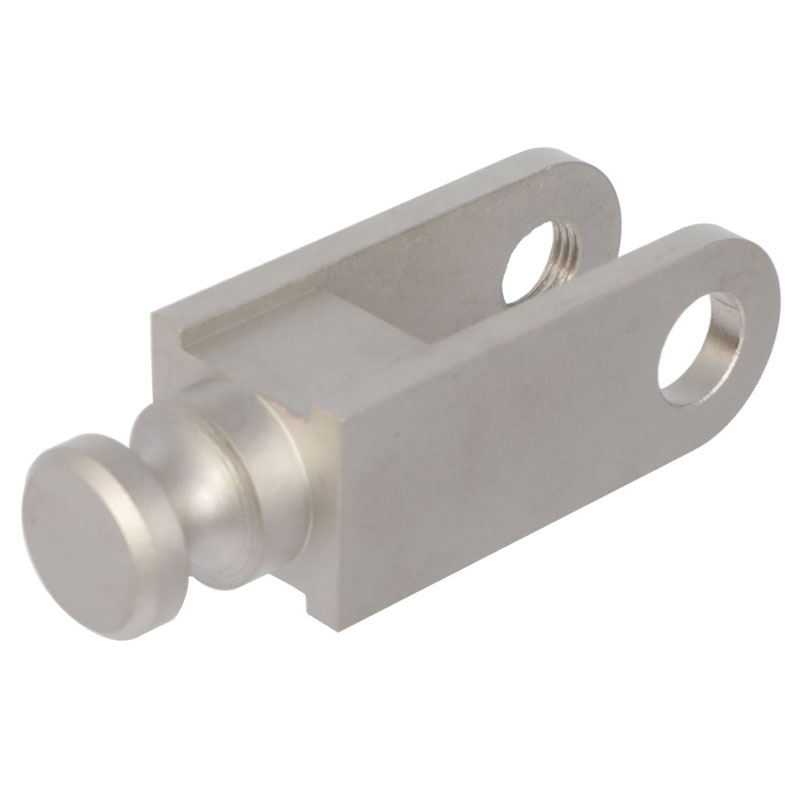
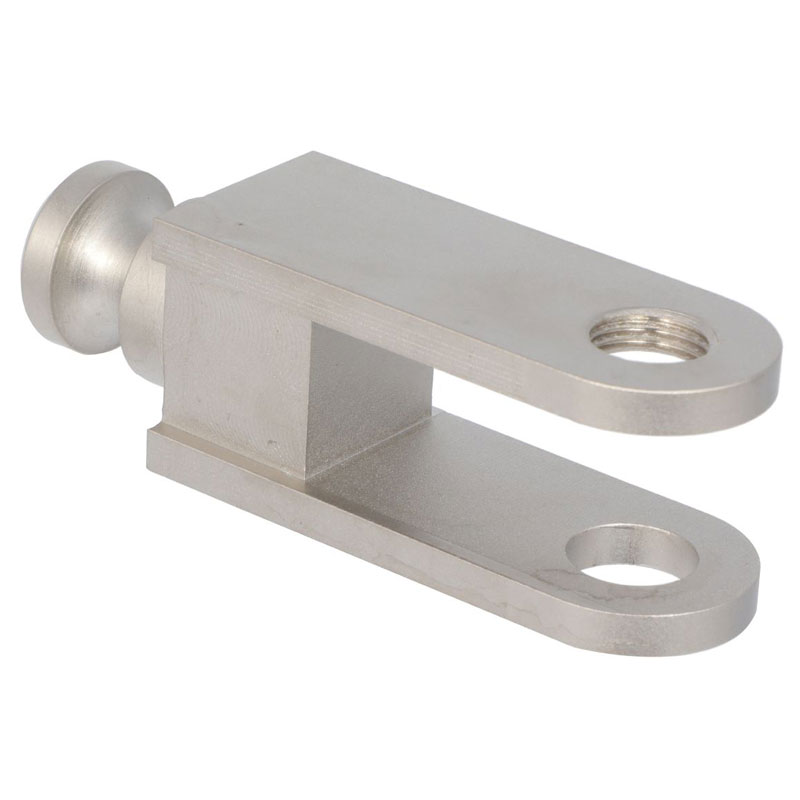
Designed for rigorous, high-frequency linear motion environments, this compact (<10cm) U-Clevis linkage connector is precision-machined from high-grade Alloy Steel or Mold Steel. Unlike standard aluminum parts, our component is engineered to withstand repetitive wear and significant mechanical stress without deformation. The integrated “one-hole-through, one-hole-threaded” design allows for secure pin locking and threaded rod attachment, making it the ultimate drop-in replacement or custom build for advanced automation and injection molding equipment.
1. CNC Machining Services & Parameter Table
Our state-of-the-art CNC turning and milling centers ensure every single unit meets rigorous engineering standards. Below are the standard technical specifications we provide for this part:
| Parameter Category | Standard Specification & Options |
|---|---|
| Available Materials | Alloy Steel (42CrMo, SCM440, 4140), Mold Steel (Cr12MoV, SKD11, P20). (Other alloys available per request) |
| Manufacturing Process | CNC Turning + 3/4/5-Axis Milling (Single-setup machining for concentricity) |
| Standard Tolerances | ISO 2768-m (Fine). Critical mating holes: H7 grade (typically ±0.01mm ~ ±0.02mm). |
| Surface Roughness | Ra 0.8 µm ~ 1.6 µm for sliding surfaces; Ra 3.2 µm for non-critical faces. |
| Surface Treatment | Electroless Nickel Plating (ENP) for corrosion and wear resistance; Black Oxide or Phosphate coating available. |
| Thread Specifications | Internal metric threads (e.g., M4 to M12) or UNC/UNF threads available. Precision tapped to 6H tolerance. |
| Inspection Equipment | CMM (Coordinate Measuring Machine), Optical Comparator, Micrometers, Thread Gauges, Hardness Testers. |
| Lead Time | 15~20 days for initial samples; 10~15 days for mass production runs. |
2. Material Analysis (Why Alloy/Mold Steel?)
Switching from common Stainless Steel (304) or Aluminum to high-strength alloy steel is a deliberate engineering choice for this component:
-
High Tensile Strength & Fatigue Limit: 42CrMo allows the small connector to withstand high tensile forces without permanent stretching. If you use Cr12MoV (Mold Steel), its HRC 45-55 hardness after heat treatment ensures it lasts through millions of high-frequency cycles without the hole elongating or the fork bending.
-
Wear Resistance on the Ball Stud: The front ball stud/guide head faces constant friction. Alloy steel guarantees minimal galling and surface deformation, ensuring smooth multi-angle oscillation.
-
Corrosion Protection via Surface Treatment: Since these steels are prone to rust in humid environments, the surface is treated with Electroless Nickel Plating (ENP). This provides a uniform, non-porous barrier that not only prevents rust but also reduces friction coefficient (improving efficiency in pneumatic/actuator systems).
3. Application Scenarios (Ideal Use Cases)
Despite its small size, this component is the “muscle” of numerous precision machines:
-
Injection Molding Mold Slide Mechanisms: Acts as the pulling/linkage component that moves the core slides in and out of the mold during the molding cycle.
-
Automated Robotic Grippers / End Effectors: Connects the pneumatic cylinders to the mechanical jaws, providing accurate push/pull motion.
-
High-Speed Assembly Line Fixtures: Used in clamping and indexing turntables where high-frequency, repetitive opening and closing is required.
-
Cleanroom & Electronics Automation: Used for precise linkage in small electric/pneumatic linear actuators where space is tight but mechanical strength cannot be compromised.
4. Tolerance Capabilities
For an engineering-driven B2B buyer, accuracy is non-negotiable. Our facility guarantees:
-
Fork Width Tolerance: We maintain a +/- 0.02mm tolerance on the U-gap to ensure the connecting plate fits snugly without lateral play.
-
Positional Accuracy: The concentricity between the threaded hole and the front ball stud is controlled within 0.01mm. This is critical to prevent the linkage mechanism from binding or creating side loads during linear motion.
-
Perpendicularity: The flat faces of the dual lugs are machined with perpendicularity within 0.02mm to ensure perfectly flush contact with the pin.
5. Manufacturing Difficulties & How We Solve Them
Producing a high-hardness, small, integrated Clevis connector is technically challenging. Here is how we ensure perfection:
-
Issue 1: The “Open-End” Deformation (Chucking Problem): The U-shape is an open structure. During CNC milling, clamping force can easily pinch the two parallel lugs inward.
-
Our Solution: We use custom soft jaws and multiple clamping sequences, performing rough machining first to relieve internal stress, then finishing the U-gap in a final pass.
-
-
Issue 2: Ball Stud Precision & Surface Finish: In single-setup machining, the tool path must transition from the U-part to the cylindrical ball stud without witness marks.
-
Our Solution: We utilize Swiss-type CNC lathes or 5-axis CNC machines that complete the turning and milling in a single clamping operation, ensuring perfect concentricity.
-
-
Issue 3: Heat Treatment Distortion: When mold steels (Cr12MoV) are heat-treated to HRC 50+, the part can warp.
-
Our Solution: We perform “Pre-hardening” (leaving 0.1mm~0.2mm stock) followed by Hard Turning (using CBN inserts) after the heat treatment to correct any minor warping without burning the material.
-
6. Frequently Asked Questions (FAQ)
Q1: What is your minimum order quantity (MOQ)?
A: We accept prototype orders with an MOQ of 1~10 pieces for testing and validation. Mass production discounts apply for orders over 500 pieces.
Q2: Can I choose a different surface treatment instead of Electroless Nickel?
A: Absolutely. Depending on your environment, we offer Zinc-Nickel plating, Black Oxide, Phosphate, or even DLC (Diamond-Like Carbon) coating for extreme low-friction applications.
Q3: How do you ensure the threaded hole is centered correctly?
A: We use CNC tapping centers with rigid tapping capabilities. After production, every thread is checked with a GO/NO-GO thread gauge and we perform a 3D CMM inspection of the hole’s true position relative to the datum axis.
Q4: Can you match my existing worn-out part if I don’t have a CAD drawing?
A: Yes. We offer a Reverse Engineering Service. You can send the damaged original part to us, and our engineering team will measure it with high-precision tools and generate 3D CAD files for you to approve before production.
7. Real-World Application Case Study
The Challenge:
A major automotive injection molding factory was facing production downtime. The small linkage Clevis connectors in their core-pulling mechanisms were breaking every 3 months. They were originally made of 304 Stainless Steel. While it didn’t rust, it lacked the fatigue strength needed for the high-speed cycles (running 24/7).
The XINQIDA Solution:
-
We analyzed their design and replaced the 304 Stainless Steel with 42CrMo Alloy Steel.
-
We heat-treated the material to HRC 52 for maximum hardness.
-
We applied Electroless Nickel Plating (ENP) to protect the alloy steel from moisture in the cooling water environment of the molding shop.
The Result:
The factory received the new batch of CNC-machined U-clevis connectors. The new parts lasted over 2 years (more than 5 million cycles) without breaking or wearing down. They reduced their machine downtime by 95% and completely eliminated their emergency replacement labor costs.
Looking for a similar custom CNC component?
We provide end-to-end CNC machining services, from material selection and heat treatment to precision finishing and surface treatment. Please [Send Us Your 3D/2D Drawings] to get an instant engineering review and a competitive quotation within 24 hours.
Additional information
| material |
|---|

Reviews
There are no reviews yet.