
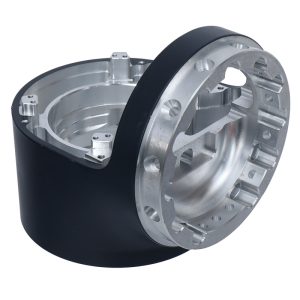
Heavy-Duty Steel Locking Adapter Flange for Robotic Joints
Description
Product Overview
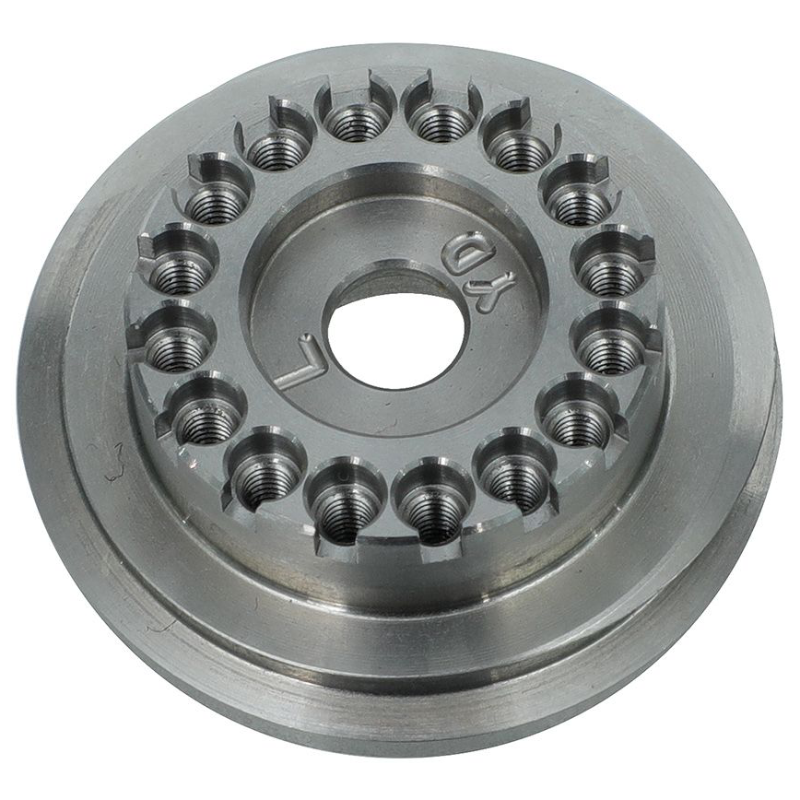
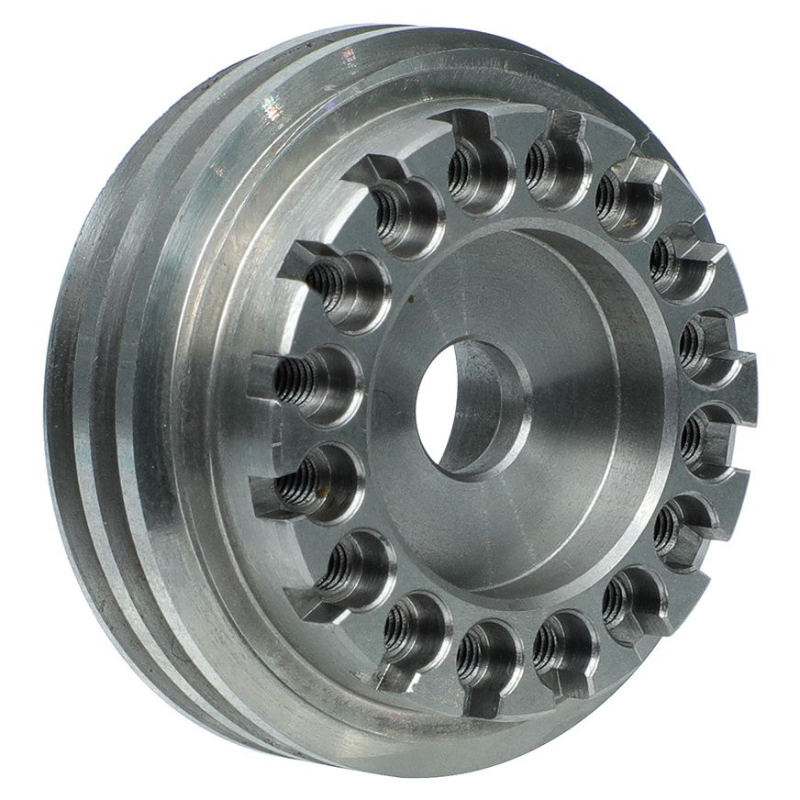
This is a precision-engineered CNC machined steel locking adapter flange, specifically designed to transmit high torque and provide rigid alignment between a rotary shaft (such as a servo motor or reducer) and external mounting equipment. Unlike standard pulleys or pipe flanges, this component features a precision circular bore without keyways or D-cuts, relying instead on friction-locking mechanisms (like tapered sleeves or expansion clamps) for high-integrity power transmission. The outer rim features annular seating grooves, while the face is equipped with 16 uniformly distributed threaded blind holes, each accompanied by precision-milled radial locking slots.
Application Scenarios
-
Industrial Robotics: Essential output flange for RV reducers, harmonic drive assemblies, and heavy-duty robot arm joints.
-
Servo Motor Drive Systems: Used as a mounting interface to couple high-torque servo motors with rotary index tables and automation fixtures.
-
Precision Automation Equipment: High-speed rotary platforms, machine tool rotary tables, and AGV steering mechanisms that require rigid, backlash-free torque transfer.
-
Semiconductor Manufacturing: Precision transfer robots and wafer-handling indexing units requiring low-vibration, high-stiffness mounting plates.
Material Analysis
Given the high torque and mechanical stress in robotic joints, this part is typically machined from:
-
Alloy Steel (e.g., 40Cr, 42CrMo, or 4140): Offers an excellent balance of strength, toughness, and fatigue resistance. These grades provide high yield strength (>850 MPa) and excellent wear resistance.
-
Carbon Steel (e.g., 45# / S45C): A cost-effective alternative for general industrial applications, providing good machinability and moderate strength.
-
Surface Treatment Options: To further enhance surface hardness and prevent galling during clamping, we recommend Surface Nitriding (HV 500-700) or Black Oxide finishing.
CNC Machining Services Parameter Table
| Machining Parameter | Specification / Capability |
|---|---|
| Primary Process | CNC Turning (Precision OD/ID lathe work) |
| Secondary Process | 4-Axis / 5-Axis CNC Milling (Radial slots, threaded holes) |
| Material Available | Carbon Steel (S45C), Alloy Steel (40Cr, 42CrMo, 4140) |
| Tolerance Capability | ±0.01 mm for critical diameters and hole positions; ISO 2768-mK for general dimensions |
| Surface Roughness | Ra 1.6 μm (standard CNC turning finish) to Ra 0.8 μm (fine turning) |
| Threading Standard | CNC Tapping / Thread Milling (Metric, UNC, UNF) with 6H/6G tolerance |
| Heat Treatment | Available upon request (Quenching & Tempering, Surface Nitriding) |
| Dynamic Balancing | G2.5 / G6.3 grade testing available for high-RPM applications |
| Quality Inspection | 100% critical dimension inspection using CMM (Coordinate Measuring Machine), Height Gauges, and Micrometers |
Tolerance Capabilities
For an adapter flange used in robotic joints, precision is non-negotiable. Our standard machining facilities guarantee:
-
Concentricity (ID to OD): ≤ 0.02 mm TIR (Total Indicator Reading), ensuring zero eccentricity during high-speed rotation.
-
Center Bore Tolerance: Supplied with precise H7 fit tolerance to guarantee a seamless, press-fit or slip-fit engagement with the precision shaft.
-
Pitch Diameter of Mounting Holes: ±0.05 mm PCD (Pitch Circle Diameter) to ensure perfect alignment with the downstream assembly.
-
Perpendicularity: The mounting face is maintained flat to within 0.02 mm to prevent stress on the mating robotic bearings.
Manufacturing Challenges & Solutions
Manufacturing this heavy-duty steel flange presents several technical hurdles, and our expertise resolves them efficiently:
-
Deformation from Internal Stress: Steel is prone to stress relief during heavy material removal, leading to warpage.
-
Our Solution: We perform rough CNC turning → stress-relief annealing → final precision finish turning.
-
-
Concentricity between Radial Slots and Center Bore: Milling the 16 outer radial slots requires extreme positioning accuracy relative to the center ID.
-
Our Solution: We use a 4-axis CNC milling machine to machine all slots in a single dedicated setup, eliminating secondary clamping errors.
-
-
Thread Breakage in Hardened Steel: After heat treatment, the steel becomes highly wear-resistant, making the final tapping process extremely difficult.
-
Our Solution: We utilize solid carbide thread mills (rather than standard taps) and a rigid coolant system to produce clean, gauge-perfect threads without breakage.
-
-
Dynamic Balancing: As a rotating steel component, even a 1-gram imbalance can cause severe vibration at high RPM.
-
Our Solution: The radial outer slots are intentionally designed as mass-reduction and weight-balancing pockets; we perform computerized dynamic balancing to remove minimal excess material.
-
Frequently Asked Questions (FAQ)
Q1: The center hole is a standard round bore with no keyway. How does it prevent slipping on the motor shaft?
A: This flange is designed for high-end servo or robotic applications that utilize friction clamping. It typically works with a tapered locking sleeve, split-type hub, or expansion disc coupling located on the back side of the flange. When the mounting screws are tightened, this sleeve expands, creating a massive friction grip against the smooth shaft, offering zero backlash and precise transmission.
Q2: Why is steel chosen over aluminum for this specific flange?
A: While aluminum is lighter, it lacks the tensile strength and fatigue resistance required for heavy-load robotic joints and high-torque servo motors. Steel (such as 42CrMo) provides superior structural stiffness and dimensional stability under high torque and extreme mechanical stress, ensuring the robot’s repeated positioning accuracy isn’t compromised by material deflection.
Q3: Can we customize the number of holes, dimensions, or outer groove shape?
A: Absolutely. This is an OEM (Original Equipment Manufacturer) custom component. We can fully adjust the outer diameter, the PCD (Pitch Circle Diameter) of the holes, the width/depth of the outer annular grooves, and the thread specifications based on your 2D/3D technical drawings. We also offer multiple steel grades to meet your specific hardening requirements.
Additional information
| material |
|---|
Reviews
There are no reviews yet.