
Table of Contents
ToggleIntroduction
Martensitic stainless steels are the backbone of high-hardness, wear-resistant precision components used in medical devices, aerospace bearings, hydraulic valves, industrial tooling, and high-performance mechanical assemblies. For decades, 440C (UNS S44004) has been the industry benchmark, capable of achieving 58–62 HRC after heat treatment. However, its inherent limitations—including coarse carbide segregation, relatively limited corrosion resistance, inconsistent mirror polishing, accelerated tool wear, and dimensional distortion after hardening—have encouraged engineers to seek more advanced alternatives.
X30N, commonly associated with Cronidur® 30 (X30CrMoN15-1, AMS 5898), represents a family of high-nitrogen martensitic stainless steels produced using Pressurized Electroslag Remelting (P-ESR) technology. In China’s precision manufacturing industry, the comparable engineering grade is 30Cr15Mo1N, which is increasingly specified for high-end CNC machining applications requiring exceptional corrosion resistance, dimensional stability, and ultra-fine surface finishes.
Unlike conventional high-carbon martensitic stainless steels, X30N utilizes nitrogen and molybdenum as primary strengthening elements instead of relying solely on carbon. This metallurgical approach significantly improves toughness, corrosion resistance, polishing performance, and machining consistency while maintaining high hardness.
This article provides a practical comparison between X30N (30Cr15Mo1N) and 440C from a precision CNC machining perspective, focusing on machinability, corrosion resistance, polishing capability, heat-treatment stability, and typical engineering applications.
1. Material Overview: X30N (30Cr15Mo1N) vs 440C
Throughout this article, X30N refers to the high-nitrogen martensitic stainless steel represented internationally by Cronidur® 30 / X30CrMoN15-1 / AMS 5898. For CNC machining applications in China, the closest commonly specified engineering grade is 30Cr15Mo1N, which offers comparable mechanical properties and is widely used as an alternative for precision components requiring high hardness, excellent corrosion resistance, and superior polishing performance.
Chemical Composition Comparison
| Element | 440C | X30N (30Cr15Mo1N) |
|---|---|---|
| Carbon | 0.95–1.20% | 0.25–0.35% |
| Chromium | 16.0–18.0% | 14.0–16.0% |
| Molybdenum | ≤0.75% | 0.85–1.10% |
| Nitrogen | Trace | 0.30–0.50% |
| Production Route | Conventional AOD/VIM | Pressurized ESR (P-ESR) |
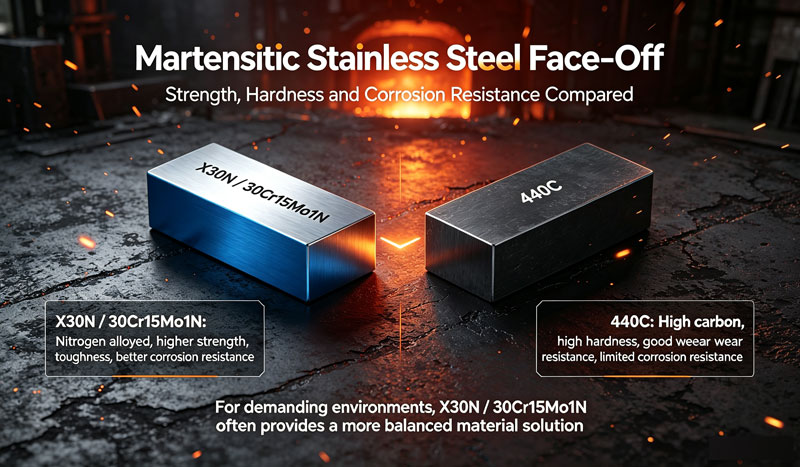
440C depends on its high carbon content to form chromium carbides that provide outstanding wear resistance. However, these coarse carbides also reduce toughness, create chromium-depleted regions that are more susceptible to corrosion, and accelerate cutting-tool wear during CNC machining.
By contrast, X30N replaces much of this carbon strengthening with nitrogen. Nitrogen refines the grain structure, promotes a finer distribution of strengthening phases, and works together with molybdenum to improve corrosion resistance, thermal stability, toughness, and fatigue performance. The P-ESR manufacturing process further enhances cleanliness and microstructural uniformity, making X30N especially suitable for high-precision engineering applications.
2. Machinability Comparison: CNC Turning, Milling & Process Stability
Machinability directly influences production efficiency, tooling costs, dimensional accuracy, and overall manufacturing consistency. Both materials are typically machined in the annealed condition before final heat treatment, but their cutting characteristics differ considerably.
2.1 Chip Formation and Work Hardening
440C tends to generate short, sharp chips and is highly susceptible to work hardening under low feed rates or shallow depths of cut. Localized hardening can rapidly increase cutting forces, promote built-up edge, and shorten tool life.
X30N, benefiting from its refined and homogeneous microstructure, produces more stable chip formation with lower work-hardening tendencies. During long production runs on Swiss-type lathes or 5-axis machining centers, cutting forces remain more consistent, resulting in improved dimensional stability and better surface quality.
2.2 Tool Life and Production Efficiency
Under comparable machining conditions using coated carbide tools and high-pressure coolant, X30N generally provides 20–30% longer tool life than 440C. The uniform wear pattern of X30N reduces unexpected tool failures and minimizes production interruptions, making it advantageous for high-volume precision manufacturing.
2.3 Post-Heat-Treatment Dimensional Stability
One of X30N’s most significant advantages is its dimensional stability after vacuum hardening, cryogenic treatment, and tempering. Properly processed components can maintain distortion within approximately ±0.001 mm, reducing the need for secondary grinding operations.
440C typically develops greater internal stress during heat treatment, increasing the likelihood of distortion and additional finishing operations.
3. Corrosion Resistance: Industrial, Medical & Marine Performance
While conventional martensitic stainless steels generally offer moderate corrosion resistance, X30N significantly improves this characteristic.
440C performs adequately in dry industrial environments but is vulnerable to pitting corrosion in humid, chloride-rich, or mildly acidic conditions. Its corrosion resistance may also decrease after higher-temperature tempering.
The combination of nitrogen and molybdenum gives X30N a substantially higher Pitting Resistance Equivalent Number (PREN), enabling significantly better resistance to chlorides, cleaning chemicals, and aggressive industrial environments. This makes it especially suitable for:
- Medical instruments
- Food processing equipment
- Hydraulic systems
- Marine auxiliary components
- Precision fluid-control devices
4. Polish Performance: Mirror Finish and Ultra-Fine Surface Quality
For surgical instruments, bearing raceways, optical components, and precision valve parts, surface finish directly affects functionality and service life.
4.1 Mirror Polishing Characteristics of 440C
The coarse carbide distribution within 440C can lead to microscopic pits, streaks, and uneven reflectivity after mirror polishing. Achieving extremely low roughness values consistently requires additional polishing time and careful process control.
4.2 Mirror Polishing Advantages of X30N
Thanks to its ultra-clean microstructure and refined grain size, X30N achieves highly uniform mirror finishes with minimal polishing defects.
| Target Surface Finish | 440C | X30N |
|---|---|---|
| Ra 0.8 μm | Excellent | Excellent |
| Ra 0.4 μm | Very Good | Excellent |
| Ra 0.2 μm | Good | Excellent |
| Mirror (Ra ≤0.02 μm) | Difficult to maintain consistently | Outstanding and highly consistent |
These characteristics make X30N particularly attractive for medical devices, semiconductor equipment, and optical precision components.
5. Mechanical Properties and Service Life
Both materials typically reach 58–62 HRC after heat treatment.
However:
- 440C prioritizes maximum wear resistance but offers relatively limited toughness.
- X30N achieves a better balance between hardness, toughness, fatigue strength, and corrosion resistance.
This balance contributes to significantly improved rolling-contact fatigue life and greater reliability under cyclic loading.
6. Application Selection Guide
| Engineering Requirement | Recommended Material |
|---|---|
| Maximum hardness and wear resistance | 440C |
| Superior corrosion resistance | X30N |
| Better toughness | X30N |
| Mirror polishing | X30N |
| Tight dimensional stability | X30N |
| Cost-sensitive indoor applications | 440C |
Typical CNC Applications of X30N (30Cr15Mo1N)
- Medical instruments
- Surgical tools
- Aerospace bearings
- Hydraulic valve cores
- Precision shafts
- Semiconductor hardware
- Optical equipment
- Marine components
In China, many precision CNC manufacturers offer 30Cr15Mo1N as the practical machining grade for customers specifying X30N or equivalent high-nitrogen martensitic stainless steels, depending on engineering drawings, customer specifications, and applicable material standards.
Typical CNC Applications of 440C
- Bearing races
- Ball bearings
- Industrial knives
- Measuring instruments
- Mechanical seals
- Wear sleeves
- Mold components
Whether you select X30N (30Cr15Mo1N), 440C, or other stainless steel grades for your precision parts project, our team delivers custom‑made high‑performance machined components. Explore our full portfolio of precision‑fabricated parts on our CNC machining stainless steel parts page, covering medical, aerospace, hydraulic, semiconductor and industrial‑automation custom stainless steel components.
7. CNC Machining Recommendations
To maximize machining performance for either material, experienced CNC suppliers should employ:
- Vacuum heat treatment
- Precision fixturing
- Low-vibration machining strategies
- Premium coated carbide tooling
- High-pressure coolant systems
- Post-machining stress relief where appropriate
- CMM dimensional inspection
These practices help achieve tight tolerances of ±0.005 mm (depending on part geometry and process capability) while minimizing heat-treatment distortion. For full-service precision component manufacturing of X30N, 440C and all stainless steel grades, explore our custom stainless steel CNC machining services with complete heat treatment, polishing and inspection support.
8. Conclusion
440C remains an excellent and cost-effective martensitic stainless steel for conventional wear-resistant applications where corrosion resistance, polishing consistency, and post-heat-treatment stability are not primary concerns.
X30N (represented internationally by Cronidur® 30 / X30CrMoN15-1 / AMS 5898 and commonly matched with China’s 30Cr15Mo1N grade) represents the next generation of high-nitrogen martensitic stainless steels. Compared with traditional 440C, it offers clear advantages in CNC machinability, corrosion resistance, polishing quality, dimensional stability after heat treatment, fatigue performance, and overall service life.
Although X30N carries a higher material cost, it often reduces tooling consumption, minimizes secondary machining operations, lowers defect rates, and improves production consistency. For manufacturers producing high-value precision components in the medical, aerospace, hydraulic, semiconductor, and advanced industrial sectors, X30N (30Cr15Mo1N) is increasingly regarded as one of the most capable upgrade options to conventional 440C stainless steel.


Pingback: 440B Vs 440C Stainless Steel: Which Grade Is Better For Precision Mechanical Parts? | XINQIDA