
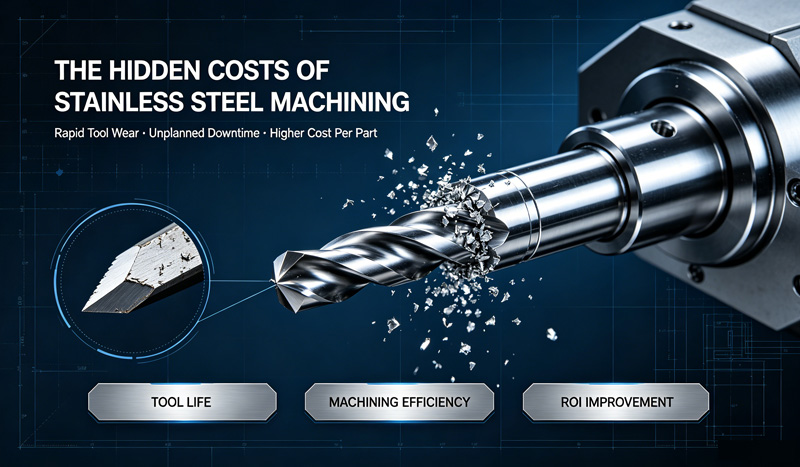
Stainless steel remains one of the most sought‑after materials for precision CNC machining across aerospace, medical devices, food processing, marine engineering, and industrial automation. Its outstanding corrosion resistance, mechanical strength, and durability make it the default choice for high‑performance custom parts. Yet, for procurement teams, manufacturing engineers, and production managers, these very same properties create a persistent and often underestimated challenge: rapid tool wear.
Unlike aluminum, carbon steel, or plastics, stainless steel exhibits severe work‑hardening, poor thermal conductivity, and high toughness. These inherent characteristics make it extremely abrasive to cutting tools. While most buyers track obvious line items—raw material costs and machining service fees—they frequently overlook the hidden cumulative costs triggered by rapid tool wear. These unaccounted expenses silently erode profit margins, extend lead times, compromise part consistency, and ultimately drag down overall project ROI.
This article breaks down the real cost of tool wear in stainless steel machining and provides a systematic, actionable playbook to optimise production efficiency and maximise returns.
Part 1: Why Does Stainless Steel “Eat” Cutting Tools?
To solve the problem, we must first understand the metallurgical roots. Compared with aluminium and carbon steel, stainless steel presents three core difficulties that accelerate wear:
Severe work hardening – Austenitic grades such as 304 and 316 harden rapidly under cutting forces. If the tool rubs rather than shears (often due to conservative speeds or worn edges), the surface layer instantly becomes harder than the underlying material, causing rapid flank wear and edge chipping.
Extremely low thermal conductivity – Stainless steel does not dissipate heat efficiently. Instead of carrying heat away with the chip, most of the cutting heat concentrates at the tool‑chip interface. Temperatures routinely exceed 800 °C, leading to coating diffusion, substrate oxidation, and crater wear.
High toughness and adhesion – Long, continuous chips tend to weld onto the cutting edge, forming a built‑up edge (BUE). This not only ruins surface finish but also rips out chunks of carbide when the BUE breaks away.
Grade‑dependent machinability – Not all stainless steels are equally punishing:
303 (sulphur‑added) offers excellent machinability.
304 work‑hardens aggressively and is among the most difficult.
316 (molybdenum‑bearing) is even more abrasive and adhesive.
17‑4 PH (precipitation‑hardened) can be machined better than many austenitic grades, but improper heat treatment drastically accelerates wear.
Choosing the wrong grade can turn a profitable order into a loss‑making nightmare.
Part 2: The Iceberg Effect – The Real Cost Amplifiers
Most procurement teams track only the direct cost of replacement inserts—typically just 3‑5% of total machining costs. Yet the cascade of hidden consequences from rapid wear can consume 15‑20% of profits, and studies show that when all factors are included, tool‑related expenses can exceed 31% of total machining cost.
Here are the four major “cost amplifiers” that procurement and engineering must quantify:
| Cost Amplifier | Impact |
|---|---|
| 1. Downtime & Labour | A CNC centre billing at $120/hour stops for every tool change. If a job requires 8 changes per 100 parts instead of 2, the lost production time alone can cost over $1,000 per batch. Operator time for measurement and recalibration adds even more. |
| 2. Scrap & Rework | Worn tools cause dimensional drift, poor surface finish, burrs, and micro‑cracks. In one medical implant project, a 40% failure rate in the first 50 parts created a costly bottleneck. Each scrapped stainless steel part wastes material and prior machining investment. |
| 3. Lead‑time Inflation | Frequent unplanned interruptions disrupt production schedules. For JIT (Just‑in‑Time) deliveries, delays invite contract penalties and damage long‑term customer relationships. |
| 4. Machine Maintenance & Depreciation | Unstable cutting forces and vibration from worn tools accelerate spindle bearing and guide‑way wear. Even a 0.01 mm increase in spindle runout can slash tool life by 45%, while regular maintenance costs and shortened equipment lifespan become a long‑term financial drag. |
Part 3: The Procurement Trap – Why “Cheapest” Is Almost Never “Least Cost”
Many buyers focus on the lowest unit price or the cheapest hourly rate. This is a classic mistake that ignores Total Cost of Ownership (TCO).
Trap 1 – Low‑cost tooling
A shop using generic carbide inserts replaced tools 8 times per 100 parts. Switching to premium TiAlN‑coated inserts, optimised for stainless steel, reduced changes to just 2 per 100 parts. The premium insert cost more upfront, but downtime savings alone amounted to $1,200 per 100 parts—and total cost per part dropped by over 20%.
Trap 2 – Lowest machining rate
A supplier with a lower hourly rate but no high‑pressure coolant or advanced CAM may take 3.2 hours per part with 8% scrap. A higher‑rate supplier using intelligent toolpath strategies can finish the same part in 2.5 hours with 3% scrap. The result: a higher rate × shorter cycle = lower total cost per good part.
Procurement must evaluate suppliers not on price alone, but on their ability to control wear and deliver consistent quality on time.
Part 4: The Five‑Pronged Strategy to Combat Wear and Boost ROI
Controlling rapid wear requires more than buying expensive tools—it demands a systematic approach that combines tooling, parameters, cooling, programming, and machine maintenance.
1. Advanced Tooling & Coatings
Replace standard carbide with micro‑grain substrates and PVD coatings such as AlCrN or TiAlN. These coatings provide exceptional thermal stability and oxidation resistance, acting as a heat barrier that keeps the cutting edge cooler. Combine with positive rake angles and larger nose radii to reduce cutting forces and distribute heat.
2. Optimised Cutting Parameters – The “Sweet Spot”
Avoid low speeds – rubbing causes work hardening; always maintain a feed rate that produces a chip thick enough to carry heat away.
Avoid excessive speeds – a 20% increase in speed can halve tool life.
Increase depth of cut (when possible) to cut beneath the hardened layer, and adjust feed to achieve consistent chip thickness.
3. High‑Pressure Coolant (HPC)
Flood coolant is insufficient for stainless steel. Through‑tool coolant at pressures above 70 bar (1,000 psi) penetrates the cutting zone, removes heat, and forcefully breaks long chips before they can weld to the edge. In one comparison, HPC extended tool life from 50 to 120 parts on the same job.
4. Advanced Toolpaths (Trochoidal / Adaptive Milling)
Modern CAM strategies maintain a constant radial engagement, avoiding full‑width cuts that cause heat spikes. This distributes thermal and mechanical loads evenly, significantly delaying flank wear and enabling higher material removal rates.
5. Machine Tool Condition
Even perfect parameters fail if the machine is not precise. Regularly monitor spindle runout, alignment, and vibration. A spindle runout increase from 0.005 mm to 0.015 mm can reduce tool life by 45%—a hidden killer that many shops ignore.
Part 5: Supplier Evaluation – 5 Questions Every Buyer Must Ask
When outsourcing stainless steel CNC parts, use these five questions to separate competent suppliers from those who simply quote low and deliver high hidden costs:
What coating and substrate do you recommend for our specific grade (304, 316, or 17‑4)? – A confident answer shows they understand material‑specific tooling.
Do you use high‑pressure through‑tool coolant? At what pressure? – This is non‑negotiable for serious stainless steel machining.
What CAM strategy do you employ for roughing – conventional or dynamic/trochoidal? – Dynamic paths indicate modern process control.
How do you monitor tool wear – by time, load, or in‑process probing? – Proactive monitoring reduces surprises.
Can you provide a Design for Manufacturability (DFM) review to suggest changes that would reduce machining cost? – This proves they care about your total cost, not just their own throughput.
A supplier who answers these questions clearly and confidently is likely to deliver lower total cost, better quality, and reliable lead times—far outweighing any minor price premium. Explore our full custom stainless steel CNC machining services to see how our optimized production processes eliminate hidden tool wear costs for your stainless components.
Before you engage with any supplier, equip yourself with a complete understanding of what can go wrong. Download / read our full guide: 10 Common Machining Stainless Steel Problems—covering work hardening, chip control, surface finish, dimensional accuracy, and grade‑specific pitfalls.
Conclusion: Turn Wear Control into a Competitive Advantage
Rapid tool wear in stainless steel machining is not an unavoidable “act of nature.” It is a manageable challenge that can be overcome through disciplined process engineering, intelligent tooling selection, and strategic supplier partnerships.
By understanding the physical causes (work hardening, heat, adhesion), quantifying the hidden costs (downtime, scrap, depreciation), and implementing the five tactical countermeasures (coatings, parameters, HPC, advanced toolpaths, machine maintenance), you can dramatically extend tool life, reduce cost per part, and stabilise production schedules.
For procurement professionals, shifting focus from the unit price to the total cost of ownership is the single most powerful move you can make. And for engineers, documenting wear data and running comparative trials will reveal where the real savings lie.
Are you struggling with rising costs, inconsistent quality, or delayed deliveries on your stainless steel components?
Don’t let rapid tool wear dictate your budget. Contact our engineering team today for a free DFM review – we will show you how our optimised processes can extend tool life, lower your total cost, and deliver the high‑quality parts your projects demand.


One point that stood out is how tool wear can quietly drive up costs through more frequent tool changes, downtime, and inconsistent part quality—not just the price of the tooling itself. It would also be interesting to explore how cutting parameters and coolant strategies influence tool life, since small process adjustments can sometimes have a significant impact on overall machining ROI.
Pingback: Precision