Walk into any mid‑sized machine shop in the American Midwest today, and you’ll hear the same complaint before you even reach the front desk: “We have the machines. We have the orders. We just don’t have the people to run them.”
It’s a story playing out from Ohio to Texas. One shop owner near Cleveland spent six months trying to hire two CNC operators — offering $32 an hour plus benefits, a wage that would have been unthinkable five years ago. He received exactly three qualified applications. Two of those applicants accepted other offers before his second interview round.
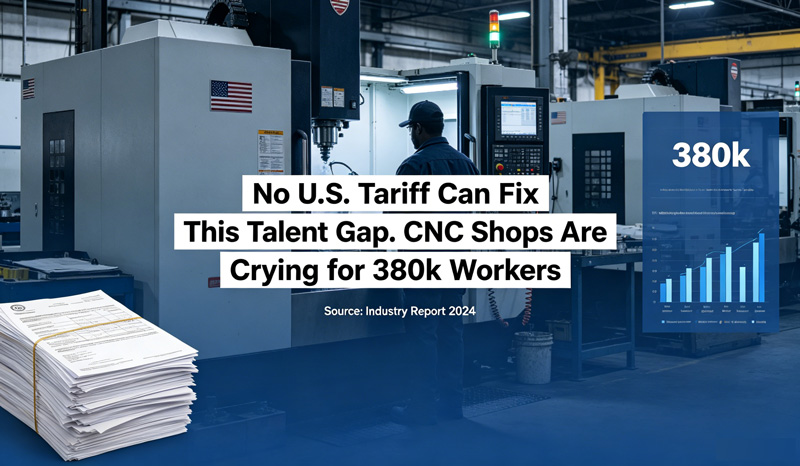
This isn’t an isolated case. The number of open skilled machining and manufacturing positions across the United States is enormous. According to a joint workforce report released in late 2025 by the National Association of Manufacturers and Deloitte, U.S. manufacturing is expected to face 3.8 million job openings by 2033. Among those, more than 380,000 are directly related to CNC and precision machining. That means the “we can’t find people” you hear today is only the tip of a much larger crisis. (Source: NAM – Deloitte 2025 Manufacturing Workforce Study) Click to view summary
Why Can’t They Find People?
The reasons are deeper than any single policy fix.
First, the workforce is aging. The average machinist in many traditional manufacturing states is now over 50. Every year, thousands retire, and they are not being replaced by young workers.
Second, the pipeline has dried up. High schools dismantled their shop classes decades ago. Vocational schools have either closed or pivoted to “cleaner” tech fields. A generation of students was told that a four‑year degree was the only path to success — and that working with your hands was something to avoid.
Third, even when training exists, it takes years to become truly proficient. Setting up a five‑axis machine, selecting the right cutter for exotic alloys, diagnosing a bad spindle bearing from vibration patterns — these are skills that only come from thousands of hours on the floor. You cannot fast‑track them with an online course.
As one frustrated plant manager put it, “I can buy a new lathe and have it delivered in four weeks. I cannot create an experienced machinist in four years.”
Tariffs Don’t Make Machinists
Over the past few years, the U.S. has used tariffs (Section 301, Section 232, and the latest rounds in mid‑2026) to try to push manufacturing back onto American soil. The theory is simple: make imported CNC parts more expensive, and domestic production becomes competitive again.
But tariffs only shift where the purchase order is signed. They do nothing to increase the number of people who can run a CNC mill, read a complex blueprint, or hold a ±0.0005 inch tolerance.
In fact, tariffs can make the talent gap worse. When a shop suddenly gets more domestic orders because foreign parts are taxed, it needs to hire even more machinists. But those machinists don’t appear out of thin air. The result is longer lead times, higher overtime costs, and burnt‑out existing staff.
A supplier in Michigan recently admitted that his backlog has doubled since the latest tariff round, but he has turned down three large contracts because he simply cannot find the people to machine the parts. “I could run three shifts if I had the bodies,” he said. “I don’t.”
What Mexico and ‘Reshoring’ Can’t Solve
Some procurement managers have turned to Mexico as an alternative. And yes, Mexico has absorbed some lower‑complexity work. But it has its own shortages of skilled CNC talent, not to mention inconsistent power and logistics that can stretch delivery times.
Others talk about “reshoring” as if it were a switch you can flip. But reshoring only works if the domestic workforce exists. Today, it does not. A shop cannot run three shifts of five‑axis machines with only one setup person and a trainee who has never touched a control panel.
The hard truth is that the United States will need years — probably a full decade — to rebuild a vocational training system that produces a steady stream of qualified machinists. That timeline does not match the needs of buyers who have orders to fill next quarter.
A Different Model: Stability in Experience
Now compare that to the precision machining industry in a place like Dongguan, China — a region that has been quietly manufacturing complex components for global automotive, medical, and aerospace brands for decades.
The difference isn’t just about lower hourly rates, though that remains a factor. It’s about availability and continuity.
A typical well‑established CNC shop in this region has a core team of machinists who have worked together for ten or fifteen years. They learned their trade through a combination of formal technical school and intensive on‑the‑job apprenticeship — a system that China never abandoned. Young people still see machining as a respectable, stable career, not a last resort.
When a buyer sends a CAD file on Monday, the shop doesn’t have to scramble to find someone who can set up the job. The people are already there. The machines are already staffed. The only question is cycle time and shipping.
This is not about “cheap labor.” It is about reliable labor — a workforce that shows up, knows what they are doing, and stays long enough to master the craft.
Take Xinqida Machining as an example. Our workshop has more than 80 advanced CNC machines, and the vast majority of our 50+ full‑time employees are technicians with over a decade of hands‑on experience. We don’t have shifts sitting idle because of missing operators — we have planned, reliable capacity. → View Our CNC Capabilities
What This Means for Your Sourcing Strategy
If you are a procurement manager or a manufacturing engineer responsible for sourcing CNC‑machined parts, the talent gap in the U.S. is not an abstract statistic. It affects your real‑world supply chain in three ways:
Longer domestic lead times – Because shops cannot staff all their machines.
Higher domestic quotes – Because wages are being bid up in a tight labor market.
Greater risk of quality slips – Because overworked or inexperienced operators make more mistakes.
None of these problems are solved by paying a tariff. None are solved by switching to a Mexican supplier that faces the same talent shortage. And none will disappear in the next year or two.
The most practical response, for many buyers, has been to maintain or even increase their sourcing from established Chinese CNC partners — not as a low‑cost alternative, but as a capacity‑reliable alternative. When your domestic supplier says “sorry, we can’t take the job,” a shop with a stable, experienced team can say “send us the drawing.”
The Bottom Line
Tariffs are a tool of trade policy. They are not a tool of workforce development. No customs duty, no matter how high, has ever taught a young person how to tram a vise, indicate a bore, or write a G‑code program.
Until the United States solves its deep and growing shortage of skilled machinists — a problem measured in the hundreds of thousands of open positions — American buyers will continue to look overseas for reliable partners. And Chinese CNC manufacturers, with their deep benches of experienced talent, will remain the most logical place to turn.
If you are tired of hearing “we can’t find the people,” perhaps it’s time to talk to a team that never has that problem.
Interested in a no‑obligation quote for your next CNC project?
Send your drawings to: admin@xinqidamachining.com
Visit our website: www.xinqidamachining.com