
Table of Contents
ToggleExecutive Summary: The Hidden Variable in Stainless Steel Performance
When engineering teams evaluate the fatigue strength of stainless steel CNC parts, the conversation typically revolves around material grade, heat treatment, surface finish, and geometric design. Yet one of the most decisive factors is routinely overlooked: how the supplier manages work hardening during the machining process.
Field failure data consistently shows that premature failures in precision stainless steel components are rarely caused by sudden fracture or raw material defects. Instead, they stem from fatigue failure—micro-cracks, surface spalling, and progressive dimensional drift that emerge after thousands or millions of load cycles.
Many parts pass incoming inspection with perfect dimensional reports, only to fail after months of service. The root cause was embedded during machining, not during operation.
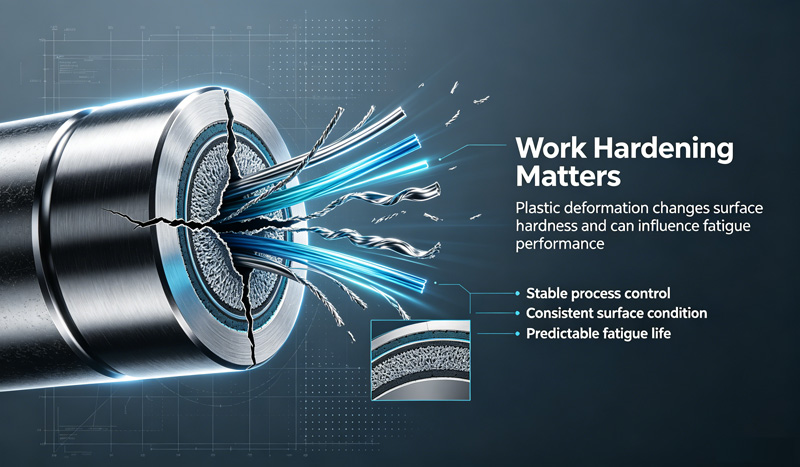
Key Takeaway: Fatigue life is not a fixed number on a material datasheet. It is largely determined by your CNC supplier’s ability to control work hardening throughout the manufacturing process.
Why Stainless Steel Is Highly Sensitive to Work Hardening
Material Characteristics That Promote Work Hardening
Austenitic stainless steels such as 304, 304L, 316, and 316L are particularly susceptible to work hardening due to their metallurgical characteristics, which creates many typical machining challenges of stainless steel.
| Material Property | Impact on Machining |
|---|---|
| High ductility | Promotes plastic deformation during cutting |
| Low thermal conductivity | Heat concentrates at the cutting edge |
| Strong strain-hardening tendency | Surface hardness increases rapidly |
| High toughness | Increases cutting forces and tool wear |
| Adhesive wear tendency | Encourages built-up edge (BUE) formation |
What Happens During Machining?
During cutting, severe plastic deformation occurs in the shear zone. The austenitic structure undergoes strain-induced martensitic transformation, resulting in a hardened surface layer.
Typical effects include:
- Surface hardness increases by 40%–120%
- Hardened layer depth reaches tens to hundreds of microns
- Tool wear accelerates dramatically
- Surface integrity deteriorates during subsequent operations
The hardened layer created in one machining pass often causes increased wear and heat generation in the next pass, creating a self-reinforcing cycle.
How Work Hardening Influences Fatigue Strength
The Positive Side: Controlled Hardening Can Improve Fatigue Life
When cold deformation is carefully controlled, moderate work hardening can increase fatigue performance.
Research has shown:
- 1Cr18Ni9Ti stainless steel: fatigue strength increased by approximately 65% after 60% cold deformation.
- 316 stainless steel: fatigue limit increased by 7% at 5% pre-strain and 27% at 15% pre-strain.
- Thin-wall bent components may achieve up to 23% higher fatigue strength due to localized strengthening.
Benefits include:
- Increased yield strength
- Higher tensile strength
- Improved low-cycle fatigue resistance
- Enhanced resistance to dislocation movement
The Negative Side: Machining-Induced Hardening Can Cause Failure
Unfortunately, machining-induced work hardening is often uncontrolled and non-uniform.
Potential problems include:
Residual Tensile Stress
Improper cutting parameters leave tensile stress beneath the machined surface, accelerating crack initiation.
Micro-Cracks
Excessive cutting force and worn tools can create microscopic defects that become fatigue crack origins.
Thermal Damage
Poor cooling leads to heat accumulation and inconsistent surface microstructures.
Surface Roughness
Built-up edge and tool chatter increase stress concentration factors.
Real-World Failure Example
A study involving stainless steel Z8CND17-04 components revealed fatigue failure after only 110,000 cycles.
Metallurgical analysis confirmed that:
- The machined hardened layer initiated fatigue cracks.
- Surface hardness exceeded core hardness significantly.
- Process optimization reduced hardness difference from 114 HV to 22 HV.
- Fatigue life improved dramatically after eliminating excessive work hardening.
Four Critical Ways Professional Suppliers Control Work Hardening
1. Optimized Cutting Parameters
Experienced suppliers avoid maximizing productivity at the expense of surface integrity.
Typical recommendations include:
- Cutting speed: 50–100 m/min
- Feed rate: 0.1–0.3 mm/rev
- Finishing depth of cut ≥ 0.1 mm
- Each pass removes the previous hardened layer completely
The key principle:
The depth of cut should always exceed the thickness of the previously work-hardened layer.
2. Advanced Tooling and High-Pressure Coolant Systems
Tool Selection
Recommended tooling includes:
- Positive rake angle: 5°–15°
- Ultra-fine grain carbide inserts
- TiAlN coatings
- CVD-coated tooling
Benefits:
- Lower cutting forces
- Reduced friction
- Less heat generation
- Improved surface quality
Cooling Technology
Top suppliers use:
- High-pressure through-tool coolant systems
- Pressure above 80 bar (1160 psi)
- Optimized coolant concentration and flow
Benefits include:
- Better chip evacuation
- Lower cutting temperature
- Reduced work hardening
- Longer tool life
3. Post-Machining Stress Relief and Surface Enhancement
Leading CNC suppliers do not simply machine and ship parts.
They typically apply:
Stress Relief Treatments
- Thermal stress relief
- Vibratory stress relief
These processes reduce residual tensile stress and stabilize part geometry.
Surface Strengthening Methods
Examples include:
- Shot peening
- Roller burnishing
These methods intentionally introduce compressive residual stress, significantly improving fatigue resistance.
Precision Surface Finishing
Processes may include:
- Fine polishing
- Superfinishing
- Micro-deburring
Benefits:
- Lower roughness values
- Reduced stress concentration
- Improved fatigue life
4. Quantitative Validation and Inspection
Professional suppliers verify work hardening scientifically.
Typical inspection methods include:
Vickers Hardness Profile Testing
Measures hardness variation from surface to core.
Target values:
- Surface-core hardness difference ≤ 22–25 HV
Metallographic Analysis
Evaluates:
- Hardened layer depth
- Grain deformation
- Micro-cracks
- Surface integrity
Fatigue Testing
For critical applications, suppliers should provide:
- Fatigue test reports
- Process validation records
- Material traceability documentation
Supplier Qualification Checklist
Before selecting a CNC machining supplier for fatigue-critical stainless steel components, ask the following questions.
| Question | What You Want to Hear |
|---|---|
| What tooling is used for 304/316 stainless steel? | Positive rake carbide tools with advanced coatings |
| How are cutting parameters determined? | Documented process and hardened-layer control strategy |
| What coolant system is used? | High-pressure through-tool coolant |
| Is post-machining stress relief performed? | Yes, with measurable process controls |
| Can hardness profiles be provided? | Yes, with quantified HV data |
| Do you manufacture fatigue-critical components? | Medical, aerospace, hydraulic, robotics experience |
| How is tool wear monitored? | Real-time monitoring and preventive replacement |
Industries Where Work Hardening Control Is Essential
Medical Devices
Typical components:
- Surgical instruments
- Orthopedic fixtures
- Implant manufacturing tooling
Failure consequences:
- Regulatory risk
- Patient safety concerns
Aerospace & Defense
Typical components:
- Structural brackets
- Sensor housings
- Flight-critical fittings
Failure consequences:
- Mission failure
- Safety hazards
Robotics & Automation
Typical components:
- Joint housings
- Servo motor mounts
- Precision transmission parts
Failure consequences:
- Positioning errors
- Production downtime
Hydraulic and Fluid Power Systems
Typical components:
- Hydraulic manifolds
- Valve bodies
- Pressure control blocks
Failure consequences:
- Leakage
- Equipment damage
Semiconductor Equipment
Typical components:
- Vacuum chambers
- Precision motion stages
- Structural support frames
Failure consequences:
- Wafer contamination
- Costly downtime
Conclusion: Fatigue Life Depends on Process Control, Not Just Material Selection
The fatigue strength of a stainless steel component is not determined solely by the material grade.
Instead, it is the result of:
- Material properties
- Machining strategy
- Tooling technology
- Cooling efficiency
- Surface integrity management
- Residual stress control
Uncontrolled work hardening creates hidden risks that may not appear during inspection but can cause costly field failures months later.
By contrast, suppliers who actively manage work hardening through optimized machining parameters, advanced tooling, high-pressure cooling, and post-processing can significantly improve fatigue performance and long-term reliability.
For companies requiring high-precision, high-reliability stainless steel CNC machined parts, evaluating a supplier’s work hardening control capability should be as important as evaluating dimensional accuracy.Learn how we implement full-process work hardening management in our custom stainless steel CNC machining services before requesting a design review.
Request a Fatigue-Critical Stainless Steel CNC Machining Review
If your application involves:
- Dynamic loading
- Cyclic stress
- Hydraulic pressure
- Robotic motion
- Long service life requirements
Our engineering team can review your design and recommend machining strategies that minimize harmful work hardening while maximizing fatigue performance.
Contact us today for a technical consultation and manufacturability review.


Pingback: 10 Common Machining Stainless Steel Problems | XINQIDA
¡Buen artículo!