
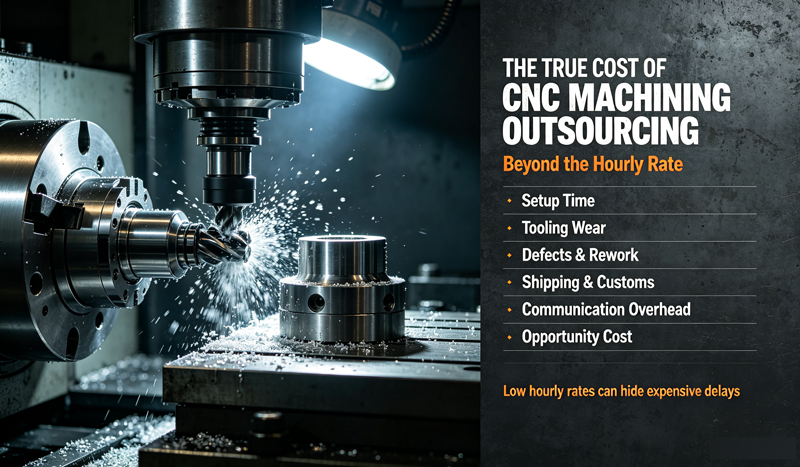
Why the Lowest Quotation Often Becomes the Most Expensive Manufacturing Decision – A Total Cost of Ownership (TCO) Analysis
Table of Contents
ToggleExecutive Summary: The Procurement Trap
In precision manufacturing, CNC machining outsourcing has long been viewed as a proven strategy to cut operational expenses. Most procurement and engineering teams make this decision based on one primary metric: the hourly machining rate. It is common to prioritize vendors offering $30–$50/hour rates over local shops charging $80–$120/hour, believing the lower quote equates to superior cost efficiency.
However, this narrow focus on surface-level pricing is a dangerous illusion. The true total cost of CNC outsourcing extends far beyond machine time. When you factor in freight volatility, tariff exposure, inventory carrying costs, rework losses, communication overhead, and intellectual property (IP) risks, a seemingly cheap offshore quote can end up 30–50% more expensive than a premium domestic partner.
To make data-driven outsourcing decisions, manufacturers must shift from a Rate-Centric approach to a Total Cost of Ownership (TCO) model. This guide breaks down the hidden expenses that spreadsheets rarely capture and provides a framework for calculating your true landed cost.
📘 For a complete framework on sourcing CNC machined parts, check out our CNC Machining Sourcing Guide.
Part I: The Illusion of Low Hourly Rates
Hourly rates are the most transparent pricing metric, yet they only reflect basic machine operation and direct labor. Regional differences further amplify this misconception:
| Region | Typical 3-Axis Rate (USD) | Typical 5-Axis Rate (USD) | Reality Check |
|---|---|---|---|
| Asia (Offshore) | $15 – $35 | $40 – $70 | Low labor costs, but shipping and duties add 20-40% back. |
| Eastern Europe | $25 – $45 | $50 – $85 | Good balance, but logistical lead times are unpredictable. |
| North America (Onshore) | $65 – $100 | $90 – $150 | Higher rate, but drastically lower risk and faster iteration. |
The Compounding Problem: Low-cost vendors often submit optimistic time estimates to win bids. For small-batch production (under 10 parts), pre-production setup and programming can consume 4–8 hours of engineering time—accounting for up to 50% of the total project cost. When a $35/hour vendor takes 10 hours to machine a part, while a $75/hour vendor takes 4 hours (due to better fixtures and CAM programming), the “cheap” vendor actually costs $350 vs. $300 for the machine time alone, before even considering quality.
Part II: The Hidden Pre-Production & Setup Black Hole
Before the first chip is cut, preparatory processes generate substantial unbudgeted costs.
1. Programming & CAM Engineering
Complex parts with intricate geometries or ultra-precise tolerances (±0.005mm) demand significant engineering time. Many vendors charge separate one-time programming fees or amortize them into bulk orders. For prototypes, this amortization doesn’t exist—the client bears the full burden.
2. Custom Fixturing & Tool Wear
Standard fixtures work for generic parts, but complex components require tailored jigs. Furthermore, high-precision machining consumes premium cutting tools. Material choice dramatically affects this:
| Material | Relative Tool Wear | Machinability Impact |
|---|---|---|
| Aluminum 6061 | Low | Standard rates apply. |
| Stainless Steel 316 | High | Requires slower speeds; higher tool replacement cost. |
| Titanium / Inconel | Extremely High | Tool life is measured in minutes; rates often double. |
If a low-rate vendor excludes tool replacement costs, you will face supplementary charges mid-project or suffer from increased scrap due to using worn tools longer than advisable.
Part III: Quality, Scrap, and the Rework Epidemic
Quality inconsistency is the costliest hidden risk. Vendors competing on ultra-low rates often cut corners on QC equipment maintenance and operator training.
The Financial Impact of Scrap: The numbers are sobering. Average rejection rates in low-cost offshore suppliers can range from 3–5%, compared to under 1% for reputable domestic shops. For a batch of 1,000 aerospace-grade stainless steel parts (material cost ~$50 each):
- Low-cost supplier: 40 scrapped parts = $2,000 material loss + wasted machining time.
- Premium supplier: 5 scrapped parts = $250 material loss.
Moreover, rework cycles consume additional machine hours and labor, effectively raising the actual hourly cost far above the original quote. If defective parts make it past incoming inspection, the cost of field failures and warranty claims is exponentially higher.
Part IV: Supply Chain, Logistics & The “Inventory Tax”
Cross-regional outsourcing incurs supply chain costs entirely detached from machining rates.
1. Freight, Tariffs, and Volatility
A typical aerospace component order might incur $2,000–$5,000 in freight alone. Customs and duties add another 3–8%. Tariffs can change with little warning, eroding the margin the lower rate was supposed to deliver.
2. Inventory Carrying Costs (The “Capital Trap”)
Ocean freight adds 4–8 weeks. To maintain operational continuity, you must hold higher safety stock. Inventory carrying costs are estimated at 20–30% of inventory value annually (storage, insurance, obsolescence, capital cost).
| Scenario | Safety Stock Required | Annual Carrying Cost (On $500k Inventory) |
|---|---|---|
| Offshore Supplier (Long Lead Time) | 8–10 weeks | $100,000 – $150,000 |
| Domestic Supplier (JIT Delivery) | 1–2 weeks | $10,000 – $20,000 |
Part V: Time-to-Market Losses & Opportunity Costs
Time is a critical financial variable that is never factored into hourly rates.
1. Lead Time Variance
What the supplier’s standard lead time doesn’t show is the distribution around it. Ocean freight holds, customs clearance delays, and port congestion can turn a 6-week lead time into 10 weeks.
2. Production Downtime
A production delay at an offshore facility doesn’t just push back a delivery date; it can halt your downstream assembly line. In automotive or consumer electronics, a delayed product launch results in lost market share and contractual penalty fees.
3. Communication Lag
When an engineering question surfaces at 2 PM EST and a supplier is 12 hours ahead, the answer comes tomorrow. Multiply that across every revision. Time-zone mismatches and language barriers lead to 24–48 hour communication delays, slowing R&D progress. Up to 68% of product launch delays stem from communication breakdowns or supplier misalignment.
Part VI: The Unspoken Strategic Risks
Beyond direct economic costs, improper outsourcing brings long-term risks that cannot be quantified by hourly rates.
1. Intellectual Property (IP) Exposure
When designs are shared with an offshore partner, you face risks of unauthorized copying or data vulnerability. Pursuing legal action in foreign jurisdictions is costly, complex, and often ineffective. Working with a domestic supplier means contracts, NDAs, and IP rights are governed by familiar and enforceable national legal frameworks.
2. The Supplier Switching Trap
Onboarding a new vendor involves early-stage instability, interpretation differences, and recovery efforts. The first late delivery feels explainable; the third usually indicates a capacity or process control failure. Repeated delivery slips force planners to add internal buffers, increasing overheads that never appear on the PO (Purchase Order).
Part VII: How to Calculate the True Total Cost (The TCO Formula)
To avoid the pitfalls of rate-only evaluation, adopt a Total Landed Cost (TLC) model:
True Cost = (Setup/Programming + [Hourly Rate × Actual Cycle Time] + Material + Tool Wear)
+ (Rework & Scrap Losses)
+ (Logistics + Duties + Insurance)
+ (Inventory Holding Costs)
+ (QC & Communication Overheads)
+ (Opportunity & Penalty Costs)
Conclusion: Prioritize Total Value Over Hourly Rate Savings
The cheapest hourly rate is rarely the cheapest total cost.
Smart CNC outsourcing decisions require shifting from rate-centric to value-centric evaluation. A capable CNC machining partner provides:
- Engineering Support: DFM analysis to reduce setup and cycle time.
- Quality Stability: Less than 1% scrap rate, comprehensive CMM inspection.
- Delivery Reliability: ERP scheduling and JIT (Just-in-Time) capability.
- Agile Iteration: Rapid prototype adjustments without 48-hour communication delays.
For finance leaders evaluating manufacturing supply chains, CNC machining rarely makes it onto the agenda until something goes wrong—a delayed shipment, a batch of out-of-tolerance components, or an unexpected tariff. But by then, the cost has already been incurred.
Run the TCO calculation before signing the contract—not after. In precision manufacturing, the true savings come from stable quality, on-time delivery, and risk-free supply chains, not a discounted hourly rate.


