
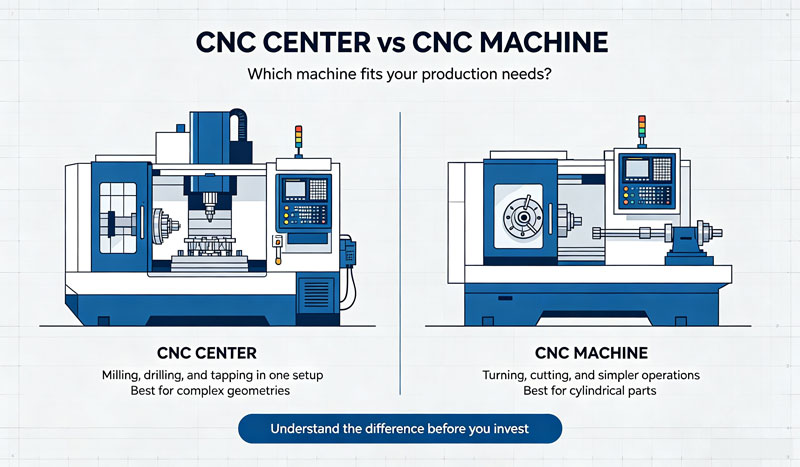
In modern industrial manufacturing, CNC (Computer Numerical Control) equipment forms the backbone of precision production across aerospace, automotive, medical devices, and 3C electronics. While industry professionals frequently use the terms CNC Machine and CNC Center interchangeably, they represent fundamentally different equipment categories—both in structural design and production philosophy.
Confusing these two can lead to improper equipment selection, unnecessary capital waste, and inefficient production workflows. This article systematically deconstructs their core differences—from mechanical structure and automation levels to application scenarios—helping manufacturers make optimized decisions for batch processing, mold making, and high-precision component production.
Table of Contents
Toggle1. Core Definition & Hierarchical Relationship
To understand their differences fundamentally, we must first clarify the hierarchical logic between these two concepts.
1.1 What Is a CNC Machine? (The General Category)
A CNC Machine is a broad umbrella term for any machine tool controlled by pre-programmed computer software (G-code and M-code). It encompasses all basic numerical control equipment, including CNC lathes, CNC milling machines, CNC grinders, CNC drills, and CNC routers.
The core characteristic of an ordinary CNC machine is single-process processing capability. Most basic CNC machines are designed for a specific machining task—for example, a CNC lathe performs only turning operations on cylindrical parts, while a basic milling machine executes only planar cutting.
1.2 What Is a CNC Center? (The Advanced Subset)
A CNC Machining Center (often referred to simply as a “CNC Center”) is a highly automated, multi-functional upgraded subset of CNC machines. Essentially, it is a refined CNC milling machine integrated with an Automatic Tool Changer (ATC) and a tool magazine.
Unlike single-function machines, a CNC center integrates multiple processes—including milling, boring, drilling, tapping, and contouring—into a single device. This integration allows a workpiece to undergo multiple complex procedures in one clamping, without manual intervention.
The Logical Relationship: Think of CNC Machines as the entire “Vehicle” category (including sedans, trucks, and vans), while CNC Centers are the “Self-driving Luxury SUVs” within that category—possessing all basic functions but offering superior automation and multi-terrain capability.
2. The Decisive Difference: The Automatic Tool Changer (ATC)
The most critical physical distinction between a standard CNC machine and a CNC center lies in the Tool Magazine and Automatic Tool Changer (ATC).
- Standard CNC Machine: No built-in tool magazine. When switching between milling, drilling, and tapping processes, the operator must manually stop the machine, change the tool, and re-calibrate. This process takes 2–5 minutes per change and introduces human error.
- CNC Machining Center: Equipped with a standard tool magazine (storing 10 to 100+ tools). The system automatically selects and swaps tools according to the pre-set program in 2 to 10 seconds, enabling seamless, uninterrupted multi-process machining.
This single feature fundamentally alters production dynamics—transforming machining from a labor-dependent operation into an automated, unattended process.
3. Comprehensive Comparison: CNC Machine vs. CNC Center
To visualize the gaps in mechanical structure, automation, and performance, refer to the detailed comparison below:
| Comparison Dimension | Standard CNC Machine | CNC Machining Center |
|---|---|---|
| Tool Magazine & ATC | Not equipped; manual tool change required. | Equipped with standard ATC and tool magazine. |
| Processing Scope | Single process (e.g., turning only, or milling only). | Multi-process integration (milling, drilling, tapping, boring). |
| Setup & Clamping | Requires multiple clamping and repositioning across setups. | One-time clamping completes all complex surfaces. |
| Positioning Accuracy | Cumulative errors from re-clamping; general tolerance (±0.01mm). | Eliminates re-clamping errors; repeatability reaches ±0.001mm. |
| Operator Intervention | High—requires frequent manual tool changes and monitoring. | Low—unattended operation; one operator can manage multiple machines. |
| Production Efficiency | Low; long downtime for adjustments. | High; minimal downtime; 24/7 continuous machining capability. |
| Initial Investment | Lower; cost-effective for basic tasks. | Higher; significant investment in multi-axis control and tool magazines. |
4. Deep Dive: Types of CNC Centers (VMC vs. HMC)
When selecting a CNC center, the configuration of the spindle determines its application. CNC centers are generally divided into two major categories:
4.1 Vertical Machining Center (VMC)
- Structure: Features a vertically oriented spindle (Z-axis).
- Advantages: Lower cost, easier operation, excellent visibility for the operator, and simple fixturing.
- Applications: Ideal for flat and shallow-cavity parts, 2D/3D milling, aluminum components, mold plates, and general mechanical brackets. VMCs are the industry standard for job shops and prototype development.
4.2 Horizontal Machining Center (HMC)
- Structure: Uses a horizontally positioned spindle.
- Advantages: Superior chip evacuation (chips fall away naturally), higher rigidity, and the ability to machine multiple sides of a part in a single setup using a rotary table.
- Applications: Ideal for complex box-shaped parts, automotive engine blocks, pump housings, and heavy industrial components. HMCs are the go-to choice for high-volume, high-efficiency mass production.
5. How CNC Centers Revolutionize Manufacturing Efficiency
Why are manufacturers rapidly shifting from standard CNCs to machining centers? The benefits extend beyond just tool changing:
- Elimination of Cumulative Errors: Every time a workpiece is re-clamped, alignment deviations occur. By performing milling, drilling, and tapping in one clamping, CNC centers completely eliminate these positioning errors, ensuring exceptional consistency across batches.
- Drastic Labor Reduction: While a standard CNC requires an operator standing by for tool changes, a CNC center can run lights-out overnight. This allows manufacturers to reduce labor costs and reallocate skilled workers to programming and quality control.
- Shorter Production Cycles: A part requiring three separate operations on three standard machines might take 6 hours. On a machining center with a 40-tool magazine, that same part is often finished in under 1.5 hours of continuous runtime.
6. Application Scenarios: Making the Right Choice
How do you decide which equipment fits your manufacturing needs?
Choose a Standard CNC Machine When:
- Your parts require only one type of operation (pure turning or pure milling).
- Production volumes are small-batch or prototype-based.
- Budget constraints are the primary concern, and you have skilled operators available.
- Examples: Simple shafts, bushings, basic fixture plates.
Choose a CNC Machining Center When:
- Your parts require multiple operations (Milling + Drilling + Tapping + Boring).
- You demand high precision and zero tolerance for re-clamping errors.
- You are engaged in medium-to-large batch production where efficiency dictates profitability.
- You are producing complex geometries for Aerospace, Medical, Automotive, or Defense industries.
7. Supplier Selection: What to Look For in a CNC Partner
If you are outsourcing precision manufacturing, understanding this difference helps you evaluate a supplier’s capability. When choosing a CNC machining supplier, do not just look at the number of machines; look for:
- Equipment Mix: Does the supplier have both VMCs and HMCs? Do they offer 5-axis machining centers for complex undercuts?
- Process Integration: Can they provide CNC milling services and turning services simultaneously to streamline your supply chain?
- Quality Assurance: Advanced centers with closed-loop controls ensure CMM inspection reports consistently meet tolerances of ±0.005mm.
Conclusion
In summary, a CNC Machine is the general category of all numerically controlled tools, while a CNC Machining Center is an advanced, multi-functional, high-automation subset distinguished by its automatic tool changer and integrated processing capabilities.
Standard CNC machines remain indispensable for straightforward, cost-sensitive single tasks. However, as the manufacturing industry marches toward Intelligent Industry 4.0, the CNC center—particularly 4-axis and 5-axis variants—is rapidly becoming the standard for competitive, high-mix precision production.
Understanding this distinction is not just technical knowledge; it is a strategic asset for optimizing workflows, balancing investment, and securing a competitive edge in modern industrial manufacturing.
