
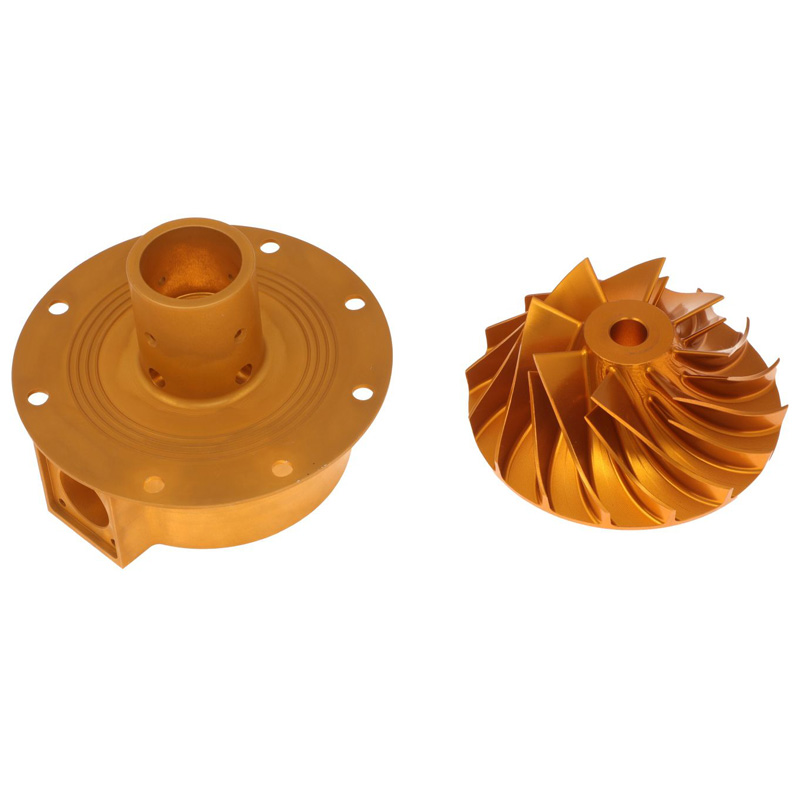
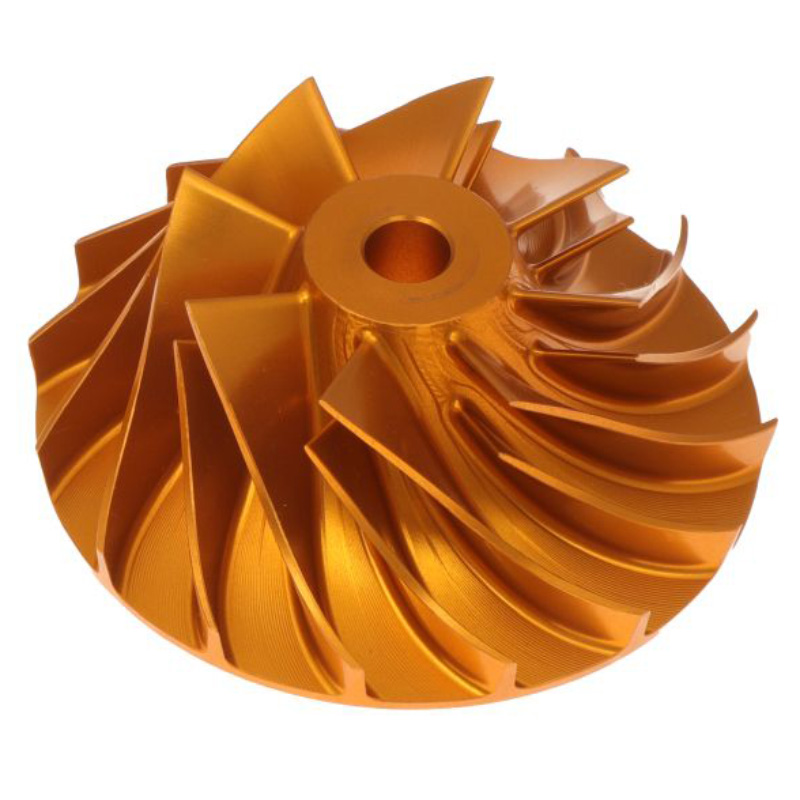
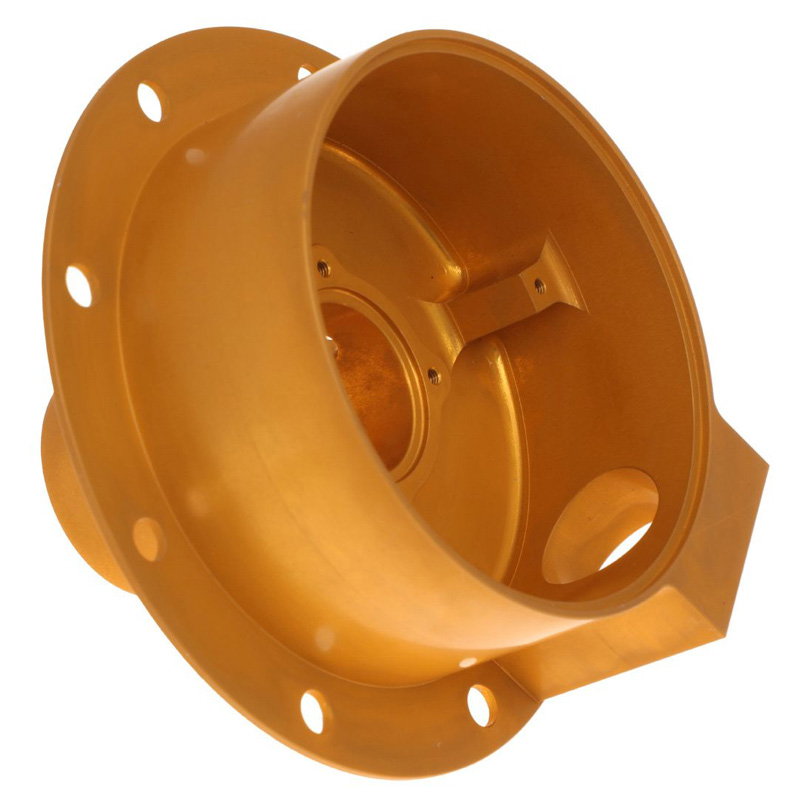
CNC Machined 6061 Aluminum Turbo Compressor Wheel & Housing Kit with Gold Hard Anodizing
Description
Product Overview
The CNC Machined 6061 Aluminum Turbo Compressor Wheel & Housing Kit with Gold Hard Anodizing represents a precision-engineered solution for high-performance forced induction systems. Manufactured from aerospace-grade 6061-T6 aluminum billet using advanced multi-axis CNC machining technology, this comprehensive kit delivers an exceptional strength-to-weight ratio, superior dimensional accuracy, and long-term durability under extreme operating conditions.
Each component undergoes a premium Type III hard anodizing process with a distinctive gold finish, providing enhanced surface hardness, superior wear resistance, and excellent corrosion protection. The hard anodized coating significantly extends component service life while delivering a professional aesthetic that signals quality and performance.
Unlike cast alternatives that may contain internal porosity, inclusions, and material inconsistencies, our billet-machined compressor wheel and housing are free from casting defects, offering superior fatigue life, consistent performance, and reliable operation at rotational speeds exceeding 100,000 RPM.
Application Scenarios
Automotive Performance & Racing
-
High-performance street and track vehicles requiring increased boost pressure and improved engine efficiency
-
Turbocharger upgrades for platforms ranging from compact cars to V8 muscle cars
-
Motorsport applications where weight reduction and component reliability are critical
-
Drift and time-attack vehicles demanding consistent boost response
Diesel Performance & Commercial Vehicles
-
Heavy-duty truck turbocharger systems demanding extended service intervals
-
Agricultural and construction equipment operating in harsh, dusty environments
-
Marine diesel applications requiring superior corrosion resistance
-
Generator sets and stationary power applications
Aerospace & Defense
-
Aircraft auxiliary power units (APUs) and turbocharger systems
-
Unmanned aerial vehicle (UAV) propulsion systems
-
Military ground vehicle engine systems
-
Helicopter and light aircraft engine upgrades
Industrial Turbo-machinery
-
Stationary power generation turbochargers
-
Compressor systems for oil and gas applications
-
High-speed centrifugal compressor applications
-
Test cell and R&D prototyping
Material Analysis: 6061-T6 Aluminum
6061-T6 is the most widely used machined aluminum alloy globally, offering an exceptional balance of mechanical properties, machinability, and cost-effectiveness — making it the ideal choice for high-performance turbocharger components.
Mechanical Properties
| Property | Value | Unit |
|---|---|---|
| Ultimate Tensile Strength | 310 (45,000 psi) | MPa (KSI) |
| Yield Tensile Strength | 270 (40,000 psi) | MPa (KSI) |
| Brinell Hardness | 95 | BHN |
| Rockwell Hardness | 60 | B Scale |
| Density | 2.70 | g/cm³ |
| Shear Strength | 210 | MPa |
| Thermal Conductivity | ~167 | W/m·K |
| Melting Point | 582–652 | °C |
| Modulus of Elasticity | 68.9 | GPa |
Data source: MatWeb, ASM Aerospace Specification Metals
Key Advantages for Turbocharger Components
Excellent Machinability – 6061-T6 enables high-speed machining at 800–1,500 SFM, significantly reducing cycle times and tooling costs compared to steel, titanium, or Inconel alternatives. The material produces clean, manageable chips and generates less cutting heat, substantially extending tool life.
Superior Strength-to-Weight Ratio – At approximately one-third the density of steel, 6061-T6 delivers structural performance that meets demanding aerospace and automotive requirements while minimizing rotating mass — a critical factor for compressor wheels spinning at speeds exceeding 100,000 RPM.
Natural Corrosion Resistance – The alloy naturally forms a protective oxide layer, providing inherent corrosion protection that is dramatically enhanced through the hard anodizing process.
Anodizing Compatibility – 6061-T6 exhibits excellent response to anodizing treatments, producing uniform, dense oxide coatings with consistent color and thickness across complex geometries.
Thermal Stability – With a thermal conductivity of ~167 W/m·K, 6061-T6 efficiently dissipates heat generated during compression, helping maintain optimal operating temperatures.
CNC Machining Parameters & Capabilities
Recommended Machining Parameters for 6061-T6
| Parameter | Recommendation | Notes |
|---|---|---|
| Cutting Speed | 800–1,500 SFM (250–500 m/min) | Higher speeds for finishing operations |
| Spindle Speed | Up to 15,000+ RPM | Depends on tool diameter and machine capability |
| Feed Rate (Roughing) | 0.002–0.006 in/tooth | Aggressive stock removal |
| Feed Rate (Finishing) | 0.001–0.003 in/tooth | Precision surface finishing |
| Depth of Cut (Roughing) | 0.100–0.150 inches | Machine rigidity dependent |
| Depth of Cut (Finishing) | 0.010–0.030 inches | For optimal surface finish |
| Tooling | Sharp, polished carbide | Prevents material adhesion (built-up edge) |
| Coolant | Water-soluble, 5–10% concentration | Essential for heat reduction and surface finish |
| Chip Load | 0.001–0.003 in/tooth | Varies with tool diameter |
Parameter sources: Sandvik Coromant, Kennametal, MachiningCloud
CNC Machining Service Capabilities
| Capability | Specification |
|---|---|
| Machining Type | 5-Axis Simultaneous CNC Milling & Turning |
| Workpiece Material | 6061-T6 Aluminum Billet |
| Maximum Part Size | Up to Ø900mm (customizable upon request) |
| Surface Finish (As-Machined) | Ra 0.4 – 3.2 µm |
| Surface Finish (Optimized) | Ra ≤ 0.65 µm achievable |
| Quality Standards | ISO 9001:2015, AS9100D (upon request) |
| Inspection Equipment | CMM, CT Scanning, Optical Measurement, Surface Profilometer |
| Dynamic Balancing | Precision balancing service available (ISO 1940) |
| Lead Time | 2–4 weeks (custom quantities) |
Tolerance Capabilities
CNC machining of 6061-T6 aluminum enables exceptional dimensional precision across all features of the compressor wheel and housing, ensuring optimal aerodynamic performance and reliable assembly.
Standard Tolerance Capabilities
| Precision Level | Tolerance | Applications |
|---|---|---|
| Standard | ±0.1 mm (±0.004 in) | Non-critical housing features, general dimensions |
| Precision | ±0.01 mm (±0.0004 in) | Critical fits, bearing journals, mounting interfaces |
| Ultra Precision | ±0.005 mm (±0.0002 in) | Blade profiles, aerodynamic surfaces (upon request) |
Process-Specific Tolerances
| CNC Process | Typical Tolerance | Best Applications |
|---|---|---|
| 5-Axis Milling | ±0.02–0.05 mm | Complex blade geometry, housing contours |
| Precision Turning | ±0.025 mm | Bearing surfaces, circular features |
| Drilling / Threading | ±0.08 mm | Mounting holes, oil passages |
Key Tolerances for Turbocharger Components
| Feature | Tolerance | Criticality |
|---|---|---|
| Blade Profile | ±0.02 mm | Aerodynamic efficiency and flow consistency |
| Bearing Journal | ±0.01 mm | Rotational stability and bearing life |
| Housing Bore | ±0.015 mm | Wheel-to-housing clearance (tip clearance) |
| Mounting Hole Position | ±0.01 mm | Assembly alignment and bolt pattern |
| Concentricity | ≤0.01 mm | Vibration reduction and balance stability |
| Surface Finish (Blades) | Ra ≤ 0.8 µm | Flow efficiency and fatigue resistance |
Tolerance data compiled from: ASME Y14.5, ISO 2768, and industry best practices
Gold Hard Anodizing (Type III)
Finish Specifications
| Parameter | Specification |
|---|---|
| Anodizing Type | Type III Hard Anodizing (MIL-A-8625) |
| Coating Thickness | 0.0020″ (nominal) ±0.0005″ |
| Surface Hardness | Up to 679 HV (Vickers) |
| Color | Gold (Class 2, dyed) |
| Standards Compliance | MIL-A-8625 Type III, ISO 10074, AMS 2469 |
| Sealing | Hot DI water seal or nickel acetate seal |
Performance Benefits
Enhanced Wear Resistance – The hard anodized oxide layer significantly increases surface hardness, protecting the compressor wheel and housing from abrasive wear caused by high-velocity airflow and particulate ingestion common in automotive and industrial environments.
Superior Corrosion Protection – The dense, inert aluminum oxide coating provides exceptional resistance to corrosion from moisture, road salts, and engine bay chemicals, ensuring long-term reliability in harsh operating conditions.
Improved Thermal Properties – The anodic coating enhances thermal management and dielectric properties, contributing to stable performance under extreme temperature fluctuations from cold start to full operating temperature.
Premium Aesthetic – The gold finish delivers a distinctive, high-end appearance that reflects the quality of the engineering within — ideal for visible engine bay components, show applications, and performance-oriented builds.
Lubricity Retention – The micro-porous structure of hard anodized surfaces can retain lubricants, reducing friction in mating interfaces and improving overall component efficiency.
Manufacturing Challenges & Solutions
Challenge 1: Complex 5-Axis Blade Geometry
The Challenge: Turbocharger compressor wheels feature complex, twisted blade geometries designed to achieve high pressure ratios and specific efficiency requirements. Machining these intricate 3D surfaces from solid billet requires advanced multi-axis machining capabilities and sophisticated CAM programming.
Our Solution: We employ simultaneous 5-axis CNC machining centers with specialized CAM software to accurately generate complex blade contours from solid 6061-T6 billet. Our experienced programmers optimize tool paths to maintain tight tolerances while minimizing cycle times and tool wear.
Challenge 2: Machining-Induced Surface Defects
The Challenge: Research has demonstrated that machining marks (cusps) left on compressor wheel surfaces can initiate fatigue failure — studies indicate that 83% of fatigue failures originate from machining marks when wheels are operated beyond design speed limits. Surface irregularities can increase local stress concentrations by 20–36% compared to nominal CAD models.
Our Solution:
-
Optimized finishing parameters: spindle speed of 7,500 RPM, feed rate of 250 mm/min, and tool approach angle of 25° for optimal surface finish
-
Advanced finishing strategies to minimize cusp depth and optimize tool size selection
-
Regression-model-based optimization of cusp specifications, proven to increase fatigue life by 34%
-
Wet machining environment to achieve 22–25% better surface finish (lower Ra) compared to dry machining
-
Post-machining surface inspection using optical profilometers
Challenge 3: Dynamic Balancing
The Challenge: Compressor wheels must be precisely balanced to prevent vibration at rotational speeds exceeding 100,000 RPM. Even minor geometric deviations can cause significant imbalance, leading to premature bearing failure, reduced turbocharger life, and potential catastrophic failure.
Our Solution: We provide precision dynamic balancing services for all compressor wheels, using specialized balancing equipment to ensure smooth operation across the entire RPM range. Each wheel is balanced to ISO 1940 G2.5 or better, ensuring vibration-free performance.
Challenge 4: Dimensional Stability During Anodizing
The Challenge: The anodizing process involves exposing parts to acidic electrolytes and electrical current, which can affect dimensional accuracy if not properly controlled. Coating thickness variations can alter critical clearances and fits.
Our Solution: We carefully manage anodizing parameters including electrolyte temperature, current density, and processing time to achieve consistent coating thickness while maintaining critical dimensional tolerances. Critical mating surfaces are masked or machined post-anodizing when required. Each batch is inspected for coating thickness uniformity.
Challenge 5: High-Speed Machining of Thin Features
The Challenge: Compressor wheel blades are thin, cantilevered features that are prone to vibration and deflection during machining, potentially compromising dimensional accuracy and surface finish.
Our Solution:
-
Rigid fixturing and stable machine setups to minimize vibration
-
Optimized tool paths that reduce cutting forces on delicate features
-
High-speed machining strategies that allow lighter cuts at higher feed rates
-
Use of specialized tooling with appropriate rake angles for aluminum
-
Progressive roughing and finishing passes to minimize material stress
Challenge 6: Material Consistency and Billet Quality
The Challenge: Inconsistent billet quality — including internal stresses, inclusions, or grain structure variations — can lead to unpredictable machining outcomes and reduced component life.
Our Solution: We source 6061-T6 billet from certified mills with full material traceability. Each billet batch is inspected for quality compliance before machining. Stress-relief processes are applied when necessary to ensure dimensional stability post-machining.
Frequently Asked Questions (FAQ)
Q1: Why choose billet-machined over cast compressor wheels?
A: Billet-machined compressor wheels are free from the internal porosity, inclusions, and material inconsistencies inherent in cast components. This results in superior fatigue life, better dimensional accuracy, more consistent performance, and the ability to achieve tighter tolerances. While cast wheels are more economical for high-volume production, billet-machined wheels offer superior performance and reliability for demanding applications.
Q2: What makes 6061 aluminum suitable for turbocharger applications?
A: 6061-T6 aluminum offers an exceptional combination of high strength-to-weight ratio, excellent machinability, good thermal conductivity, and natural corrosion resistance. Its lightweight nature reduces rotating mass, allowing faster spool-up and improved throttle response, while its thermal properties help manage the heat generated during compression.
Q3: How does the hard anodizing process benefit the compressor wheel?
A: Type III hard anodizing significantly increases surface hardness (up to 679 HV), enhances wear resistance against particulate ingestion, provides superior corrosion protection, improves thermal management, and delivers a premium gold aesthetic. The micro-porous structure of the anodized surface can also retain lubricants, reducing friction.
Q4: What tolerances can you achieve on the compressor wheel blades?
A: We can achieve blade profile tolerances of ±0.02 mm under standard conditions, with ultra-precision capabilities of ±0.005 mm available upon request. Surface finishes as low as Ra 0.65 µm are achievable with optimized finishing parameters.
Q5: Do you offer dynamic balancing services?
A: Yes, we provide precision dynamic balancing services for all compressor wheels. Each wheel is balanced to ISO 1940 G2.5 or better, ensuring smooth, vibration-free operation at high rotational speeds.
Q6: What is the typical lead time for custom orders?
A: Standard lead time for custom orders is 2–4 weeks, depending on quantity, complexity, and current production capacity. Rush services may be available upon request.
Q7: Can you accommodate custom designs or modifications?
A: Yes, we welcome custom designs and modifications. We can work from your CAD files or collaborate on design development to meet your specific performance requirements. Please contact our engineering team to discuss your project.
Q8: What quality certifications do you hold?
A: We operate under ISO 9001:2015 quality management standards, with AS9100D compliance available upon request for aerospace and defense applications. All components undergo rigorous inspection using CMM, CT scanning, and optical measurement equipment.
Q9: How does the gold hard anodizing compare to other finishes?
A: Gold hard anodizing (Type III) offers superior hardness and wear resistance compared to standard (Type II) anodizing. The gold color is achieved through dyeing after the anodizing process, and the coating thickness is carefully controlled to maintain critical dimensional tolerances.
Q10: What is the maximum operating temperature for these components?
A: 6061-T6 aluminum maintains structural integrity up to approximately 150°C (300°F) for continuous operation. The hard anodized coating provides additional thermal protection. For applications exceeding these temperatures, we recommend consulting our engineering team for material alternatives.
Contact Us
For custom quotes, engineering consultation, or to discuss your specific turbocharger component requirements, please contact our sales and engineering team. We are committed to delivering precision-machined components that meet the highest standards of quality and performance.
Keywords: CNC machined 6061 aluminum turbo compressor wheel, turbo housing kit, gold hard anodizing, Type III anodizing, 5-axis CNC machining, billet compressor wheel, turbocharger components, CNC machining services, aluminum turbo parts, high-performance turbo parts
Additional information
| material |
|---|
Reviews
There are no reviews yet.