
Introduction: Why Surface Finish Is a Design Decision, Not an Afterthought
Aluminum is the backbone of precision manufacturing—lightweight, highly machinable, and naturally corrosion-resistant to a degree. However, that native oxide layer is measured in nanometers; it is porous, soft, and vulnerable to workshop fluids, salt spray, and mechanical abrasion.
For engineers and specifiers in North America, Europe, and Australia, choosing the wrong surface treatment doesn’t just affect appearance—it leads to premature galvanic corrosion, failed tolerance fits, worn sealing surfaces, or failed environmental compliance (RoHS/REACH).
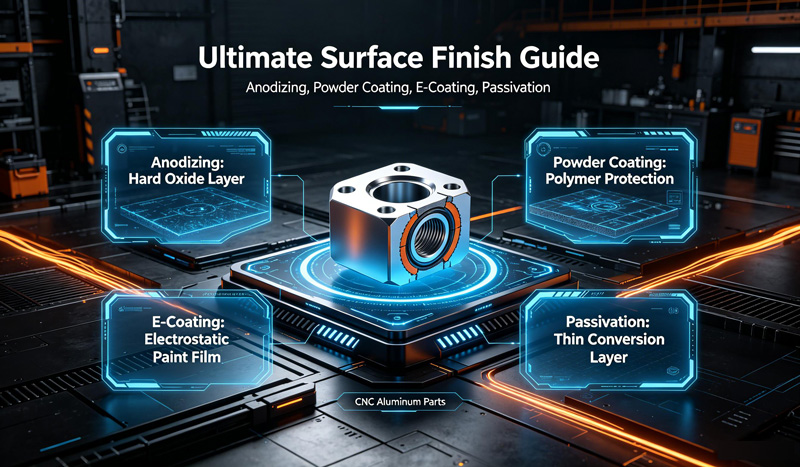
This guide breaks down the four dominant industrial finishes—Hard Anodizing, Powder Coating, E-Coating (Electrophoretic Deposition), and Chemical Passivation—specifically for CNC machined aluminum components. We will compare their process chemistry, dimensional impact, wear resistance, alloy compatibility, and true total cost to help you select the exact finish your application demands.
1. Hard Anodizing (Type II & Type III) – The Integral Hard Shell
The Process
Anodizing is an electrochemical oxidation process that converts the aluminum surface itself into a durable, porous aluminum oxide layer. Unlike paints, this film is integral to the base metal—it cannot peel or flake. Type II is thinner and decorative; Type III (Hardcoat) is the industrial standard for wear components.
Critical Advantages for CNC Parts
Superior Wear Resistance: Type III coatings (40–100 µm) approach the hardness of tool steel, making them ideal for hydraulic valve spools, manifold sealing faces, and frequent-assembly threads.
Dimensional Stability: The coating adds 0.0001″–0.003″ (2.5–75 µm) to surfaces. While thicker than passivation, it is far more predictable than powder coating, allowing machinists to compensate during pre-machining.
Thermal Conductivity Retained: Unlike polymer coatings, anodizing preserves aluminum’s heat dissipation—critical for LED housings and fluid power equipment.
Aesthetic Versatility: Offers matte silver, black, grey, and dyed colors (blue/red/gold) while retaining a premium metallic lustre.
Critical Limitations & Alloy Warnings (The “Gotcha”)
Alloy Sensitivity: Not all aluminums anodize equally. 6061 and 6063 yield bright, uniform films. 7075 tends to produce duller, streaky appearances due to zinc content. Cast alloys (A356) with >7–8% silicon result in uneven grey/black films—powder coating or e-coating is better suited for castings.
Color Matching: Batch-to-batch dye uptake varies; if your assembly requires exact color matching across multiple orders, prepare for tighter quality control.
Conductivity: The oxide layer is an electrical insulator, making it unsuitable for grounding or EMI/RFI shielding applications.
Best Use Cases: Precision hydraulic/pneumatic manifolds, aerospace fittings, robotics arms, sliding mechanisms, and heat sinks.
2. Powder Coating – The Thick-Skinned Decorator
The Process
Electrostatically charged dry powder (polyester, epoxy, or hybrids) is sprayed onto the part and cured in an oven at 160–200°C, forming a thick, continuous polymer skin.
Critical Advantages for CNC Parts
Unlimited Aesthetics: Virtually any RAL color, texture (wrinkle, matte, gloss, metallic), or gloss level. It hides minor surface porosity or machining marks better than anodizing.
Exceptional UV & Weather Resistance: Polyester powders withstand decades of outdoor UV exposure without chalking, making them ideal for exterior machinery.
Cost-Effective for Large Volumes: Overspray can be reclaimed, and processing costs are low for non-critical housings.
Critical Limitations & CNC Tolerances (The Big Risk)
Tolerance Disaster: Coating thickness ranges from 0.002″–0.006″ (60–150 µm). This will close up precision bores, plug threaded holes, and ruin press-fit diameters. All critical mating surfaces require expensive masking (plugs/tapes) or post-machining.
Wear Resistance is Poor: It chips and scratches under friction. Once penetrated, moisture creeps under the film, causing under-film corrosion that is invisible until it’s too late.
Heat Insulation: It reduces heat dissipation, making it unsuitable for thermal management components.
Faraday Cage Effect: Deep internal corners and blind holes receive thinner coverage, potentially leaving bare spots.
Best Use Cases: Large equipment housings, outdoor structural frames, agricultural machinery casings, and non-precision decorative covers where aesthetics and UV stability are paramount.
3. E-Coating (Electrophoretic Deposition) – The Intricate Cavity Filler
The Process
Parts are submerged in a water-based paint bath, and an electric current drives paint particles into every nook, including deep blind holes and internal channels. The part is then rinsed and cured.
Critical Advantages for Complex Geometries
100% Penetration: Reaches internal cross-drilled holes, threads, and complex multi-angle cavities that powder coating misses.
Ultra-Thin & Uniform: At 15–35 µm (0.0005″–0.0015″), the film is thin enough to preserve most CNC tolerances while providing excellent barrier protection.
Exceptional Salt-Spray Performance: Cathodic epoxy e-coats routinely pass 1000+ hours of ASTM B117 testing, surpassing many powder coats.
Critical Limitations
Limited Palette: Almost exclusively black, grey, and clear. Custom bright colors are prohibitively expensive for most industrial runs.
Poor UV Stability: Epoxy-based e-coats chalk and degrade under sunlight—they require a topcoat for outdoor applications.
Abrasion: Softer than hard anodizing; not suitable for dynamic sealing or sliding contact surfaces.
Best Use Cases: Complex multi-port valve bodies, intricate automation fittings, and high-volume small industrial hardware requiring full internal coverage but static load conditions.
4. Chemical Passivation (Conversion Coating) – The Invisible Enabler
The Process
A chemical immersion treatment (traditionally hexavalent yellow chromate, now increasingly trivalent chromium or zirconium-based non-chrome) reacts with the aluminum to form a thin, conductive conversion layer (0.5–4 µm). No electricity is required.
Critical Advantages for Precision & Electronics
Negligible Dimensional Change: Below 0.0003″ (7 µm). It is the only finish that is 100% safe for critical threads, fine-pitch bores, and gauge-tolerance mating surfaces without pre-adjustment.
Maintains Conductivity: Unlike anodizing, passivation leaves the surface electrically conductive—essential for grounding, EMI/RFI shielding, and electronic chassis.
Excellent Paint/Adhesive Base: The porous crystalline layer acts as a molecular key for secondary painting, bonding, or sealant application.
Regulatory Shift: While hexavalent chrome offers superior corrosion (500+ h salt spray), it is heavily restricted. Modern trivalent and non-chrome alternatives provide 336+ hours of salt spray in a compliant package.
Critical Limitations
Zero Mechanical Protection: Soft and easily scratched; offers no wear or impact resistance.
Poor Standalone Corrosion: Not suitable for harsh outdoor or hydraulic fluid environments without a topcoat.
Aesthetics: Faint pale gold, clear, or greenish tint—purely functional, not decorative.
Best Use Cases: Electronic enclosures, precision spacer shims, temporary in-transit rust prevention, and parts receiving secondary adhesive bonding or painting.
Side-by-Side Engineering Comparison Matrix
| Property | Hard Anodizing (Type III) | Powder Coating | E-Coating | Passivation |
|---|---|---|---|---|
| Coating Thickness | 0.001″–0.004″ (25–100 µm) | 0.002″–0.006″ (60–150 µm) | 0.0005″–0.0015″ (15–35 µm) | <0.0003″ (<7 µm) |
| Tolerance Impact | Moderate (machinable) | Critical (must mask) | Slight | Negligible |
| Wear/Abrasion | Excellent | Poor (chips) | Fair | Very Poor |
| Corrosion (Salt Spray) | Excellent (500–1000+ h) | Excellent (500–1000+ h) | Excellent (1000+ h) | Good (336–500 h) |
| UV/Weather Stability | Excellent | Excellent (Polyester) | Poor (needs topcoat) | Good (functional) |
| Electrical Conductivity | Insulating | Insulating | Insulating | Conductive |
| Alloy Compatibility | Wrought only (6xxx/5xxx best; 7xxx dull; avoid high-Si cast) | All alloys (covers defects) | All alloys | All alloys |
| Color Options | Limited, metallic | Unlimited (RAL/textures) | Very limited (black/grey) | None (gold/clear) |
| Relative Cost (Part) | Medium-High | Low-Medium | Medium | Low |
The Decision Matrix: 5 Scenarios to Guide Your Choice
Choose Hard Anodizing IF:
Your part is a precision fluid manifold, hydraulic valve block, pneumatic fitting, or sliding component operating indoors. You need high abrasion resistance, preservation of sealing bores, and a premium metallic look—and you are using a wrought aluminum alloy (6061/6082).
Choose Powder Coating IF:
Your design is a large external housing, outdoor machinery frame, or decorative casing with loose tolerances (±0.005″ or greater). Aesthetics and UV protection are your top priorities, and you are willing to mask off all critical bores and threads.
Choose E-Coating IF:
Your CNC part has complex multi-angle geometries, dense arrays of deep blind holes, and internal channels that must be fully protected. You require automotive-grade corrosion resistance, but the part is static (no sliding friction) and used indoors or will receive a topcoat.
Choose Passivation IF:
You need to maintain strict dimensional tolerances (gauge fits).
The component must remain electrically conductive (grounding/EMI).
The part serves as an internal bracket, spacer, or will undergo secondary painting/bonding.
You only need mild, temporary rust protection or an adhesion primer.
Special Casting Rule: If your part is a die-cast aluminum alloy (e.g., A380, A356), cross off anodizing. High silicon content causes ugly, uneven films. Your best bets are Powder Coating or E-Coating.
Practical Shop-Floor Tips for Procurement & Design
Combine Processes for Maximum Life: High-end aerospace and off-highway equipment often use passivation as a primer underneath powder or e-coat for ultimate corrosion resistance. Conversely, some anodized parts are sealed and top-coated for UV-critical outdoor use.
Order of Operations: If you require tight threads and anodizing or powder coating, always specify the finish thickness. The machinist can cut the threads oversized to compensate, or better yet, apply the finish first and post-machine the critical sealing surfaces.
Test Before Full Production: Anodizing dyes react differently to different heat treats and batches. Run a pilot batch to approve the visual match before committing to 10,000 parts.
Supplier Capabilities: In Western markets, powder coating and passivation are widely available at local job shops. True Type III Hard Anodizing and E-Coating require specialized rectifiers and tank lines—check your supplier’s certifications (e.g., MIL-A-8625 for anodizing) early.
FAQ – Quick Answers for Common Concerns
Q: Is anodizing better than powder coating for aluminum valve manifolds?
A: Yes, for precision bores. Hard anodizing preserves critical tolerances (0.001″ added) and provides superior abrasion resistance. Powder coating’s 0.004″+ thickness will block threads and ruin dynamic sealing fits unless extensively masked.
Q: Can e-coating replace hard anodizing for hydraulic aluminum parts?
A: Not for dynamic surfaces. E-coat provides excellent corrosion coverage in deep cavities, but its soft organic film lacks the wear resistance required for sliding spools or high-pressure fluid contact. Use e-coat for static internal fittings only.
Q: Why does my 7075 aluminum look dull after anodizing?
A: 7075 contains high zinc and copper. During anodizing, these intermetallics dissolve differently than the aluminum matrix, resulting in a streaky, less reflective surface. If aesthetics are critical on 7075, choose powder coating or passivation.
Q: Does passivation change the dimension of my CNC threaded holes?
A: No. The conversion film is sub-micron thick (under 7 µm). It is the only finish guaranteed to have zero measurable impact on thread pitch diameter and gauge fit.
Q: Which finish complies with EU RoHS/REACH out of the box?
A: Clear/trivalent passivation, powder coating (VOC-free), e-coating (water-based), and anodizing (sealed with nickel acetate or hot water) are all compliant. Avoid specifying hexavalent yellow chromate unless you have a specific military exemption.


¡Excelente artículo!
Great content! Keep up the good work!
The detailed comparison between Hard Anodizing and Passivation is very informative for precision CNC manufacturing. Maintaining tight dimensional stability while preventing galvanic corrosion is critical for high-tolerance components. Thanks for sharing this engineering guide.
Great engineering breakdown, especially the tolerance impact table for hard anodizing vs powder coating. The point about masking precision bores before powder coating saved me a lot of rework planning. Thanks for sharing the alloy compatibility warnings for 6061 vs 7075.