
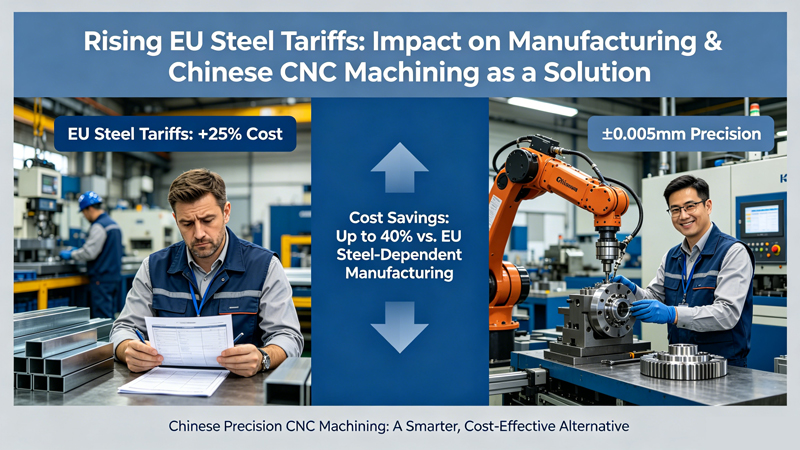
European manufacturers are entering a new era of cost pressure.
With the EU introducing stricter steel import regulations and significantly higher tariffs in 2026, manufacturers across industries — from automotive and industrial equipment to robotics and renewable energy — are facing rapidly rising production costs. Steel prices are climbing, procurement cycles are getting longer, and local machining margins are shrinking faster than many companies expected.
For European CNC machining companies and component manufacturers, the challenge is no longer just about sourcing raw materials. It is about maintaining competitiveness in an increasingly expensive production environment.
As a result, more European manufacturers are now shifting part of their precision component supply chain to China — not simply to reduce costs, but to secure stable production capacity, predictable delivery, and long-term manufacturing flexibility.
Table of Contents
ToggleEurope’s Manufacturing Cost Structure Is Changing
The latest EU steel policies are tightening import quotas while increasing tariffs on excess steel imports. Combined with high energy prices and carbon compliance costs, the result is a sharp increase in regional manufacturing expenses.
For downstream industries, the impact is immediate:
- Steel procurement costs continue to rise
- Lead times are becoming less predictable
- Inventory pressure is increasing
- Profit margins are narrowing
- Production planning is becoming more difficult
Many European CNC workshops and precision component suppliers are already operating under intense cost pressure. In sectors such as automotive, industrial automation, and machinery manufacturing, even small increases in material costs can quickly erode profitability.
At the same time, customers still expect competitive pricing, short delivery times, and consistent product quality.
This is forcing manufacturers to rethink how and where precision components are produced.
Why European Companies Are Turning to Chinese CNC Machining
Over the past decade, China’s precision CNC machining industry has evolved far beyond low-cost manufacturing.
Today, leading Chinese CNC factories are equipped with advanced multi-axis machining centers, automated inspection systems, and highly standardized production management processes. Many already supply precision components for demanding industries such as:
- Automotive
- Robotics
- Semiconductor equipment
- Medical devices
- New energy systems
- Industrial automation
For European buyers, the biggest advantage is not simply lower pricing. It is the combination of:
- Stable quality
- Scalable production
- Fast turnaround
- Mature export experience
- Competitive total manufacturing cost
Even after including logistics and import costs, Chinese precision CNC machining can still reduce total production expenses by 25%–40% compared with local European manufacturing.
Cost Reduction Without Sacrificing Precision
One common misconception is that lower manufacturing costs automatically mean lower quality. That is no longer true in today’s precision machining industry.
Experienced Chinese CNC machining suppliers now routinely achieve:
- Tight tolerance control
- Full dimensional inspection
- ISO-compliant quality systems
- Production traceability
- Complex custom machining capability
For European manufacturers facing rising domestic production costs, this creates a practical opportunity to maintain product quality while significantly improving cost efficiency.
Supply Chain Flexibility Has Become a Competitive Advantage
Global manufacturing is becoming increasingly unpredictable. Rising tariffs, geopolitical uncertainty, energy costs, and environmental regulations are all reshaping industrial supply chains.
In this environment, relying entirely on local production is becoming increasingly risky and expensive.
Many European manufacturers are therefore adopting a hybrid sourcing strategy:
- Core engineering and assembly remain local
- Precision CNC component production is globally optimized
- Supply chains become more flexible and cost-efficient
Chinese precision CNC machining suppliers are playing an increasingly important role in this transition.
A Long-Term Shift, Not a Temporary Trend
The move toward Chinese precision CNC manufacturing is no longer just a short-term response to rising steel tariffs.
It reflects a larger transformation in global manufacturing economics.
European companies still lead in engineering, product development, and industrial innovation. But maintaining global competitiveness now requires smarter cost structures and more flexible supply chain strategies.
For many manufacturers, partnering with reliable Chinese CNC machining suppliers is becoming a strategic decision — one that helps balance quality, delivery stability, and long-term profitability in an increasingly challenging market.


The point about shrinking machining margins in Europe is especially important because a lot ofEU Steel Tariffs Impact manufacturers are already dealing with longer lead times and unstable material pricing. Diversifying sourcing strategies and working with partners that can maintain precision while controlling costs seems like a practical way for companies to stay competitive as these tariff changes take effect.