
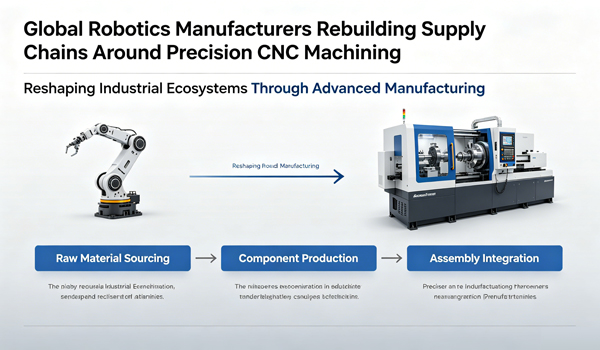
The global robotics industry is entering a new phase of rapid growth.
From industrial robots and collaborative robots to humanoid robots and UAV systems, competition is no longer focused only on AI algorithms, software, and motion control systems. As robots move closer to large-scale commercialization, the industry is shifting its attention back to the foundation of every robot: precision manufacturing.
Today, mechanical accuracy, structural consistency, lightweight design, and supply chain reliability are becoming critical factors that directly determine robot performance, product lifespan, and mass-production capability.
As a result, a major industry trend is emerging worldwide:
More robot manufacturers are rebuilding their supply chains around high-precision CNC machining services.
Whether it is global automation leaders or fast-growing humanoid robot startups, companies are increasingly treating precision CNC machining not as a supporting process, but as a core manufacturing capability essential to the future of robotics.
Table of Contents
ToggleWhy the Robotics Industry Depends More Than Ever on Precision CNC Machining
At its core, a robot is a highly integrated precision mechanical system.
A modern robot contains a large number of critical CNC machined components, including:
Robot joint housings
Harmonic reducer housings
Servo motor mounting parts
Robotic arm structural components
EOAT end effectors
Sensor mounting brackets
Lightweight aluminum frames
These components typically require:
Complex geometries
Multi-sided machining
Tight concentricity control
Micron-level tolerances
High assembly consistency
Lightweight structural optimization
In humanoid robots especially, joint systems are extremely sensitive to machining precision.
Even a minor deviation in a bearing seat, reducer housing, or motor mounting surface can lead to:
Motion instability
Reduced positioning accuracy
Increased motor load
Premature reducer wear
Excessive vibration and noise
Shortened service life
This is why more robotics companies are prioritizing suppliers with proven expertise in:
Precision CNC machining
5-axis CNC machining
Tight tolerance machining
Robotic parts manufacturing
The Rise of Humanoid Robots Is Accelerating CNC Machining Upgrades
2025 and 2026 are widely viewed as the beginning of humanoid robot commercialization.
Compared with traditional industrial equipment, humanoid robots demand far higher standards for mechanical structures:
Lighter weight
Higher strength
Greater durability
Better motion stability
Superior assembly precision
This is driving a major increase in demand for advanced CNC machining capabilities.
1. Demand for 5-Axis CNC Machining Is Growing Rapidly
Many robotic components feature highly complex geometries, such as:
Biomimetic joints
Curved structural housings
Multi-angle mounting surfaces
Internal cavities
Integrated lightweight designs
Traditional 3-axis machining is no longer sufficient for many of these applications.
As a result, robotics manufacturers are increasingly relying on:
5-axis CNC machining
Multi-axis machining
CNC turning and milling
High-speed precision machining
5-axis machining reduces setup operations, improves surface finish quality, and increases dimensional consistency — all of which are critical for robotic assemblies.
For robotics manufacturers, this directly impacts:
Product reliability
Assembly efficiency
Motion accuracy
Long-term durability
Mass-production stability
2. Lightweight Design Has Become a Core Competitive Advantage
In robotics, lighter structures offer major performance benefits:
Lower motor load
Faster movement
Reduced energy consumption
Longer battery life
Improved flexibility
This is why many robotics projects are heavily adopting materials such as:
Aluminum 6061
Aluminum 7075
Titanium alloys
Magnesium alloys
High-strength aluminum robotic components, in particular, are becoming one of the fastest-growing segments in precision CNC machining.
However, lightweight materials also introduce additional manufacturing challenges, including:
Complex cutting parameters
Deformation control
Higher surface finishing requirements
More advanced fixture design
This makes real-world machining experience increasingly valuable when selecting a CNC machining supplier.
Why Robotics Companies Are Consolidating Their Supplier Networks
In the past, many robotics companies relied on fragmented supply chains:
One supplier for machining
Another for anodizing
Another for inspection
Another for assembly
But as robotic systems become more sophisticated, this model creates growing problems:
Tolerance stack-up issues
Poor communication efficiency
Unstable lead times
Unclear quality responsibility
Increased logistics complexity
As a result, more buyers are moving toward:
One-Stop CNC Machining Services
Robotics manufacturers increasingly prefer suppliers that can provide:
CNC machining
Surface finishing
Anodizing
Quality inspection
Rapid prototyping
Low-volume production
Assembly support
An integrated manufacturing model helps reduce supply chain complexity while improving consistency and production stability.
Geopolitical Changes Are Reshaping Robotics Supply Chains
For decades, the robotics industry prioritized:
Lowest manufacturing cost
Global sourcing
Distributed production
However, recent years have introduced significant disruptions, including:
Trade restrictions
Global logistics instability
Regional supply chain risks
Export control policies on advanced manufacturing technologies
These changes are forcing robotics companies to rethink their sourcing strategies.
For high-precision CNC machined components, supply chain reliability is now often more important than achieving the absolute lowest cost.
As a result, many robotics manufacturers are:
Building regional supply chains
Partnering with long-term CNC suppliers
Expanding localized machining capacity
Reducing dependence on single-region sourcing
For robotics companies, supply chain stability now directly affects:
Product development speed
Prototype turnaround time
Mass-production scalability
Long-term manufacturing strategy
Precision CNC Machining Is Becoming the Key Barrier to Robot Mass Production
One of the biggest challenges in robotics today is no longer prototype development.
The real challenge is achieving stable mass production.
Many robot companies can build functional prototypes, but struggle when scaling production due to:
Inconsistent part quality
Assembly variation
Low production yield
Unstable motion performance
In many cases, the root cause is insufficient precision machining capability.
Critical robotic components such as:
Bearing seats
Reducer housings
Precision shafts
Motor mounting surfaces
all require extremely stable machining precision over large production volumes.
Only a mature high-precision CNC machining system can support the consistency required for large-scale robotic manufacturing.
The Future of Robotics Competition Will Be Defined by Manufacturing Capability
Over the next decade, growing demand from:
Humanoid robots
Industrial automation
Medical robotics
Service robots
UAV systems
will continue driving the expansion of precision CNC machining worldwide.
At the same time, the market will gradually eliminate manufacturers that rely solely on:
Basic machining capabilities
Conventional 3-axis equipment
Weak quality control systems
The most competitive CNC machining suppliers of the future will need to offer:
High-precision machining capability
Advanced 5-axis machining systems
Tight tolerance control
Rapid prototyping support
Flexible low-volume production
Stable quality management systems
Real robotics industry experience
Because ultimately, robotics is not only a competition of AI and software.
It is also a competition of manufacturing capability, precision engineering, and supply chain strength.
Conclusion
The global shift toward rebuilding robotics supply chains around precision CNC machining is not a temporary trend — it is a fundamental transformation of the industry.
As humanoid robots and industrial automation continue to expand, high-precision CNC machining services will become an increasingly critical foundation of robotic manufacturing.
In the future, companies that can provide:
Stable precision machining
Advanced 5-axis manufacturing
Deep robotics component expertise
Fast prototyping and scalable production
will be best positioned to support the next generation of robotic innovation and large-scale commercialization.


