
Introduction
When sourcing custom CNC machined plates for automation systems, test fixtures, machining workshops, or industrial equipment, many engineers and procurement professionals find themselves confused by the terminology. Terms like fixture plate, mounting plate, base plate, tooling plate, jig plate, and adapter plate are often used interchangeably—but they are not the same.
While all are typically manufactured from aluminum, steel, or stainless steel via precision milling, each type carries a distinct functional purpose, different design requirements, and specific application scenarios. Selecting the wrong plate can lead to poor positioning accuracy, insufficient structural rigidity, assembly difficulties, or unnecessary cost overruns.
This guide clarifies the practical differences between the most commonly specified CNC machined plates and provides actionable selection criteria for engineers, designers, and procurement teams.
1. What Is a CNC Machined Plate?
A CNC machined plate is a flat, plate-shaped component manufactured by CNC milling or related machining processes. Unlike a simple cut-to-size metal sheet, a precision CNC plate can include a variety of engineered features:
- Precision mounting holes and threaded holes
- Counterbores and countersinks
- Locating holes and dowel pin holes
- Slots, pockets, steps, and shoulders
- Recessed areas and datum surfaces
- Alignment features and custom interfaces
The final geometry depends entirely on the plate’s intended role within the equipment or assembly. A CNC plate may serve as a structural foundation, a fixture interface, a component mounting surface, a positioning reference, or an adapter between two different mechanical interfaces. Explore our full lineup of custom CNC machined plates including base, fixture, mounting and adapter styles to match your mechanical design requirements.
2. Fixture Plate vs. Mounting Plate vs. Base Plate: Core Definitions
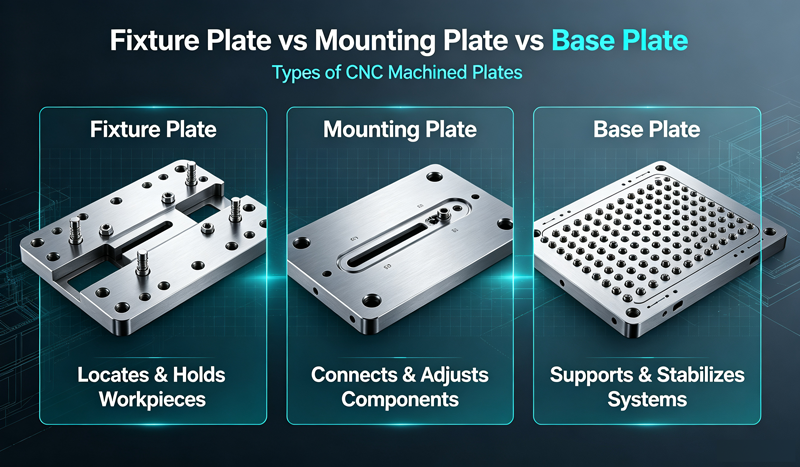
The easiest way to distinguish these three types is to look at their primary function:
| Plate Type | Primary Function | Key Features | Common Applications |
|---|---|---|---|
| Fixture Plate | Holding and locating a workpiece during manufacturing, inspection, or assembly | Precision locating holes, threaded holes, clamping grooves, hardened wear surfaces | CNC machining fixtures, ICT test fixtures, assembly jigs, welding positioning tooling |
| Mounting Plate | Attaching components (motors, sensors, actuators) to equipment or structures | Bolt holes, threaded holes, adjustable slots, interface-specific hole patterns | Motor mounts, robot accessory installation, sensor brackets, equipment module transition plates |
| Base Plate | Providing structural support and a stable reference foundation for an entire system | High rigidity, thicker blanks, large reference surfaces, dense array of mounting holes | Automation workstations, equipment bases, multi-station assembly platforms, robotic work cells |
3. What Is a CNC Fixture Plate?
A fixture plate (also referred to as a jig plate or tooling plate) is primarily designed to hold, locate, or support a workpiece during manufacturing, inspection, or assembly. It is the carrier that comes into direct contact with the product being machined or tested and bears clamping forces.
Key Design Features:
- Equipped with precision locating pins, clamping thread holes, vacuum grooves, or positioning grooves
- Strict flatness and dimensional tolerance requirements to ensure workpiece repeat positioning accuracy
- Certain areas may feature hardened surface treatment to resist wear from frequent clamping
- Usually medium thickness, with emphasis on positioning stability rather than overall load-bearing capacity
- Standardized hole patterns for quick changeover and repeatable setups
Typical Applications:
- CNC machining workholding fixtures
- ICT test fixtures
- Assembly jigs
- Welding positioning tooling
- Production tooling and workholding systems
When to Specify a Fixture Plate:
Choose a fixture plate when the primary requirement is: “I need a precision platform for locating and holding something repeatedly.”
4. What Is a CNC Mounting Plate?
A mounting plate acts as an intermediate transition connecting two different components. It bridges equipment bodies, motors, actuators, sensors, and other parts to enable installation and position adjustment. Unlike a fixture plate, the mounting plate does not directly hold a workpiece—instead, it serves as the mechanical interface between components.
Key Design Features:
- Mainly distributed mounting through-holes and counterbores for bolt connections
- Adjustable slots are common to allow position fine-tuning
- Tolerance requirements are generally moderate unless high-precision alignment is required
- Focus on interface compatibility to solve mismatched hole positions between different parts
- Features are customized to specific component mounting patterns
Typical Applications:
- Servo motor mounting
- Robot accessory installation
- Sensor and camera brackets
- Equipment module transition connection plates
- Automation equipment mounting interfaces
When to Specify a Mounting Plate:
Choose a mounting plate when the primary requirement is: “I need to attach one component to another and provide the correct interface.”
5. What Is a CNC Base Plate?
A base plate is the bottom foundation of the entire mechanical unit. It carries all upper modules, bears the combined weight and vibration of the system, and provides a stable reference platform. Its main functions are supporting the assembly, establishing a reference surface, connecting the assembly to the machine structure, and maintaining rigidity and alignment.
Key Design Features:
- High rigidity, often using thicker plate blanks
- Rib reinforcements can be added for large-size base plates
- Strict flatness and parallelism to avoid overall tilt after assembly
- Large-area reference datum surface with numerous distributed threaded holes for installing multiple sub-components
- Anti-vibration and anti-deformation performance is the primary consideration
Typical Applications:
- Automation workstation platforms
- Equipment bottom substrates
- Multi-station assembly platforms
- Robotic work cell base platforms
- Industrial machinery frames
When to Specify a Base Plate:
Choose a base plate when the primary requirement is: “I need a stable foundation to support a complete assembly or machine module.”
6. Fixture Plate vs. Mounting Plate vs. Base Plate: A Practical Example
Consider an automated assembly machine. The system may contain three different plates, each serving a distinct role:
| Level | Plate Type | Function |
|---|---|---|
| Bottom | Base Plate | Attached to the machine frame, provides the primary structural foundation and vibration damping |
| Middle | Mounting Plate | Attached to the base plate, provides the interface for a servo motor or actuator |
| Top | Fixture Plate | Holds and accurately positions the workpiece during the assembly process |
In this configuration, the three plates may appear physically similar—flat, machined metal plates with holes—but their engineering functions are fundamentally different:
- Base = support and foundation
- Mounting = attachment and interface
- Fixture = locating and holding
This functional distinction is far more useful than judging a part by its name alone.
7. Adapter Plates, Jig Plates, Positioning Plates, and Tooling Plates
Beyond the three main categories, several other plate types are commonly specified in industrial applications:
Adapter Plate
Used when two components or systems have different mounting interfaces. Instead of redesigning the entire structure, an adapter plate provides an intermediate interface with two different bolt patterns, stepped features, or custom geometries.
Jig Plate
Closely associated with guiding or locating a manufacturing operation. A common example is a drilling jig, where precisely positioned guide holes in the plate direct a drill bit or establish workpiece location.
Tooling Plate
A broader term that generally refers to plates used as the foundation for interchangeable tooling or workholding systems. Often equipped with standardized hole patterns, tooling plates are common in quick-change manufacturing setups.
Positioning / Locating Plate
Specifically designed to establish an accurate reference location. Features include precision holes, slots, and datum features for automation and precision assemblies.
Quick Reference Table
| Plate Type | Primary Purpose | Key Features |
|---|---|---|
| Fixture Plate | Hold and locate workpieces | Locating holes, clamping features, hardened surfaces |
| Mounting Plate | Attach components | Bolt patterns, adjustable slots, interface-specific holes |
| Base Plate | Provide structural support | Thick, rigid, flat reference surfaces |
| Adapter Plate | Connect different interfaces | Multiple hole patterns, stepped features |
| Jig Plate | Guide manufacturing operations | Guide holes, locating features |
| Tooling Plate | Support interchangeable tooling | Standardized hole patterns |
| Positioning Plate | Establish reference locations | Precision holes, slots, datum features |
8. Material Selection for CNC Machined Plates
Material choice depends on the required combination of rigidity, weight, wear resistance, corrosion resistance, machinability, and operating environment.
| Material | Advantages | Typical Applications |
|---|---|---|
| Aluminum (e.g., 6061) | Lightweight, good machinability, cost-effective | Automation equipment, mounting plates, robot components, camera/sensor mounts |
| Steel (e.g., 4140, mild steel) | High rigidity, strength, wear resistance, vibration damping | Heavy-duty fixtures, tooling plates, high-load base plates, wear-resistant components |
| Stainless Steel | Corrosion resistance, durability, strength | Semiconductor equipment, harsh environments, precision fixtures, fluid-related equipment |
| Brass | Good machinability, corrosion resistance | Specialized tooling and fixture applications |
| Engineering Plastics (FR4, Bakelite) | Electrical insulation, lightweight | Test fixtures, electrical applications |
Surface Finishing Options
- Anodizing (aluminum): Improved surface protection, wear resistance, and appearance
- Powder coating: Enhanced corrosion protection and aesthetics
- Grinding: Achieves high flatness and surface finish for critical reference surfaces
9. CNC Machining Processes for Plates
A CNC machined plate may require more than simple profile milling. Depending on the drawing, manufacturing may include:
- CNC milling (face, contour, pocket)
- Drilling, tapping, and reaming
- Counterboring and countersinking
- Slot and pocket milling
- Surface machining and chamfering
- Deburring and surface finishing
For complex plates with multi-sided features or tight tolerances, 5-axis machining may be considered. The correct process selection depends on part geometry, tolerance requirements, material, production volume, and required surface finish.
10. What Engineers Should Specify on a CNC Plate Drawing
For procurement and engineering teams, the drawing should clearly define the features that actually affect function. Important specifications include:
| Specification | Why It Matters |
|---|---|
| Overall dimensions | Defines size and envelope |
| Critical tolerances | Identify functionally critical dimensions; avoid over-tolerancing |
| Flatness | Directly affects assembly accuracy for mounting and fixture applications |
| Hole position | Critical when the plate interfaces with other components |
| Parallelism/perpendicularity | Important when the plate establishes a mechanical reference |
| Surface finish | Affects sealing, sliding, positioning, and assembly |
| Material grade | Clearly state alloy and condition |
| Heat treatment | Specify if required for hardness or stress relief |
| Surface treatment | Anodizing, plating, passivation, black oxide, etc. |
11. How Procurement Teams Should Compare CNC Plate Suppliers
When requesting quotations for custom CNC plates, price should not be the only factor. A well-prepared RFQ package should include:
- 2D engineering drawing
- 3D CAD model
- Material specification
- Quantity
- Tolerance requirements
- Surface finish requirements
- Heat treatment requirements
- Surface treatment requirements
- Inspection and packaging requirements
When evaluating suppliers, consider:
- Machining capability and equipment
- Quality control and inspection processes
- Material traceability
- Finishing capability (in-house vs. subcontracted)
- Production capacity and lead times
- Total cost (including logistics and quality assurance)
A supplier that can manufacture the plate but cannot consistently control critical hole positions or flatness will create downstream assembly problems that far outweigh any initial cost savings.
12. How to Choose the Right Plate Type: A Decision Framework
| If your primary need is… | Then consider… |
|---|---|
| Supporting a machine or complete assembly | Base Plate |
| Attaching a component to equipment | Mounting Plate |
| Locating and holding a workpiece | Fixture Plate |
| Guiding a manufacturing operation | Jig Plate |
| Connecting two different interfaces | Adapter Plate |
| Establishing a precision reference location | Positioning/Locating Plate |
In real-world projects, these functions can overlap. A single component may sometimes serve more than one role. Therefore, the engineering function and interface requirements should take priority over the name of the part.
13. Final Takeaway
Fixture plates, mounting plates, and base plates are not simply different names for the same CNC component. Their primary functions are distinct:
| Plate Type | Core Function |
|---|---|
| Fixture Plate | Locates and holds a workpiece |
| Mounting Plate | Provides an interface for attaching components |
| Base Plate | Provides structural support and a stable foundation |
| Adapter Plate | Connects different mounting interfaces |
| Jig Plate | Guides or locates a manufacturing operation |
| Positioning Plate | Establishes a precise reference position |
For OEM buyers, engineers, and designers, the most important step is to communicate the function, critical interfaces, material, tolerances, surface requirements, and quantity clearly in the RFQ. A knowledgeable CNC machining supplier should be able to evaluate the drawing and recommend an appropriate machining process, material, tolerance strategy, and finishing process—not simply quote the plate based on its overall dimensions.
By understanding these distinctions, you can make smarter design and procurement decisions, build workholding systems that are stable and accurate, and avoid costly rework caused by improper plate selection.
XINQIDA’s CNC machined plate range covers fixture plates, tooling plates, jig plates, adapter plates, mounting plates, locating plates, clamping plates, support plates, guide plates, positioning plates, and base plates for applications including precision fixtures, automation equipment, machine integration, and semiconductor-related equipment.


Bài viết hay, mình học được nhiều điều.