
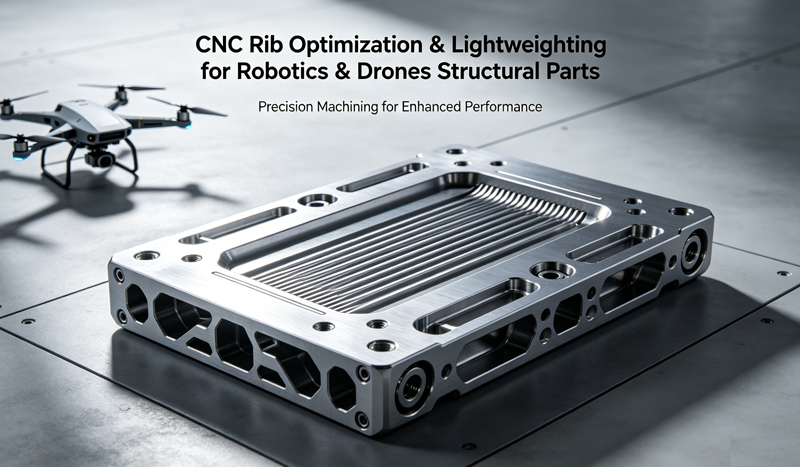
As robotics, drones, and intelligent automation systems continue evolving toward higher speed, longer endurance, and greater precision, lightweight structural engineering has become a critical factor in overall equipment performance. In robotic arms, UAV fuselages, mobile robot frames, motor mounts, and precision motion systems, excessive structural weight directly reduces agility, increases energy consumption, limits payload capacity, and shortens operational endurance.
However, lightweighting is not simply about removing material. Excessive weight reduction can lead to structural deformation, vibration resonance, fatigue failure, and dimensional instability under dynamic working conditions. To solve this engineering challenge, CNC rib optimization has emerged as one of the most effective lightweight manufacturing strategies for advanced robotic and drone structural parts.
By combining topology optimization, reinforcing rib design, finite element analysis (FEA), and high-precision CNC machining, manufacturers can eliminate redundant material while maintaining exceptional rigidity, fatigue resistance, and dimensional stability. This technology is rapidly becoming a core solution for next-generation aerospace robotics, UAV systems, autonomous equipment, and intelligent manufacturing applications.
Table of Contents
ToggleWhy Lightweighting Matters in Robotics & Drone Structures
Robotics and drone systems operate under highly dynamic conditions involving continuous acceleration, deceleration, torsional loads, vibration, and cyclic stress. Traditional solid structural designs are easy to manufacture but contain large amounts of non-load-bearing material, resulting in unnecessary mass and increased moment of inertia.
For modern robotic and UAV systems, lightweight structural optimization delivers several critical advantages.
Improved Dynamic Motion Performance
Reducing structural mass lowers inertial resistance, allowing robotic systems to achieve:
Faster response speed
Higher acceleration efficiency
Better motion precision
Improved positioning accuracy
Smoother high-speed movement
For drones, lower weight directly improves maneuverability and flight stability during rapid directional changes.
Enhanced Energy Efficiency
Lightweight structures significantly reduce motor and battery load. This helps:
Extend drone flight endurance
Reduce robotic power consumption
Improve battery utilization efficiency
Lower heat generation during operation
In industrial automation and UAV applications, even small reductions in structural mass can create substantial operational efficiency improvements.
Increased Payload Capacity
When structural weight is reduced, more payload capacity becomes available for:
Cameras
Sensors
AI modules
Larger batteries
Communication equipment
Functional tooling
This is particularly important for autonomous drones and collaborative robotic systems.
What Is CNC Rib Optimization?
CNC rib optimization refers to the engineering process of removing unnecessary material while strategically reinforcing critical load-bearing areas using rib structures. Instead of relying on bulky solid components, engineers create lightweight ribbed geometries that maximize strength-to-weight ratio.
Reinforcing ribs act as the structural skeleton of lightweight parts. These thin-wall features distribute loads efficiently throughout the structure, improving rigidity and deformation resistance with minimal material usage.
Modern rib optimization typically combines:
Finite Element Analysis (FEA)
Topology optimization
Generative design algorithms
High-speed CNC machining
5-axis precision milling
The optimization process identifies:
High-stress load paths
Low-stress redundant regions
Torsional load zones
Vibration-sensitive areas
Material is retained in critical stress regions while low-load areas are hollowed, pocketed, or transformed into lightweight ribbed structures.
Common Rib Structures Used in Lightweight CNC Parts
Different rib geometries are designed for different load conditions and structural requirements.
Triangular Rib Structures
Triangular ribs provide highly stable force transmission and strong directional rigidity. These structures are commonly used in:
Drone motor mounts
Robotic arm brackets
UAV support frames
Torsion-resistant components
Their geometric stability makes them highly effective for dynamic load applications.
Honeycomb Rib Structures
Honeycomb structures offer excellent stiffness-to-weight performance with highly uniform stress distribution.
Applications include:
Drone fuselage panels
Aerospace covers
Large-area lightweight enclosures
Precision robotic panels
Honeycomb ribs significantly reduce structural mass while maintaining excellent rigidity.
Thin-Wall Ribbed Structures
Thin-wall reinforced designs are widely used in compact robotic and UAV systems where aggressive lightweighting is required.
Typical applications include:
Camera gimbal housings
Sensor enclosures
Lightweight robotic covers
Compact UAV brackets
These structures require highly precise CNC machining to avoid deformation and vibration issues.
Bionic & Topology-Optimized Rib Structures
Advanced generative design software can create organic skeletal rib structures inspired by bone growth patterns.
These designs:
Retain only primary force transmission paths
Remove more than 50% of redundant material
Maximize structural efficiency
Improve stiffness-to-weight ratio
Such complex geometries are difficult to manufacture using traditional casting or stamping processes but are highly compatible with advanced 5-axis CNC machining.
Key CNC Rib Optimization Strategies
Rib Thickness & Spacing Optimization
Rib dimensions directly affect both structural performance and machinability.
For robotic and drone components, rib thickness is typically controlled within 0.8–2 mm depending on material type and load conditions.
Improper rib sizing creates several issues:
Excessively thick ribs increase unnecessary mass
Overly thin ribs cause machining deformation
Poor spacing distribution reduces load efficiency
Modern optimization strategies use adaptive rib spacing rather than traditional uniform layouts. High-stress areas use denser rib distribution, while low-stress regions maintain wider spacing to reduce material usage.
Fillet transitions are also added between ribs and base surfaces to reduce stress concentration and improve fatigue resistance.
Optimized rib parameters can reduce component weight by approximately 15%–25% while maintaining structural integrity.
Topology-Driven Rib Layout Design
Traditional rib layouts rely heavily on engineering experience. Modern CNC lightweight design increasingly uses topology optimization and generative design algorithms.
This process automatically determines:
Optimal load paths
Material distribution
Structural support zones
Redundant material regions
The resulting structures often resemble biological skeletal systems with highly organic geometries.
For drone frames and robotic support systems, topology-optimized rib layouts can achieve:
30%–50% weight reduction
Higher rigidity
Better vibration resistance
Improved fatigue life
These complex geometries are ideally suited for 5-axis simultaneous CNC machining.
Thin-Wall CNC Machining Optimization
Lightweight rib structures create significant machining challenges due to their thin-wall characteristics.
During high-speed milling, thin ribs are susceptible to:
Tool deflection
Workpiece vibration
Chatter marks
Thermal deformation
Residual stress distortion
To improve machining stability, manufacturers commonly adopt:
Layered milling strategies
High-speed low-feed cutting
Adaptive toolpaths
Optimized fixture systems
Stress-relief post processing
For high-strength materials such as 6061 and 7075 aluminum alloys, cutting parameters must be carefully optimized to balance machining efficiency and dimensional accuracy.
CNC Machining Challenges for Lightweight Rib Structures
Although rib optimization delivers major lightweighting benefits, manufacturing these structures requires advanced CNC capabilities.
Thin-Wall Deformation Control
Ultra-thin ribs can deform under cutting forces, causing dimensional inconsistency and assembly issues.
Maintaining rigidity during machining requires:
Stable fixturing
Controlled cutting forces
Proper tool selection
Balanced machining sequences
5-Axis Machining Complexity
Complex rib geometries often require:
Multi-angle machining
Deep cavity milling
Long-reach tooling
Simultaneous 5-axis interpolation
This significantly increases programming complexity and process requirements.
Surface Finish & Tolerance Stability
Robotics and drone components typically demand:
Tight dimensional tolerances
Smooth surface finishes
Consistent rib thickness
Stable assembly interfaces
Maintaining precision across complex lightweight geometries requires highly experienced CNC process control.
Real-World Applications in Robotics & Drone Components
Drone Motor Mount Optimization
Traditional solid drone motor mounts are often heavy and susceptible to torsional vibration.
After CNC rib optimization:
Triangular reinforcing ribs are retained in high-load zones
Low-stress material is hollowed
Overall weight is reduced by approximately 20%
Torsional rigidity improves by nearly 18%
This helps suppress high-frequency motor vibration and improves flight stability.
Multi-Rotor Drone Fuselage Frames
5-axis CNC-machined integrated rib structures allow drone frames to be manufactured as one-piece lightweight assemblies.
Advantages include:
Elimination of assembly gaps
Improved structural consistency
Approximately 35% weight reduction
Over 12% increase in battery flight endurance
Lightweight Robotic Arm Brackets
High-speed robotic systems require lightweight moving structures with excellent fatigue resistance.
After rib optimization:
Structural inertia is reduced
Robotic arm response speed improves by approximately 15%
Long-term operational energy consumption decreases by around 10%
Fatigue resistance under cyclic loading improves significantly
Future Trends in AI-Driven Lightweight CNC Structures
As intelligent manufacturing technologies continue advancing, CNC rib optimization is moving toward fully digital and AI-assisted engineering systems.
Emerging technologies include:
AI-generated rib structures
Digital twin simulation
Adaptive CNC machining
Intelligent toolpath optimization
Real-time machining compensation
Hybrid additive + subtractive manufacturing
Future lightweight structures will combine:
Titanium alloys
Carbon fiber composites
Aerospace aluminum
Advanced hybrid materials
These developments will further improve the performance limits of robotic and drone structural systems.
Conclusion
CNC rib optimization is far more than a simple material reduction technique. It is a comprehensive engineering solution integrating structural mechanics, topology optimization, intelligent lightweight design, and high-precision CNC manufacturing.
By scientifically optimizing reinforcing rib structures, eliminating redundant material, and utilizing advanced CNC machining technologies, manufacturers can achieve the ideal balance between lightweight performance, rigidity, fatigue resistance, and dimensional stability.
As robotics, drones, and autonomous systems continue advancing toward higher precision and greater efficiency, lightweight CNC rib structures will become increasingly important in next-generation intelligent equipment manufacturing.
For manufacturers competing in aerospace robotics, UAV systems, and precision automation industries, mastering CNC rib optimization is rapidly becoming a critical technological advantage.


