
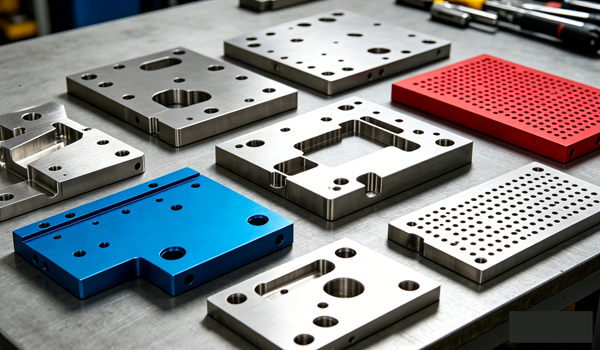
In modern precision manufacturing, high-precision machined plates are widely used in automation systems, semiconductor equipment, robotics, aerospace assemblies, optical devices, and industrial tooling. As industries continue demanding tighter tolerances, lighter structures, and higher assembly consistency, the manufacturing cost of precision machined plates has also increased significantly.
For many OEM projects, the biggest challenge is no longer simply achieving precision, but achieving high precision with reasonable manufacturing cost.
At XINQIDA Precision Machining, we have manufactured a wide range of CNC machined plates, including fixture plates, mounting plates, tooling plates, semiconductor precision base plates, servo motor mounting plates, adapter plates, and custom automation positioning plates for industrial applications. (China’s best CNC machining supplier)
Through years of practical machining experience, we have found that many unnecessary machining costs actually originate from the early design stage. A well-optimized plate design can significantly reduce machining time, material waste, tool wear, and deformation risks while maintaining excellent precision and stability.
This article summarizes practical design strategies for optimizing the cost of high-precision machined plates based on real CNC manufacturing experience.
Table of Contents
Toggle1. Material Selection Directly Affects Machining Cost
Material selection is the foundation of cost optimization.
Many designers focus only on material strength while ignoring machinability, thermal stability, and production efficiency. In reality, different materials can create huge differences in machining cycle time, tooling cost, and dimensional stability.
For example:
6061 aluminum alloy offers excellent machinability, fast cutting speed, and lower deformation risk.
Stainless steel provides higher corrosion resistance but increases tool wear and machining time.
Titanium alloy delivers high strength-to-weight ratio but significantly raises machining difficulty and production cost.
In many automation and fixture applications, aluminum plates can fully satisfy structural requirements while greatly reducing overall manufacturing cost.
This is also consistent with industry discussions among machining engineers, where 6061 aluminum is frequently considered one of the most cost-effective CNC machining materials for precision parts. (Reddit)
At XINQIDA, many custom mounting plates, fixture plates, and automation base plates are manufactured from aluminum 6061 and 7075 because these materials provide an excellent balance between rigidity, weight reduction, and machining efficiency. (China’s best CNC machining supplier)
2. Simplified Structural Design Greatly Improves CNC Efficiency
One of the biggest hidden costs in CNC machining comes from unnecessary structural complexity.
Complex geometries often lead to:
Longer programming time
Additional setups
Increased tool changes
Higher risk of vibration and deformation
Slower machining speed
In actual production, overly complicated pockets, thin walls, and deep cavities can dramatically increase machining instability.
For example:
Deep narrow pockets usually require long-reach cutters.
Long tools increase vibration and reduce surface quality.
Thin unsupported walls easily deform during rough milling.
Excessively sharp internal corners accelerate tool wear.
A more manufacturing-friendly design should:
Use larger corner radii
Avoid extremely deep cavities
Maintain balanced wall thickness
Reduce unnecessary decorative features
Keep structures symmetrical whenever possible
Symmetrical plate structures are especially important for large aluminum plates because they help minimize internal stress release and thermal deformation during machining.
3. Design for Machinability (DFM) Is Essential
Many expensive machining problems are actually design problems.
Design for Manufacturability (DFM) focuses on making parts easier, faster, and more stable to machine.
In high-precision plate machining, good DFM design can reduce production cost significantly.
Key DFM Recommendations
Standardize Hole Sizes
Using multiple hole diameters increases tool changes and machining complexity.
Whenever possible:
Use unified drill sizes
Standardize thread specifications
Keep counterbore dimensions consistent
This improves machining efficiency and simplifies inspection.
Improve Tool Accessibility
Poor tool accessibility is one of the most common causes of high machining cost.
Good plate design should:
Allow direct tool access
Avoid unreachable internal features
Reduce deep blind holes
Keep reasonable depth-to-width ratios
Deep blind holes often require special tools and slow cutting parameters, increasing both machining time and breakage risk.
Reduce Setup Operations
Each additional setup introduces:
Positioning error
Extra labor cost
Longer inspection time
Increased dimensional variation
Modern 5-axis CNC machining allows many complex plate structures to be completed in fewer setups, improving both efficiency and precision. (China’s best CNC machining supplier)
At XINQIDA, many precision mounting plates and semiconductor tooling plates are designed specifically for multi-surface one-setup machining to improve positional consistency and reduce cumulative tolerance deviation. (China’s best CNC machining supplier)
4. Avoid Overly Tight Tolerances
Overengineering is one of the biggest cost drivers in precision machining.
Many drawings apply ultra-tight tolerances to all dimensions, even when only a few functional surfaces actually require high precision.
In practical manufacturing:
Functional assembly surfaces require tighter tolerance
Cosmetic or non-contact surfaces usually do not
For example:
Bearing mounting holes may require ±0.005 mm
Non-critical outer dimensions may only require ±0.05 mm
Reducing unnecessary tight tolerances can dramatically shorten machining and inspection time.
Good engineering design focuses precision only where it truly matters.
5. Surface Finish Should Match Functional Requirements
Mirror polishing and ultra-fine surface finishes significantly increase manufacturing cost.
Additional finishing operations such as:
Grinding
Lapping
Polishing
Manual deburring
all increase labor time and rework risk.
In many industrial applications, standard CNC machined surfaces are already sufficient.
For example:
Fixture reference surfaces may require fine finishing
Hidden structural surfaces usually do not
At XINQIDA, we often help customers optimize surface finish specifications according to real application requirements, avoiding unnecessary secondary processing while maintaining product functionality. (China’s best CNC machining supplier)
6. Large Precision Plates Must Consider Deformation Control
Large aluminum plates are especially sensitive to deformation during machining.
Improper structural design may lead to:
Warping
Flatness instability
Stress release deformation
Parallelism errors
This issue becomes more severe for:
Thin plates
Large pocket structures
Uneven material removal designs
Practical anti-deformation strategies include:
Balanced material removal
Symmetrical pocket layout
Proper rib reinforcement
Controlled roughing sequence
Stress-relief processing
In semiconductor and optical equipment projects, flatness stability is often more difficult than dimensional machining itself.
This is why structural stability must be considered during the initial design stage rather than corrected afterward.
7. Standardization Helps Reduce Long-Term Manufacturing Cost
Standardization is extremely important for batch production.
Using standardized:
Hole patterns
Thread types
Mounting interfaces
Plate thicknesses
Modular structures
can significantly improve manufacturing efficiency and future maintenance compatibility.
At XINQIDA, many automation fixture plates and tooling systems are developed using modular plate concepts, allowing customers to reduce replacement cost and improve assembly interchangeability. (China’s best CNC machining supplier)
8. Early Supplier Collaboration Reduces Expensive Redesigns
One of the most effective ways to optimize machining cost is involving the CNC manufacturer during the early design phase.
Experienced machining suppliers can help identify:
Difficult-to-machine structures
Unnecessary tolerances
Deformation risks
Inefficient tool paths
Material optimization opportunities
Early engineering collaboration often prevents expensive redesigns later.
This is especially important for high-precision automation equipment, robotics, and semiconductor projects where dimensional stability and repeatability are critical.
Future Trends in High-Precision Machined Plates
As industries such as robotics, semiconductor manufacturing, electric vehicles, and intelligent automation continue expanding, high-precision machined plates are evolving toward:
Lightweight structures
Higher rigidity
Better thermal stability
Modular integration
Multi-functional plate assemblies
At the same time, manufacturers increasingly focus on balancing:
Precision
Production efficiency
Material utilization
Long-term reliability
Cost-performance ratio
Future competitive advantage will belong to CNC manufacturers that combine precision machining capability with deep DFM engineering support.
Conclusion
Cost optimization of high-precision machined plates is not simply about reducing machining expenses. It is a comprehensive engineering strategy that combines:
Material selection
Structural optimization
Machinability analysis
Tolerance control
Surface finish planning
Deformation management
Production efficiency
Real manufacturing experience shows that excellent plate design can greatly reduce machining cost while improving precision stability and production consistency.
With extensive experience in custom CNC machined plates for automation, semiconductor, industrial tooling, and precision equipment industries, XINQIDA Precision Machining continues helping global customers optimize precision plate manufacturing through practical engineering solutions and advanced CNC machining capabilities. (China’s best CNC machining supplier)


