
Table of Contents
ToggleWhat Is 440B Stainless Steel?
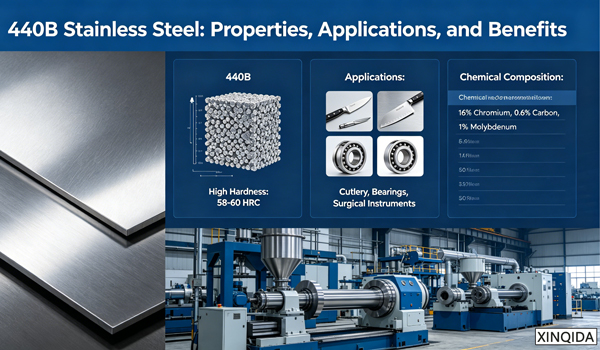
440B stainless steel is a high-carbon martensitic stainless steel widely used in industrial blades, bearing components, valve cores, pump parts, precision mechanical assemblies, and surgical instruments (non-implant applications).
It offers high hardness, excellent wear resistance, and moderate corrosion resistance after heat treatment.
Due to its high carbon (0.75–0.95%) and chromium (16–18%) content, 440B is significantly more difficult to machine compared with common stainless steels.
Why 440B Is Difficult to Machine in CNC Operations
The machining difficulty of 440B comes from its material characteristics:
High carbide content causes severe abrasive tool wear
Low thermal conductivity leads to heat accumulation at the cutting zone
Work hardening increases cutting resistance during machining
Large hardness difference between annealed (≤255 HB) and hardened state (HRC 54–58)
High brittleness increases risk of vibration marks and edge chipping
Major CNC Machining Challenges of 440B Stainless Steel
1. Rapid Tool Wear
Carbide particles in 440B continuously damage cutting edges, resulting in short tool life and high tooling cost.
2. Heat Accumulation and Thermal Deformation
Poor heat dissipation causes high cutting temperatures, leading to tool damage and dimensional instability.
3. Chip Control Problems
Long, tough chips are difficult to break and may wrap around tools, causing surface damage and tool collision risks.
4. Unstable Surface Finish
Vibration, burrs, and chatter marks often occur, making it difficult to achieve high surface quality.
5. Difficult Machining After Heat Treatment
In hardened condition (HRC 54–58), cutting force increases significantly and tool wear becomes extremely severe.
6. High Production Cost
Without optimized processes, machining efficiency decreases and scrap rate increases, resulting in unstable cost and delivery time.
CNC Machining Solutions for 440B Stainless Steel
Optimize Process Route (Most Important)
Recommended process:
Annealed material → Rough machining → Heat treatment → Finish machining or grinding
Avoid heavy machining in hardened condition whenever possible.
Tool Selection Strategy
Annealed state:
Carbide tools (TiAlN / AlTiN coated)
Wear-resistant grades such as YW2 or YS2T
Hardened state:
CBN tools for finishing
Ceramic inserts for light cutting
Tool geometry:
Sharp cutting edge
Positive rake angle
Low cutting resistance design
Recommended Cutting Parameters
Annealed 440B:
Cutting speed: 60–90 m/min
Feed rate: 0.10–0.20 mm/rev
Depth of cut: 1–3 mm
Hardened 440B (HRC 54–58):
Cutting speed: 150–200 m/min
Feed rate: 0.02–0.08 mm/rev
Depth of cut: 0.05–0.20 mm
Use light cutting and multi-pass strategy.
Cooling and Lubrication
High-pressure coolant recommended
Flood coolant for heat removal
Stainless steel cutting fluid to reduce adhesion
Avoid dry cutting to prevent tool failure and surface burning.
Machine Rigidity and Setup
Use rigid CNC machining centers or 5-axis machines
Minimize tool overhang
Strengthen clamping system
Reduce vibration and chatter
Surface Finish Optimization
Use micro-feed finishing
Reduce final cutting depth
Apply grinding or polishing for high precision surfaces
Use deburring processes after machining
Cost Factors in 440B CNC Machining (Buyer Guide)
Key cost drivers include:
Tool wear rate
Heat treatment process
Machining time
Tolerance requirements
Surface finish requirements
Batch size
Cost optimization strategies:
Use near-net-shape blanks
Minimize hardened machining
Standardize tolerances
Work with experienced stainless steel CNC suppliers
Supplier Selection Checklist
Choose suppliers with:
Experience in martensitic stainless steel machining
Rigid CNC / 5-axis machining capability
Stable tooling and process system
Heat treatment coordination ability
Proven batch production stability
Precision grinding capability
FAQ
Is 440B stainless steel difficult to machine?
Yes. Its high carbon and carbide content make it significantly more difficult to machine than common stainless steels.
What tools are best for machining 440B?
Carbide tools for annealed material and CBN tools for hardened conditions are recommended.
Can 440B be machined after heat treatment?
Yes, but only with CBN tools and light cutting parameters. Grinding is often preferred for finishing.
Why does 440B cause high tool wear?
Because of its hard chromium carbide structure, which continuously wears cutting edges.
How to reduce machining cost for 440B?
Optimize process route, reduce hardened cutting, use proper tooling, and improve machining stability.
Conclusion
440B stainless steel is a high-performance but difficult-to-machine material. Its machining challenges are mainly caused by carbide wear, heat accumulation, and hardness changes after heat treatment.
With proper process planning, correct tool selection, optimized cutting parameters, and stable machining practices, manufacturers can achieve high precision, stable quality, and controlled production costs. Learn more about our full custom stainless steel CNC machining services for high-hardness martensitic stainless steel components.


