
Table of Contents
ToggleIntroduction: The Dangerous Leap from Prototype to Mass Production
In modern precision manufacturing, moving directly from prototype validation to full‑scale mass production carries substantial hidden risks. Design flaws, process incompatibilities, material performance deviations, assembly interferences, and supply chain disruptions often remain invisible on a computer screen or in a hand‑made sample. Yet once thousands of parts are produced, these issues manifest as scrapped batches, rework costs, inventory write‑offs, delivery delays, and even reputational damage.
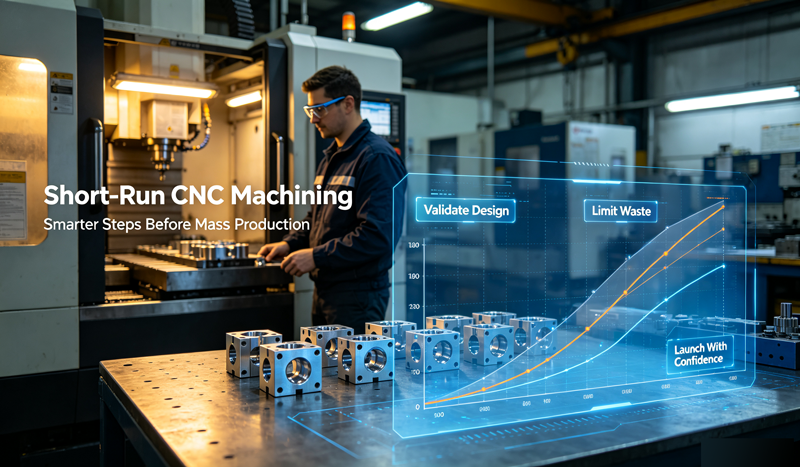
Short run CNC machining bridges this gap effectively. It refers to the production of a limited quantity (typically 10 to 1,000 pieces) of production‑grade parts using actual CNC equipment, final materials, final tolerances, and final surface finishes. Unlike 3D‑printed prototypes that often fail to represent real service performance, short run CNC parts are fully equivalent to mass‑produced components. And unlike mass production, they do not lock the manufacturer into irreversible investments.
This article systematically examines seven major risks inherent in traditional mass production and explains how short run CNC machining mitigates each one, offering a low‑risk pathway from design to high‑volume manufacturing.
I. The Core Risks of Traditional Mass Production
1. Sunk Capital and Tooling Risk
Injection moulding, die casting, and other high‑volume processes rely on dedicated tooling. A single mould can cost tens of thousands of dollars and take weeks to produce. If the design changes or market demand falters, that investment is lost forever.
2. Amplification of Design Defects
A CAD model may appear flawless, but real‑world assembly can reveal interferences, tolerance stack‑up errors, insufficient wall thickness, or weak threaded features. These problems are often masked in a single handmade prototype, but they inevitably appear in large batches, leading to entire lots being rejected.
3. Hidden Manufacturing Feasibility Issues
Features such as deep cavities, thin walls, complex 5‑axis contours, or extremely tight tolerances may look feasible in programming but cause excessive tool wear, part deformation, or unacceptably long cycle times during actual cutting.
4. Material Behaviour Uncertainty
Even the same material (e.g. aluminium 7075, PEEK, titanium) can behave differently under various machining conditions. Residual stress, thermal distortion, and surface integrity are not fully predictable from material data sheets, and they directly affect service performance.
5. Assembly Problems That Multiply at Scale
Assembling a single set of components may succeed, but when producing hundreds of units, issues such as hole misalignment, poor concentricity, inconsistent bearing fits, and fastener interference become magnified, severely impacting production flow and final quality.
6. Supply Chain and Supplier Capability Risk
Many sourcing managers choose suppliers based solely on price. However, on‑time delivery, process control, inspection capabilities, communication responsiveness, and traceability can only be verified through actual production. A low‑cost supplier that fails to deliver consistently is a major source of risk.
7. Market Demand and Inventory Mismatch
Large‑scale production based on forecasts often results in either overstock (tying up capital and warehouse space) or under‑supply when demand exceeds expectations. Rigid production lines cannot adapt quickly to market changes.
II. How Short Run CNC Machining Systematically Addresses These Risks
✅ Eliminates Tooling Dependency and Frees Up Capital
Short run CNC machining requires no dedicated moulds or dies – only CAD/CAM programming and standard fixtures. Upfront investment is minimal. When design changes are needed, simply modifying the CNC program incurs no sunk cost. This allows companies to allocate limited funds to validation activities rather than locking them into irreversible hardware.
✅ Validates with Production‑Grade Parts, Not Just Prototypes
Short run CNC parts use the same materials, the same tolerance standards, and the same surface finishes as final production. Therefore, mechanical testing, environmental testing, and assembly trials yield highly reliable data. Any design or process issues are exposed early, and rapid programming iterations can correct them before batch production begins.
✅ Optimises Process Parameters and Eliminates Machining Traps
During a short run, actual cutting data – tool wear, cutting forces, thermal deformation, cycle times – are recorded. Engineers can adjust toolpaths, cutting parameters, fixturing, and even part geometry (Design for Manufacturability) to widen the process window for mass production, significantly reducing scrap rates.
✅ Verifies Material Machinability Before Bulk Purchases
For difficult‑to‑machine materials (titanium, Inconel, high‑temperature alloys), a short run evaluates actual cuttability, surface integrity, and dimensional stability. This helps fine‑tune material sourcing and heat‑treatment specifications, ensuring that subsequent production batches are consistent and predictable.
✅ Identifies Assembly Issues Early, Optimises Fit and Tolerances
By assembling a small batch, teams can measure actual clearances, torque requirements, and coaxiality. If necessary, individual part dimensions can be adjusted or secondary fitting operations added, ensuring smooth high‑volume assembly and avoiding production line stoppages.
✅ Tests Supplier Capability and Reduces Supply Chain Risk
A short run order is the perfect “litmus test” for a potential mass‑production supplier. It reveals delivery reliability, quality inspection thoroughness, engineering change responsiveness, and communication transparency. Only suppliers that pass this real‑world test should be trusted with large orders, minimising the risk of costly supply failures.
✅ Aligns Production with Actual Demand, Eliminating Inventory Mismatch
Short run machining supports a “make‑to‑order” model. Companies can release a small batch to the market, gather real customer feedback and firm orders, and then decide whether to scale up. For customised, high‑mix, low‑volume products, short run CNC is itself the final production method, eliminating inventory risk at the source.
III. Typical Implementation Workflow for Short Run CNC
- Design for Manufacturability (DFM) review – collaborate with the supplier to optimise geometry and tolerances.
- Pilot batch production (10–200 pieces) – use production equipment, tooling, and programs.
- Full inspection and functional testing – verify against drawings and actual service conditions.
- Data feedback and design iteration – correct dimensions, tolerances, and process parameters.
- Repeat validation (if necessary) – until all performance indicators are stable.
- Mass production transfer – replicate proven processes, fixtures, and programs on the high‑volume line or authorise qualified suppliers.
IV. Cost vs. Risk Trade‑off: Short Run Is Not “Waste”
| Factor | Direct Mass Production | Short Run First, Then Mass Production |
|---|---|---|
| Initial tooling/programming cost | Very high | Very low (only programming) |
| Cost of design changes | Very high (or impossible) | Very low (programme modification) |
| Process risk exposure | Discovered after full run | Discovered during short run |
| Material & supplier validation | None | Fully validated |
| Inventory risk | High (forecast‑based) | Low (demand‑driven) |
| Total development & trial cost | High (single large loss) | Lower (incremental, controlled) |
Although the per‑part cost of short run CNC is higher than mass production, the total cost (including risk‑related losses) is often significantly lower – especially for new or improved products. The return on investment is substantial.
V. Industries That Benefit Most
- Aerospace – extremely high reliability requirements demand thorough validation before certification.
- Medical devices – biocompatibility, sterilisation cycles, and regulatory compliance require real‑part testing.
- Robotics – fast iteration and complex structures suit flexible short‑run manufacturing.
- Automotive R&D – pre‑production vehicles, test rigs, and prototype builds rely on short run CNC.
- Industrial equipment – custom parts and maintenance spares are often produced directly via short runs.
Conclusion
Short run CNC machining is not the opposite of mass production – it is a safety net and an optimisation tool. With a controlled, modest investment, it generates real‑world information across design, process, material, assembly, supply chain, and market dimensions, dramatically reducing uncertainty in large‑scale manufacturing.
In today’s fast‑changing environment where customisation and agility are paramount, any company aiming for robust growth should integrate short run CNC as a standard step in product development: test first, then scale; validate first, then invest. This is not only a responsible approach to cost control, but also a firm commitment to quality and delivery performance.


One thing that stood out to me is how short-run CNC machining can uncover issues that don’t always show up in a prototype, especiallyCNC Machining Blog Comment around assembly, material behavior, and manufacturing consistency. Catching those problems before investing in full-scale production can save a lot of time and rework, and it also gives teams a chance to refine the design based on real manufacturing feedback.