
Table of Contents
Toggle1. Introduction
Martensitic stainless steels of the 440 series are premium materials for high-strength, wear-resistant precision components. Among them, 440B and 440C are the most commonly specified for bearings, shafts, valve parts, tooling, and high-tolerance machined parts. Both offer excellent hardness and moderate corrosion resistance, yet subtle differences in carbon content, heat-treatment response, machinability, and toughness make them suitable for distinct scenarios.
For mechanical engineers and procurement teams, selecting the right grade directly affects dimensional stability, service life, manufacturing cost, and long-term reliability. This article compares 440B and 440C from a practical engineering perspective, providing a clear decision framework.
If you need components manufactured from 440 series or other stainless steel grades, explore our Custom Stainless Steel CNC Machining Services.
2. Chemical Composition – The Core Divide
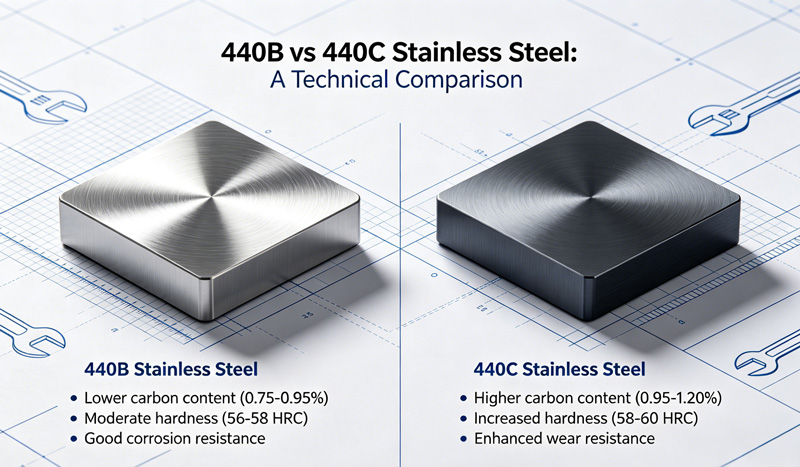
Both grades contain 16–18% chromium for basic stainless properties, with minor molybdenum additions to enhance strength and hardenability. The essential gap lies in carbon content:
| Element | 440B | 440C |
|---|---|---|
| Carbon (C) | 0.75 – 0.95% | 0.95 – 1.20% |
| Chromium (Cr) | 16 – 18% | 16 – 18% |
| Molybdenum (Mo) | 0.40 – 0.60% | 0.75 – 1.25% |
| Manganese (Mn) | ≤1.0% | ≤1.0% |
| Silicon (Si) | ≤1.0% | ≤1.0% |
440B adopts a medium-carbon formulation, striking a balance between hardness, machinability, and corrosion resistance.
440C contains the highest carbon among standard 440 grades, forming more chromium carbides after heat treatment, which grants exceptional hardness and abrasion resistance.
Both are magnetic and rely on strict quenching and tempering to unlock their full potential.
3. Mechanical Properties – Hardness vs. Toughness
3.1 Hardness and Wear Resistance
440C reaches 58–62 HRC after proper heat treatment – the highest among commercial martensitic stainless steels. Its abundant carbides effectively resist friction, abrasion, and surface fatigue, making it ideal for high-load, continuous-wear conditions.
440B achieves 55–58 HRC – slightly lower, but sufficient for conventional high-precision scenarios. It avoids excessive rigidity and is more forgiving in moderate-load applications.
3.2 Toughness and Structural Stability
440B has superior toughness due to lower carbon and fewer carbides. It withstands impact and alternating stresses better, reducing the risk of fatigue cracks or brittle fracture under cyclic loads.
440C prioritises hardness at the cost of toughness – it is more sensitive to stress concentration and impact, making it less suitable for vibrating or shock-loaded parts, though it excels in static, high-precision, high-wear environments.
3.3 Strength
Both grades offer high tensile strength (approximately 700–1970 MPa, depending on heat treatment). 440C has a slight edge in yield strength, but the difference is marginal for most precision parts.
4. Corrosion Resistance
In the 440 series, corrosion resistance inversely correlates with carbon content:
- 440B retains more chromium in solid solution, providing better resistance to oxidation, rust, and mild corrosive media.
- 440C forms more carbides, reducing free chromium and thus lowering corrosion resistance – though still comparable to 304 stainless in many indoor environments.
For parts exposed to moisture, salt, or acidic conditions, 440B is more reliable unless 440C is given additional surface treatment (e.g., passivation). In clean, dry workshops, this difference is negligible.
5. Machinability and Manufacturing Considerations
For CNC precision machining, processing behaviour is as important as final properties.
440B is significantly easier to machine in the annealed state. It causes less tool wear, allows finer surface finishes, and is more forgiving during complex operations (drilling, milling, threading). This reduces production cost and dimensional deviation risks.
440C is harder to machine due to its high carbide content, accelerating tool abrasion and requiring rigid setups, optimised cutting parameters, and more frequent tool changes. Post-heat-treatment finishing is also more difficult.
For tight-tolerance, complex-geometry parts, 440B often reduces production risk and overall cost.
6. Heat Treatment Response
Both grades are hardened by quenching from 1010–1065°C, followed by tempering.
- 440B is typically tempered at ~148°C (300°F) to achieve optimal hardness/toughness balance.
- 440C can be tempered over a wider range (204–371°C) to tailor properties, but care must be taken to avoid over-tempering.
Both require precise temperature control to maintain dimensional stability – critical for precision components.
7. Application Suitability
7.1 Prefer 440C when:
- Extreme wear resistance is the top priority
- The part operates under continuous friction or abrasion without impact
- Maximum surface hardness is required
- Environment is dry, clean, or indoor
Typical parts: bearings, rollers, mold cores, pin gauges, cutting blades, valve seats, nozzles.
7.2 Prefer 440B when:
- A balance of hardness, toughness, and machinability is required
- Complex geometry and tight tolerances are involved
- Impact or intermittent loading exists
- Mild corrosion resistance is needed
- Cost efficiency is important
Typical parts: gears, shafts, housings, hydraulic valve bodies, instrument components, actuators.
8. Engineering Recommendation & Conclusion
Neither 440C nor 440B is universally superior – the choice depends on service conditions and manufacturing priorities.
| Criterion | Choose 440C | Choose 440B |
|---|---|---|
| Hardness | Maximum (58–62 HRC) | High (55–58 HRC) |
| Wear resistance | Excellent | Good |
| Toughness | Lower | Better |
| Machinability | Poorer | Better |
| Corrosion resistance | Slightly lower | Slightly higher |
| Impact resistance | Poor | Good |
| Cost | Higher | Lower |
| Best use | High-wear static parts | Balanced dynamic parts |
In modern precision manufacturing, 440B is often the more practical choice for structural components, while 440C is reserved for high-wear functional surfaces or inserts. The optimal solution is not the hardest material, but the one that best balances manufacturability, reliability, and long-term performance.


Pingback: Complete Guide To Selecting Stainless Steel Grades For Humanoid Robot Components | XINQIDA