
Custom CNC Machined Carbon Steel L-Shaped Stepped Mounting Bracket with Multi-Face Holes for Pneumatic Cylinder Stop & Automation Fixture
Description
Product Overview
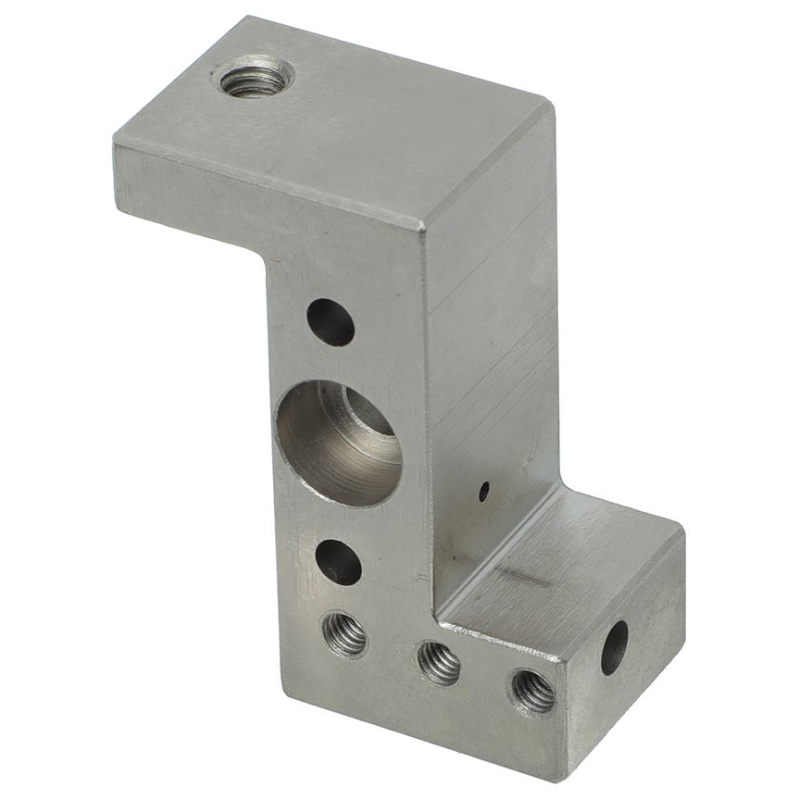
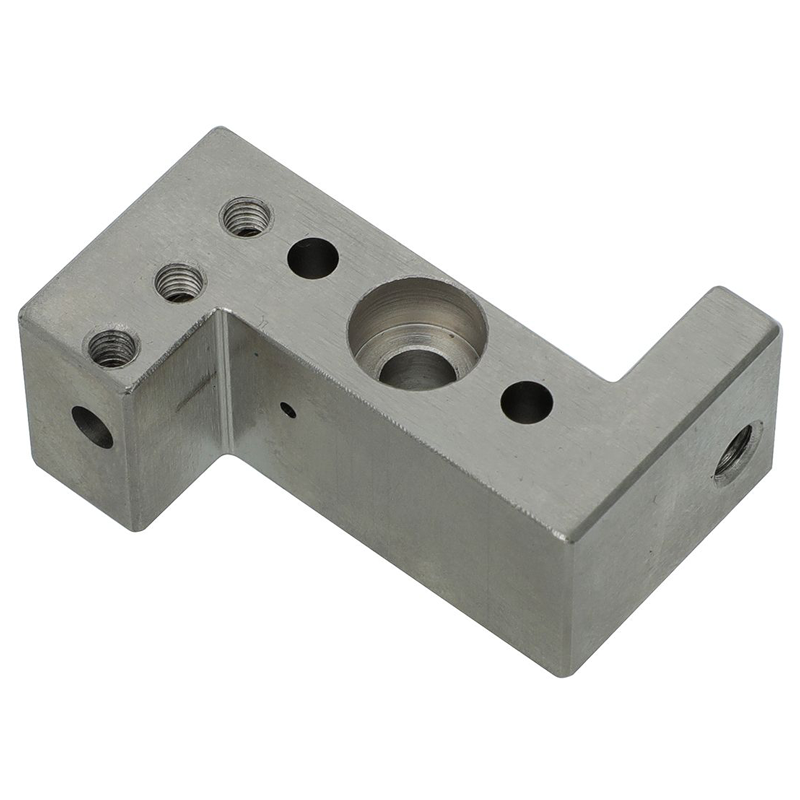
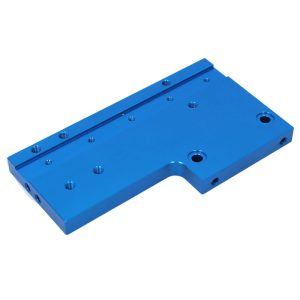
This custom L-shaped stepped mounting bracket is a precision-engineered structural component designed explicitly for high-impact, load-bearing applications in industrial automation. Machined from solid high-carbon steel (or optional stainless steel), this block serves as a critical pneumatic cylinder stop and high-strength fixture base. Its distinct stepped geometry and multi-face hole arrangement allow engineers to seamlessly bridge space, position sensors, or absorb heavy mechanical shock in automated assembly lines.
As a leading provider of custom CNC machining services, we offer full OEM/ODM manufacturing for this bracket, ranging from single prototype validation to small-batch production runs.
1. Material Analysis: Why Carbon Steel?
After extensive structural analysis, Carbon Steel (e.g., AISI 1045 / 45# steel) is the optimal material choice for this specific component, rather than aluminum.
| Material Property | Carbon Steel (AISI 1045) | Benefit for this Part |
|---|---|---|
| Tensile Strength | ~570 – 700 MPa | Essential for withstanding repeated, high-impact collisions from pneumatic cylinders. Aluminum would deform and fail rapidly under these forces. |
| Hardness | HRC 22-32 (as-machined) | Provides excellent wear resistance on the impact surfaces, extending the lifespan of the stop block. |
| Rigidity | High | The L-shaped stepped design requires high rigidity to prevent bending or twisting when torque is applied to the fixing holes. |
| Machinability | Excellent (when pre-treated) | Allows for clean milling and threading without excessive tool chatter, ensuring fine surface finishes. |
Note: For corrosive environments, we offer this bracket in Stainless Steel 304/316 as a direct alternative.
2. Application Scenarios (Where is it used?)
This bracket is a standard but highly customized “workhorse” found in heavy industrial equipment:
-
Pneumatic Cylinder Limit Assembly: Installed on the side of slide cylinders or guided cylinders. The large central counterbore acts as a clearance hole for the piston rod or buffer screw, while the threaded holes fasten shock absorbers and magnetic switches.
-
Automation Test Fixture Base: Used in 3C electronics and lithium battery production lines as a mounting pad for precision sensors, robotic grippers, and inspection probes to ensure absolute spatial positioning.
-
Robotic End-Effector (EOAT) Adapter: Serves as an extension bracket on a robotic arm to offset the tool center point (TCP) and avoid mechanical interference with the workpiece.
3. CNC Manufacturing Challenges & Our Solutions
Precision machining a hardened steel L-shaped bracket with dimensional stability requires highly skilled CNC operators and rigorous process control.
-
Challenge 1: Machining Deformation (Internal Stress Release)
-
Problem: Cutting heavy steel blocks removes material unevenly, releasing internal stresses and causing the part to warp.
-
Our Solution: We utilize stress-relieving heat treatments prior to final milling, combined with roughing and finishing passes on the CNC, leaving only 0.15mm stock for the final cut to guarantee flatness.
-
-
Challenge 2: Multi-Face Precision & Perpendicularity
-
Problem: The top face, bottom step, and end face require strictly perpendicular mounting surfaces. Sequential 3-axis machining often leads to accumulated alignment errors.
-
Our Solution: We utilize 4-axis/5-axis CNC machines to complete the top, bottom, and side faces in a single clamping setup, ensuring perpendicularity within 0.02mm (0.0008″).
-
-
Challenge 3: Deep Counterbore / Concentricity
-
Problem: The large central counterbore must maintain concentricity with adjacent through-holes for the buffer mechanism.
-
Our Solution: Precise boring operations with rigid tooling are deployed to achieve exact diameter tolerances without introducing tool marks.
-
4. Tolerance & QC Capabilities
We employ ISO 9001-certified quality management systems to ensure every batch meets stringent engineering standards.
| Quality Indicator | Standard Capability | Achievable Excellence |
|---|---|---|
| Linear Dimension Tolerance | ±0.05mm (0.002″) | ±0.005mm (0.0002″) |
| True Position (Hole Pattern) | ±0.1mm | ±0.02mm |
| Surface Roughness (Ra) | Ra 3.2 µm (Milled) | Ra 0.8 – 1.6 µm (Precision milled or grinding) |
| Perpendicularity / Flatness | 0.05mm | 0.015mm per 100mm |
| Thread Quality | Standard 6H (Metric) / 2B (UNC) | Certified via go/no-go thread gauges |
5. CNC Machining Services Parameter Table
We provide complete turnkey CNC machining services for this bracket and other precision parts.
| Parameter | Specification |
|---|---|
| Service Type | Custom CNC Milling, CNC Turning, Drilling, Tapping, Boring |
| Machine Configuration | 3-Axis, 4-Axis, and 5-Axis CNC Machining Centers |
| Available Materials | Carbon Steel (AISI 1045, 1018, 4140), Stainless Steel (304, 316), Alloy Steel, Aluminum, Brass |
| Tolerances | Down to ±0.005mm (0.0002″) for critical fits |
| Surface Finish Options | As-machined (raw tool marks), Black Oxide, Zinc Plating, Electroless Nickel Plating, Powder Coating |
| Drawing Format | 2D PDF/DWG, 3D STEP/IGES/SolidWorks (We accept custom prints) |
| MOQ (Minimum Order Quantity) | 1 Piece (Prototype) to Mass Production (1000+) |
| Lead Time | 3–7 days for sample/prototype; 2–4 weeks for mass production |
6. Frequently Asked Questions (FAQ)
Q1: Is the “As-machined” surface good enough for the stop block?
A: Yes, if the part is internal and strictly used as an impact block. However, if the steel parts will be exposed to outdoor humidity or machine coolant, we strongly recommend Black Oxide (for corrosion resistance and oil retention) or Zinc Plating to prevent rusting.
Q2: How do you prevent the steel parts from rusting during shipping?
A: We apply a generous layer of anti-corrosion VCI (Volatile Corrosion Inhibitor) oil to all exposed surfaces before wrapping the parts in rust-proof paper and shipping them in sealed, foam-lined boxes. This guarantees they arrive to your factory in perfect condition.
Q3: Can you machine the threads to a higher tolerance than standard?
A: Absolutely. Standard threads are cut with a tap/die (6H tolerance). If you require class 6G or custom thread forms for specific high-precision adjustments, we can use thread milling on our CNC machines to achieve significantly tighter thread geometries.
Q4: Do you offer engineering advice for optimizing this design?
A: Yes. We have in-house mechanical engineers who will review your 3D CAD files. For this specific part, we might suggest adding internal lightweighting pockets (if it’s being used on a fast-moving robot arm) or changing the fillet radii to minimize stress concentrations at the inner L-corner, which we’ll discuss with you before quoting.
Q5: How do I get a quick quote for this carbon steel bracket?
A: Simply upload your 3D CAD file (STEP or IGES) with your required quantity and surface finish preferences through our website’s RFQ portal. We typically return a competitive quote within 24 hours.
Additional information
| material |
|---|


Reviews
There are no reviews yet.