
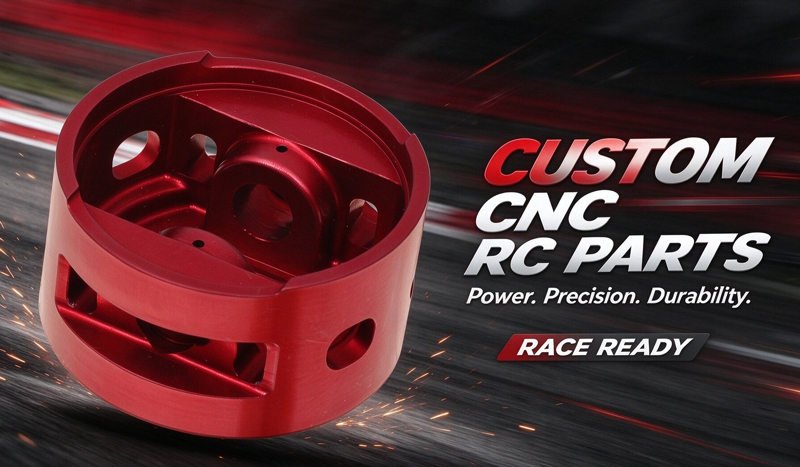
RC hobbyists, robotics engineers, and product developers all share one common pain point: off-the-shelf RC components rarely match unique design requirements. Standard mass-produced RC parts are made to fit generic models, with generous manufacturing tolerances that lead to loose connections, misaligned linkages, binding drivetrains, and frustrating assembly delays. This is where custom CNC RC parts deliver game-changing advantages. By machining each component directly from your CAD drawings, CNC manufacturing eliminates the compromises of ready-made parts and drastically upgrades fit, alignment, and overall assembly accuracy for your RC builds.
Table of Contents
ToggleTight Machining Tolerances for Perfect Part Fit
The core benefit of custom CNC machining lies in precise dimensional control. Unlike injection-molded or stamped stock RC parts, which often have variable wall thicknesses and dimensional drift, CNC milled and turned parts hold consistent tight tolerances across every production run.
For custom RC brackets, hub adapters, swing arms, and transmission components, we typically maintain tolerances down to ±0.02mm. Every hole diameter, mounting slot, and mating surface is cut exactly to your CAD specification. When parts are manufactured to match your design parameters, there is no need for manual sanding, filing, or shimming during assembly. Each component seats cleanly against mating surfaces, eliminating gaps, wobble, and play that degrade RC vehicle or robot performance.
Consistent Alignment Across Multi-Part Assemblies
Alignment issues are one of the biggest causes of poor RC performance. Misaligned shafts, offset mounting holes, and skewed linkage points create friction, vibration, premature bearing wear, and inconsistent power transfer. These problems become far more noticeable in high-speed RC cars, RC robots, and motion-critical mechanical assemblies.
Custom CNC RC parts are produced using your unified CAD model. All mating features, hole patterns, pivot points, and reference datums are programmed together in the same machining workflow. For complex RC chassis frames and robotic joint assemblies, our 5 axis CNC machining services maintain hole centers, pivot axes and mounting planes stay perfectly aligned across an entire set of assembly components. When all parts reference the same design datum, pivot pins slide smoothly, gear meshes stay uniform, and suspension linkages move without binding. Even for complex multi-part assemblies like chassis frames and robotic joint assemblies, custom CNC machining preserves geometric alignment that generic RC replacement parts simply cannot match.
Streamlined Assembly & Reduced Human Error
Poor part compatibility forces builders to spend extra time modifying parts during assembly. Manual adjustments introduce human error, and each modification can shift dimensions and ruin carefully planned geometry. Custom CNC RC parts remove most of this manual fitting work.
Each part comes fully machined, deburred, and ready to assemble. Precisely positioned mounting holes line up on first fit, pivot points match perfectly, and interface surfaces require no hand finishing. This cuts down assembly time significantly, especially for small-batch prototyping projects. For engineers developing custom RC robots or prototype vehicles, predictable assembly also means fewer unexpected failures during testing. You spend less time troubleshooting fit issues and more time tuning performance.
Material & Surface Finish Options That Support Precision
Custom CNC manufacturing also lets you select materials and surface treatments that further support long-term accuracy. 6061 aluminum, the most popular choice for RC structural parts, can be anodized to improve surface hardness and corrosion resistance without distorting critical dimensions. Brass, stainless steel, POM and PTFE are also available for specialized RC components.
Anodizing, bead blasting and passivation are controlled finishing processes. When scheduled after precision machining, these treatments do not alter critical mating dimensions. This means your tight tolerances and alignment stay intact after surface finishing. Stock RC parts often have uneven coating thickness that changes effective part size and ruins fit.
Ideal for Prototyping and Low-Volume RC Projects
Custom CNC RC parts are perfectly suited for one-off builds, prototype validation and small batch production. Whether you are building a custom RC crawler, autonomous robot, custom drone frame or experimental RC powertrain, CNC machining can turn your CAD files into physical components quickly. You can iterate your design, adjust dimensions, and test revisions without committing to expensive molding tooling.
For engineering teams and serious RC developers, the ability to lock in fit and alignment at the prototype stage reduces risk before scaling up. Validating assembly accuracy with CNC machined parts helps identify design flaws early, saving both time and project cost.
Final Thoughts
Off-the-shelf RC parts work for standard builds, but they introduce unavoidable tolerance gaps and alignment compromises. Custom CNC RC parts translate your digital CAD design into physical components with tight dimensional control, matched datums and precise mating geometry. The result is superior part fit, reliable multi-component alignment, simpler assembly and more consistent mechanical performance.
If your RC or robotic project demands precise mechanical interfaces and reliable assembly, custom CNC machining is the practical solution to eliminate fit issues and bring your design to life exactly as engineered.


