
Table of Contents
ToggleIntroduction
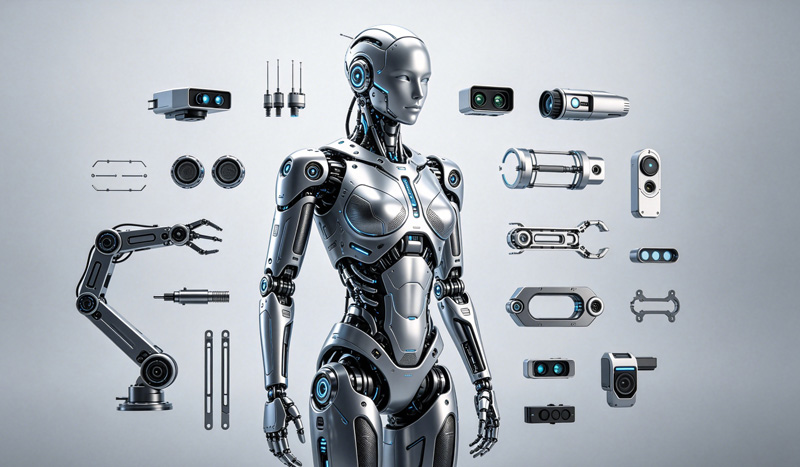
Humanoid robots are rapidly evolving from experimental prototypes into commercially deployable systems used in logistics, manufacturing, healthcare, and service industries. Unlike traditional industrial robotic equipment, these robots are designed to simulate human limb movements, adapt to complex indoor and outdoor scenarios, and achieve frequent flexible rotation, friction movement, and long-term stable operation.
Material selection—especially for structural and functional components—has become critical. Stainless steel, with its unique combination of mechanical performance, anti-rust capability, fatigue resistance, and machining adaptability, remains the preferred metal material for key parts. However, “stainless steel” is not a single material; it is a broad family of grades with vastly different properties. Choosing the wrong grade can lead to excessive weight, joint failure, premature wear, rust, or unnecessary manufacturing cost.
This guide provides a systematic framework for selecting the optimal stainless steel grade for each humanoid robot component.
1. Core Selection Principles for Humanoid Robot Components
1.1 Match Mechanical Performance to Working Conditions
- Joint rotating parts require high strength and fatigue resistance
- Shell parts prioritize toughness and formability
1.2 Balance Corrosion Resistance with Application Scenarios
- Indoor service robots: moderate corrosion resistance is sufficient
- Medical / outdoor robots: require high anti-corrosion grades
1.3 Adapt to Precision Machining Requirements
- Most parts require micron-level precision
- Target surface finish: Ra ≤ 0.8 μm or better
1.4 Control Weight and Cost Efficiency
- Avoid overusing high-end alloys for non-critical parts
- Optimize cost-performance balance
2. Performance Analysis of Mainstream Stainless Steel Grades
2.1 Material Overview Table
| Grade | Type | Key Properties | Hardness | Corrosion Resistance |
|---|---|---|---|---|
| 304/304L | Austenitic | General-purpose, ductile | ~HV200 | Good |
| 316L | Austenitic | Chloride resistance, biocompatible | ~HV200 | Very good |
| 303 | Free-machining | Excellent machinability | ~HV200 | Moderate |
| 17-4PH | Precipitation hardening | High strength & fatigue resistance | HRC 35–44 | Good |
| 15-5PH | Precipitation hardening | High stability & precision | HRC 38–45 | Good |
| 431 | Martensitic | High strength shaft material | HRC 40+ | Moderate |
| 420 | Martensitic | Wear resistant | HRC 50 | Moderate |
| 440C | Martensitic | Very high hardness | HRC 58–60 | Moderate |
2.2 Key Material Descriptions
304 / 304L – General Structural Grade
Best for: housings, covers, non-load parts
- Good formability
- Cost-effective
- Not suitable for high load parts
316L – High Corrosion Resistance Grade
Best for: medical, outdoor, humid environments
- Excellent corrosion resistance
- Non-magnetic
- Higher cost than 304
17-4PH – Core Structural Material
Best for: robot joints, load-bearing frames, shafts
- Tensile strength: 1100–1310 MPa
- Excellent fatigue resistance
- Ideal for dynamic mechanical systems
15-5PH – Ultra Precision Grade
Best for: high-end precision assemblies
- Better dimensional stability than 17-4PH
- Lower residual stress
- Higher cost
431 – Shaft and Gear Material
Best for: rotating shafts, torque transmission parts
- Heat treatable to HRC 40+
- Good balance of strength and toughness
420 / 440C – Wear Resistant Grades
Best for: bearings, sliding parts, friction interfaces
- 440C: extreme hardness up to HRC 60
- Not suitable for high impact loads
303 – High Efficiency Machining Grade
Best for: mass production CNC parts
- Excellent machinability
- Lower corrosion resistance than 304
3. Targeted Material Selection by Robot Subsystem
3.1 Arm System
| Component | Recommended Grade | Reason |
|---|---|---|
| Shoulder housing | 17-4PH | High load |
| Forearm structure | 17-4PH / Aluminum hybrid | Weight balance |
| External cover | 304 / 316L | Corrosion protection |
| Joint shaft | 420 / 440C | Wear resistance |
3.2 Leg System
| Component | Grade | Reason |
|---|---|---|
| Hip joint | 17-4PH | High load |
| Knee bracket | 17-4PH | Dynamic stress |
| Foot base | 316L / 17-4PH | Environment dependent |
3.3 Torso System
| Component | Grade | Reason |
|---|---|---|
| Main frame | 17-4PH | Structural strength |
| Internal plates | 304 | Static load |
| Battery housing | 316L | Safety + corrosion |
3.4 Sensor System
| Component | Grade | Reason |
|---|---|---|
| Sensor housing | 316L | Non-magnetic |
| Gimbal | 17-4PH | Precision stability |
| Optical frame | 304 | Low deformation |
4. Heat Treatment and Surface Engineering
4.1 Heat Treatment
- 17-4PH: H900 / H1025 / H1150M aging
- 420: quenching up to HRC 50
- 440C: hardness up to HRC 58–60
Note: Without proper aging, PH steels cannot reach designed strength.
4.2 Surface Treatment
- Electropolishing → Ra ≤ 0.2 μm
- DLC coating → low friction wear reduction
- Nitriding → surface hardness up to 65 HRC
- Passivation → corrosion resistance recovery
5. Machining Considerations
| Grade | Machinability | Notes |
|---|---|---|
| 304/316L | Good | Standard CNC |
| 303 | Excellent | Mass production |
| 17-4PH | Medium | Requires heat treatment |
| 420/440C | Difficult | High tool wear |
Key point:
Precision robotic joints often require ±0.01 mm tolerance control.
6. Weight vs Strength Optimization
- Use steel only for load paths
- Replace non-critical parts with aluminum or composite
- Use hollow structures with rib reinforcement
- Hybrid design = steel + aluminum + carbon fiber
7. Common Mistakes
- Overusing high-grade steel → cost explosion
- Ignoring heat treatment → performance failure
- Wrong material near sensors → interference issues
- Using 440C for large parts → brittle fracture risk
8. Case Study: Tesla Optimus
| Component | Material |
|---|---|
| Shell | 304 |
| Outdoor parts | 316L |
| Joints & shafts | 17-4PH / 431 |
Key insight:
Multi-material strategy > single-material design
9. Future Trends
- Hybrid materials (steel + aluminum + carbon fiber)
- Additive + CNC hybrid manufacturing
- DLC and nano-surface engineering
- Lightweight high-strength alloys expansion
10. Decision Framework
- Define function
- Identify environment
- Set performance priority
- Choose heat treatment route
- Select surface engineering
- Evaluate total cost
- Prototype testing
11. Quick Reference Table
| Application | Grade |
|---|---|
| Covers | 304 / 304L |
| Outdoor parts | 316L |
| Machining efficiency | 303 |
| Structural joints | 17-4PH |
| Precision parts | 15-5PH |
| Shafts | 431 |
| Wear parts | 420 |
| High wear inserts | 440C |
Conclusion
Selecting stainless steel for humanoid robots is a system-level engineering decision rather than a material choice alone.
- 304 / 316L → housing & protection
- 17-4PH / 15-5PH → structural & motion systems
- 420 / 440C → wear interfaces
- 431 → shafts & torque systems
Proper material matching directly improves robot lifespan, precision, and reliability—critical for scaling humanoid robots from prototypes to commercial deployment.


