
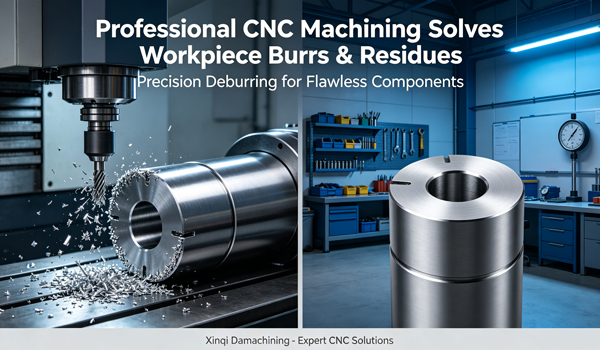
When buyers search for a reliable CNC machining factory, one of the most important concerns is the quality of the finished parts—especially whether the workpieces are free from burrs, sharp edges, chips, and machining residues. Although these issues may appear minor, they can directly affect assembly efficiency, product performance, surface finishing quality, and long-term reliability.
In many industries such as automation equipment, robotics, aerospace, medical devices, semiconductor equipment, and optical systems, even microscopic burrs or residual particles can lead to assembly interference, abnormal wear, surface defects, or product failure. For this reason, professional CNC machining is not only about dimensional accuracy, but also about delivering clean, smooth, and ready-to-assemble precision parts.
Table of Contents
ToggleWhy Burrs & Residues Are a Serious Problem
Burrs and machining residues are among the most common quality challenges in CNC machining. However, they are not unavoidable defects. In many low-cost machining factories, insufficient process control, worn cutting tools, or poor post-processing management often result in parts requiring secondary deburring and cleaning after delivery. This increases labor costs, delays assembly schedules, and reduces overall production efficiency for buyers.
Common problems caused by burrs and residues include:
-
Assembly jamming or improper fitting
-
Damage to seals, bearings, or precision surfaces
-
Surface contamination affecting anodizing or coating
-
Reduced dimensional consistency
-
Premature component wear
-
Metal particle contamination in sensitive equipment
-
Additional manual rework costs
For buyers, receiving parts that still require secondary processing is not only inconvenient, but also increases hidden manufacturing costs.
Professional CNC Machining Starts with Process Optimization
A professional CNC machining factory solves burr and residue problems from the very beginning of the machining process.
Different materials such as aluminum, stainless steel, brass, titanium, and engineering plastics all require different machining strategies. Experienced CNC engineers optimize:
-
Cutting speed
-
Feed rate
-
Toolpath strategy
-
Depth of cut
-
Tool geometry
-
Cooling and chip evacuation
Reasonable cutting parameters help reduce excessive cutting force, minimize material tearing, and improve edge quality during machining.
At the same time, professional CNC machining factories use high-quality precision cutting tools and regularly monitor tool wear conditions to maintain stable machining performance throughout production.
Advanced CNC Programming Reduces Burr Formation
Professional CNC programming is one of the key factors in controlling burr generation.
Optimized toolpaths can effectively reduce:
-
Tool vibration
-
Sharp edge tearing
-
Material accumulation
-
Chip adhesion
-
Corner deformation
For complex precision parts, proper tool entry and exit strategies are especially important for maintaining clean edges and smooth surfaces.
Compared with ordinary machining factories, experienced CNC manufacturers pay far more attention to these processing details, because they understand that burr control directly affects final product quality.
Professional Deburring Solutions for Precision Parts
Even with optimized machining processes, certain complex structures may still require post-processing deburring. Professional CNC machining factories use different deburring technologies according to the workpiece structure and precision requirements.
Mechanical Deburring
Mechanical deburring methods include:
-
Brush deburring
-
Abrasive belt deburring
-
Vibratory finishing
-
Abrasive flow deburring
These methods are suitable for batch production and can efficiently remove fine edge burrs.
Precision Manual Deburring
For high-precision parts or complex internal structures, skilled technicians perform manual precision deburring to ensure that delicate surfaces and critical dimensions are not damaged.
Automatic Deburring Equipment
For products requiring high consistency, automatic deburring systems provide:
-
Uniform edge quality
-
Stable batch performance
-
Improved production efficiency
-
Reduced human error
This is especially important for precision industrial components and high-volume production projects.
Residue Removal & Precision Cleaning
Professional CNC machining is not limited to burr removal. Residual chips, coolant, polishing particles, and oil contamination must also be completely removed before shipment.
Professional factories usually implement multiple cleaning processes, including:
-
Ultrasonic cleaning
-
High-pressure air cleaning
-
Industrial solvent cleaning
-
Deionized water washing
-
Surface contamination inspection
For industries with extremely high cleanliness requirements, such as semiconductor or optical equipment manufacturing, residue-free parts are critical for maintaining system stability and precision performance.
Strict Quality Inspection Ensures Burr-Free Parts
A professional CNC machining factory treats burr and residue inspection as a core part of quality control.
Inspection methods may include:
-
Visual inspection
-
Magnification inspection
-
Precision caliper measurement
-
Coordinate Measuring Machine (CMM) inspection
-
Surface roughness testing
Before shipment, every finished part must pass strict burr and cleanliness inspection standards. Any unqualified products are reworked or rejected to ensure customers receive clean, smooth, and assembly-ready components.
Industry Applications Requiring Burr-Free CNC Parts
Robotics & Automation Equipment
Precision motion systems require smooth edges and clean surfaces to maintain stable operation.
Aerospace Components
Burr-free machining improves reliability, safety, and fatigue performance under extreme conditions.
Medical Devices
Smooth surfaces and residue-free parts are essential for product safety and precision assembly.
Semiconductor Equipment
Microscopic metal particles can contaminate sensitive manufacturing environments.
Optical & Precision Instruments
Clean surfaces help maintain alignment accuracy and overall equipment stability.
Why Buyers Prefer Professional CNC Machining Factories
For global buyers, choosing a professional CNC machining manufacturer means more than simply purchasing machined parts. It means reducing manufacturing risks and improving supply chain reliability.
A professional factory can help buyers:
-
Reduce secondary processing costs
-
Improve assembly efficiency
-
Avoid product quality problems
-
Shorten production cycles
-
Improve consistency in batch production
-
Ensure better surface finishing quality
-
Increase final product reliability
Most importantly, buyers receive parts that can be directly used for assembly without additional deburring or cleaning work.
CNC Machining Quality Reflects True Manufacturing Strength
In today’s competitive manufacturing market, the quality of CNC machined parts reflects the true capability of a machining factory. Precision dimensions alone are not enough. The control of burrs, sharp edges, and machining residues is also a critical standard for evaluating professionalism.
Professional CNC machining factories focus on every production detail—from machining strategy and tool selection to deburring, cleaning, and final inspection—to ensure every component meets high-quality manufacturing standards.
If you are looking for a reliable CNC machining partner that can deliver burr-free, residue-free, and high-precision machined parts, choosing an experienced professional manufacturer is the best way to ensure product quality, production efficiency, and long-term reliability.


Reading this made me realize that CNC machining quality isn’t just about dimensions—ensuring parts are free from burrs and residues is just as critical. Tiny imperfections can really affect assembly and long-term reliability, especially in high-precision industries. It’s a great reminder of how much attention to detail matters in machining.