
Custom CNC Machined Threaded Locking Adapter Fitting with Dual Set Screw Holes
Description
Product Overview
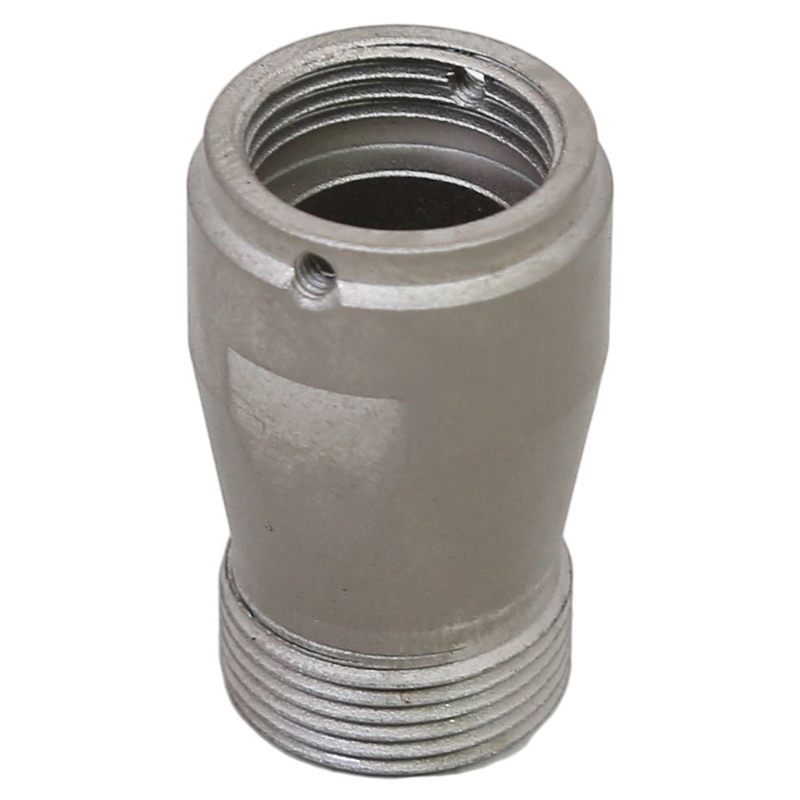
This custom CNC machined threaded locking adapter fitting is designed for mechanical connections that require secure fastening, accurate positioning, and reliable component retention. Featuring an internally threaded upper section, an externally threaded lower section, and two radial threaded holes, this precision-machined component combines threaded connectivity with additional mechanical locking functionality.
The dual set screw holes allow fastening screws to engage with an inserted shaft, component, or mating part, helping prevent unwanted movement or rotation during operation. The combination of internal and external threads also provides flexibility when connecting components with different mounting interfaces.
Manufactured through precision CNC turning and milling, this threaded locking adapter fitting can be customized according to engineering drawings, including thread specifications, bore dimensions, outer diameters, hole positions, material selection, and surface treatments.
At XINQIDA, we provide custom CNC machining services for non-standard metal components, supporting prototype development, small-batch production, and repeat OEM manufacturing. Our engineering team can review your drawings and provide DFM feedback to help optimize machining processes, dimensional accuracy, and manufacturing costs.
CNC Machining Services & Specifications
| Parameter | Specifications |
|---|---|
| Product Type | Threaded Locking Adapter Fitting |
| Manufacturing Process | CNC Turning, CNC Milling, CNC Drilling, CNC Threading |
| Component Structure | Internal Thread, External Thread, Dual Radial Threaded Holes |
| Available Materials | Aluminum, Stainless Steel, Carbon Steel, Alloy Steel, Brass |
| Aluminum Grades | 6061-T6, 7075-T6 |
| Stainless Steel Grades | 304, 316, 316L, 17-4PH |
| Steel Grades | 1018, 1045, 4140, Alloy Steel |
| Brass Grades | C36000, C46400 (subject to application) |
| Thread Types | Metric, UNC, UNF, BSP, NPT (as specified) |
| Standard Machining Tolerance | ±0.02 mm |
| Precision Machining Tolerance | Up to ±0.005 mm, subject to feature geometry and process requirements |
| Surface Finishes | As-Machined, Anodizing, Electroless Nickel Plating, Zinc Plating, Black Oxide, Passivation |
| Production Volume | Prototypes, Low-Volume Production, Batch Production |
| Quality Inspection | Dimensional Inspection, Thread Gauging, Optical Measurement, CMM Inspection |
| Customization | Manufactured according to customer drawings and specifications |
The specifications above represent available material and manufacturing options, not verified measurements of every finished part. Final tolerances, materials, thread standards, and finishes are confirmed during drawing review.
Applications of Threaded Locking Adapter Fittings
Custom threaded locking adapter fittings are suitable for mechanical assemblies that require a combination of threaded mounting and additional locking features. Their final application depends on the mating components, thread specifications, and functional requirements.
1. Industrial Machinery and Equipment
Used as mechanical connection adapters in industrial machinery, equipment assemblies, and customized mechanical structures. The internal and external threads provide alternative mounting interfaces, while the set screw holes offer additional component retention.
2. Industrial Automation Systems
Suitable for customized automation equipment, positioning mechanisms, and mechanical actuator assemblies. These fittings can connect mounting components, cylindrical shafts, and other precision-machined parts where secure positioning is required.
3. Shaft and Mechanical Connection Assemblies
The dual set screw configuration can help secure an inserted shaft or cylindrical component within the adapter. Depending on the design, this structure may be used in shaft connections, mechanical supports, and customized coupling assemblies.
4. Hydraulic and Pneumatic Equipment
Potentially suitable for specialized fluid power equipment when the material, thread form, sealing geometry, pressure rating, and surface finish meet the system requirements.
Important: A threaded locking adapter is not automatically a pressure-rated hydraulic or pneumatic fitting. Pressure-bearing applications require appropriate sealing design, material verification, and pressure testing.
5. Custom Equipment and OEM Assemblies
For OEM manufacturers developing specialized equipment, custom threaded locking adapter fittings can be manufactured to match proprietary thread dimensions, installation spaces, and assembly requirements.
Material Selection and Engineering Analysis
Material selection directly affects the strength, corrosion resistance, wear performance, machinability, and service life of a threaded locking adapter fitting.
The following materials are commonly considered for this type of CNC machined component.
Aluminum Alloy
Recommended grades: 6061-T6 and 7075-T6
Aluminum alloys are suitable for applications where lightweight construction, good machinability, and corrosion resistance are important.
- 6061-T6: Offers a good balance of strength, machinability, and corrosion resistance. Suitable for general industrial machinery and automation components.
- 7075-T6: Provides higher strength and is suitable for applications requiring improved mechanical load capacity.
Anodizing can be applied to improve surface protection and wear resistance, depending on the application.
Stainless Steel
Recommended grades: 304, 316, 316L, and 17-4PH
Stainless steel is a practical choice for components exposed to moisture, corrosive environments, or demanding operating conditions.
- 304: Suitable for general industrial environments.
- 316/316L: Offers improved corrosion resistance in many chloride-containing environments compared with 304.
- 17-4PH: Provides high strength and can be heat treated to achieve different mechanical properties.
Stainless steel is particularly suitable when thread durability, structural strength, and corrosion resistance are important.
Carbon Steel and Alloy Steel
Recommended grades: 1045 and 4140
Carbon steel and alloy steel are suitable for applications involving higher mechanical loads and greater strength requirements.
- 1045: Offers good strength and machinability for general mechanical components.
- 4140: Provides higher strength and toughness, particularly when supplied and heat treated to the required condition.
Black oxide, zinc plating, or other suitable protective treatments may be considered to improve surface protection.
Brass
Recommended grade: C36000
Brass offers excellent machinability and good corrosion resistance in many environments. It is suitable for certain threaded connectors and specialized mechanical fittings where ease of machining and thread quality are priorities.
Material selection should always be based on the actual load, operating environment, mating components, and functional requirements rather than appearance alone.
CNC Machining Tolerance and Precision Control
Threaded locking adapter fittings require careful dimensional control because several functional features must work together during assembly.
At XINQIDA, machining tolerances are determined according to the engineering drawing, material properties, component geometry, and inspection requirements.
| Machining Feature | Typical Tolerance Reference |
|---|---|
| General Linear Dimensions | ±0.02 mm |
| Precision Machined Dimensions | Up to ±0.005 mm |
| Internal Bore Diameter | According to drawing requirements |
| External Diameter | According to drawing requirements |
| Internal Thread | Specified thread class and fit |
| External Thread | Specified thread class and fit |
| Radial Threaded Holes | Position and thread requirements according to drawing |
| Concentricity / Coaxiality | Defined according to functional requirements |
| Surface Roughness | Ra specified according to application |
For critical threaded interfaces, thread gauges can be used to verify thread dimensions and fit. Bore diameters and external diameters can be checked using appropriate dimensional measuring instruments.
Where the internal bore and external thread share a common axis, concentricity and coaxiality are particularly important for proper assembly and alignment.
For precision applications, XINQIDA can provide dimensional inspection based on agreed drawing requirements, with CMM and optical measurement available where appropriate.
Manufacturing Challenges in CNC Machining
Producing a threaded locking adapter fitting involves more than machining its external cylindrical profile. Several features require careful process planning and dimensional control.
1. Internal and External Thread Accuracy
The component incorporates two different threaded interfaces. Internal and external threads must meet their specified thread standards, pitch, diameter, and fit requirements.
Incorrect thread dimensions may cause assembly difficulties, excessive clearance, or interference with mating components.
Our machining process considers thread specifications and appropriate cutting tools to maintain consistent thread quality.
2. Positioning of Dual Set Screw Holes
The two radial threaded holes must be accurately positioned relative to the main bore and external geometry.
Incorrect hole positioning can affect screw engagement, locking performance, and assembly alignment.
CNC milling and drilling operations help maintain the specified hole positions and angular relationships.
3. Concentricity Between Bore and External Diameter
The internal bore and external cylindrical features may need to share a common axis.
Poor concentricity can result in uneven assembly contact, shaft misalignment, or unwanted vibration in rotating applications.
Careful workholding, machining sequence planning, and dimensional inspection help control these geometric relationships.
4. Thin-Wall Deformation and Clamping
Depending on the wall thickness, machining the internal bore, external threads, and radial holes may create localized stresses or deformation.
Appropriate clamping methods, cutting parameters, and machining sequences are important to maintain dimensional stability.
5. Surface Finish and Thread Protection
Surface treatments such as anodizing, plating, and black oxide can change final dimensions or affect thread fit.
Thread allowances and masking requirements should therefore be considered before finishing, particularly for precision mating interfaces.
Why Choose XINQIDA for Custom CNC Machined Fittings?
XINQIDA specializes in non-standard CNC machining parts manufactured according to customer drawings and technical specifications.
Our manufacturing capabilities support customers who require customized mechanical connectors, threaded adapters, locking sleeves, and other precision-machined components.
- Multi-Axis CNC Machining: 3-axis, 4-axis, and 5-axis machining capabilities for complex geometries.
- CNC Turning and Milling: Integrated machining processes for cylindrical profiles, threaded features, and radial holes.
- Material Flexibility: Machining solutions for aluminum, stainless steel, carbon steel, alloy steel, brass, and engineering plastics.
- Precision Manufacturing: Standard machining tolerances around ±0.02 mm, with tighter tolerances available for suitable features.
- DFM Engineering Support: Drawing review and manufacturing feedback to identify potential machining challenges before production.
- Flexible Production: Support for prototypes, small batches, and repeat OEM orders.
Whether you need a single prototype or recurring production quantities, our team can evaluate your drawings and recommend an appropriate manufacturing approach.
Send your 2D drawings or 3D CAD files to XINQIDA for a free DFM review and CNC machining quotation.
Frequently Asked Questions (FAQ)
1. What is a threaded locking adapter fitting?
A threaded locking adapter fitting is a mechanical connection component that combines threaded mounting interfaces with additional locking features. Depending on its design, it may include internal threads, external threads, and radial holes for set screws to secure an inserted component.
2. What is the purpose of the two set screw holes?
The two set screw holes are designed to accommodate fastening screws that engage with an inserted shaft or mating component. They can help prevent relative rotation, reduce unwanted movement, and improve mechanical retention.
The actual locking performance depends on screw size, engagement depth, tightening torque, contact geometry, and material strength.
3. Can you manufacture custom threaded locking adapter fittings according to drawings?
Yes. XINQIDA provides custom CNC machining services for non-standard threaded fittings and locking adapters. We can manufacture components according to customer-supplied 2D engineering drawings or 3D CAD files, including customized thread dimensions, bore sizes, hole positions, and overall geometry.
4. Which materials are suitable for CNC machined locking adapter fittings?
Common material options include 6061-T6 aluminum, 7075-T6 aluminum, 304 and 316 stainless steel, 1045 carbon steel, 4140 alloy steel, and C36000 brass.
The appropriate material depends on mechanical loads, corrosion exposure, weight requirements, machinability, and operating conditions.
5. What machining tolerances can you achieve?
General machining tolerances are typically around ±0.02 mm, while tighter tolerances down to ±0.005 mm may be achievable for suitable dimensions and machining conditions.
Final tolerances depend on the material, feature geometry, dimensions, and inspection requirements.
6. Can you machine both internal and external threads on the same component?
Yes. CNC turning and threading operations can produce internal and external threads on the same component. Thread specifications, including diameter, pitch, thread form, and tolerance class, should be provided in the engineering drawing.
7. Can the surface finish be customized?
Yes. Available surface treatment options may include anodizing, electroless nickel plating, zinc plating, black oxide, and passivation, depending on the selected material and application.
Critical threads and mating surfaces can be considered during finishing process planning to help maintain the required dimensional fit.
8. What information is needed to request a CNC machining quotation?
To evaluate a custom threaded locking adapter fitting, we recommend providing:
- 2D engineering drawings with dimensions and tolerances.
- 3D CAD files, such as STEP or IGES.
- Material grade and heat treatment requirements, if applicable.
- Internal and external thread specifications.
- Set screw hole dimensions and positions.
- Surface finish requirements.
- Estimated order quantity and annual demand.
Our engineering team can review the information and provide DFM feedback, manufacturing recommendations, and a quotation.
Additional information
| material |
|---|
You must be logged in to post a review.



Reviews
There are no reviews yet.