
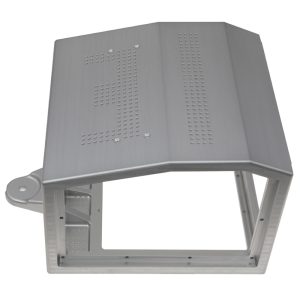
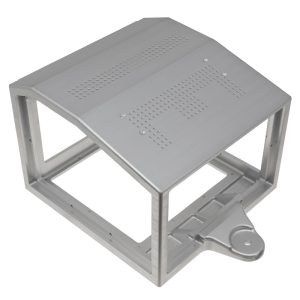
OEM Custom CNC Machined Aluminum Parallel Air Gripper Housing for Industrial Robot End Effector
Description
Product Overview
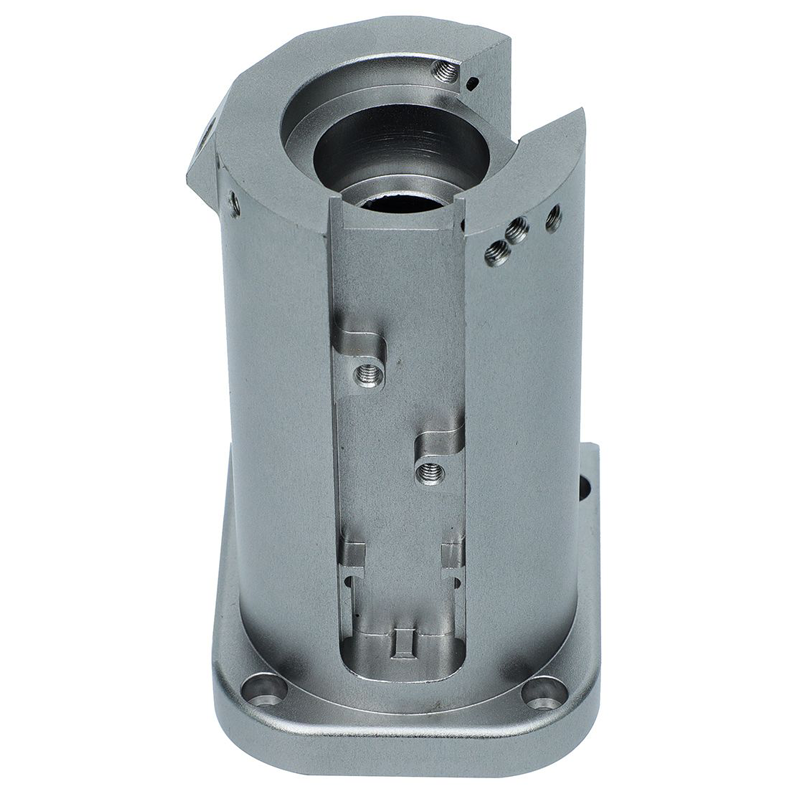
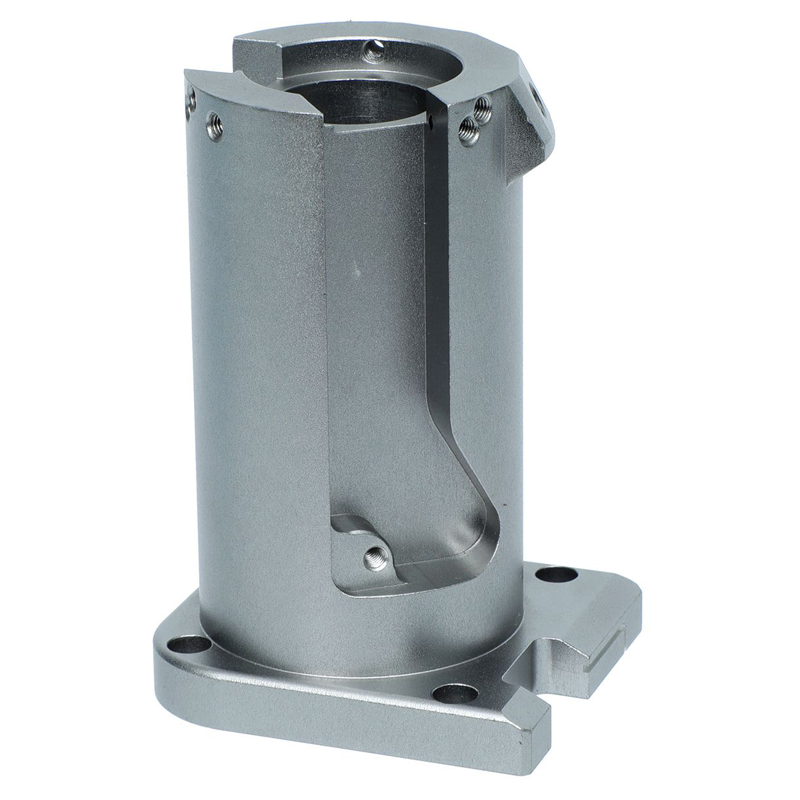
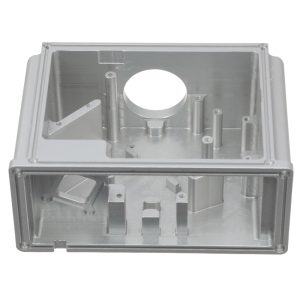
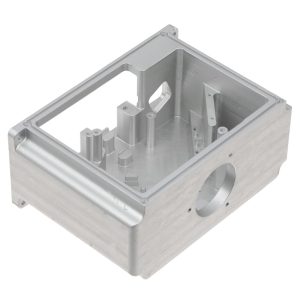
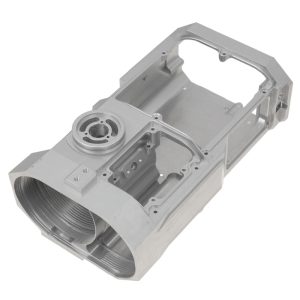
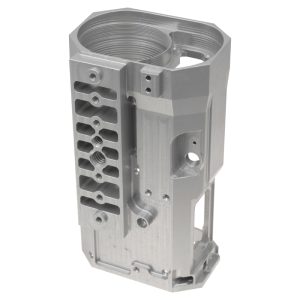
This precision-engineered pneumatic parallel air gripper housing is the critical core component for robotic end effectors used in high-speed industrial automation. Designed with an integrated wire routing slot and linear guide mounting grooves, this housing acts as the structural backbone, housing the piston, rack-and-pinion mechanisms, and pneumatic chambers. Manufactured via advanced 5-axis CNC machining, it ensures exceptional dimensional stability, lightweight strength, and long-lasting wear resistance for heavy-duty pick-and-place operations.
1. CNC Machining Services & Parameter Table
Our machining capabilities are strictly certified to meet the rigorous demands of international automation markets. Below is our standard production capability matrix for this specific housing:
| Production Parameter | Specification Details |
|---|---|
| CNC Machining Equipment | 4-Axis & 5-Axis Vertical Machining Centers (VMC), CNC Turning Centers |
| Maximum Machining Size | ≤ 600mm (L) x 500mm (W) x 400mm (H) |
| Primary Materials | Aluminum Alloy (6061-T6, 6063, 7075), Stainless Steel (304, 316L – for food/medical grade) |
| Standard Tolerance | ISO 2768-m (General tolerance) |
| Precision Tolerance | +/- 0.01 mm (For critical ID/OD mating surfaces and locating dowels) |
| Geometric Tolerances (GD&T) | Concentricity ≤ 0.02 mm, Positional tolerance ≤ 0.02 mm, Parallelism ≤ 0.015 mm |
| Surface Finish (Ra) | Ra 1.6 μm to Ra 3.2 μm (Standard), Ra 0.8 μm (For pneumatic piston sealing surfaces) |
| Surface Treatment | Sandblasting + Hard Clear/Black Anodized (Aluminum), Passivation (Stainless Steel) |
| Thread Specification | M1.6 to M36, metric standard, UNC/UNF (with strict tapping depth control) |
| Quality Control | 100% dimensional inspection using CMM (Coordinate Measuring Machine), 2D Optical Profilers, and Go/No-Go gauges |
| MOQ (Minimum Order Quantity) | 1 piece (Prototype) to 1,000+ pieces (Mass production) |
| Lead Time | 3-5 days for samples; 15-20 days for mass production |
2. Material Analysis: Why Aluminum 6061-T6?
The choice of material is paramount for the structural integrity and lifespan of an air gripper.
-
Primary Choice – Aluminum 6061-T6: Our default manufacturing material is Aerospace-grade Aluminum 6061-T6. It possesses the optimal strength-to-weight ratio. In robotic automation, the “End of Arm Tooling” (EOAT) mass directly affects the robot’s payload capacity and operating speed. Using aluminum reduces the tool’s inertial load significantly, allowing the robot to move faster while consuming less power.
-
Surface Anodizing: The 6061-T6 alloy responds excellently to Hard Anodizing (Type III). This treatment creates a micro-porous ceramic-like layer that gives the housing a beautiful matte metallic finish, highly improves corrosion resistance against industrial coolant and humidity, and reinforces the surface to prevent scratching from abrasive environments.
-
Alternative – Stainless Steel (SUS304 / 316L): For heavy-duty food processing, pharmaceutical, and semiconductor cleanroom environments where chemical sterilization is mandatory, stainless steel is available. However, it increases the part weight by approximately 170% compared to aluminum and presents greater CNC machining challenges (we offer both options based on your application).
3. Application Scenarios
This parallel air gripper housing is designed for high-frequency, precision-critical industrial tasks. Its primary applications include:
-
Robotic Automated Assembly Lines: Used on SCARA and 6-axis robotic arms for pressing, inserting, and snapping electronic components and automotive parts.
-
3C Electronics Manufacturing: Handling delicate, lightweight components (like mobile phone screens, chips, or PCB boards) where precise, smooth parallel gripping prevents damage.
-
Packaging & Logistics: Installed on high-speed pick-and-place robotic arms in packing machines for sorting boxes, bottles, or blister packs.
-
Automotive Parts Manufacturing: Used in robotic welding or welding jigs to firmly grip metal plates or automotive frames.
-
Medical Device & Food Packaging: When engineered with stainless steel materials, it is used in sterile production lines for gripping medical vials or food trays safely.
4. Tolerance Capabilities
For an air gripper housing, maintaining exact tolerances is not just about “fitting pieces together”; it is about ensuring air-tight pneumatic seals and perfect linear movement.
-
Precision Bore Tolerance: The central cavity holds the piston. We control the internal cylinder diameter to +/- 0.01 mm to guarantee a perfect seal with the O-ring and prevent air leakage.
-
High Positional Accuracy: The thread holes on the side and top for installing the sensor switches and end caps feature a strict positional tolerance of 0.02 mm. Any deviation prevents the tight fitting of standard off-the-shelf magnetic sensors.
-
Face Flatness & Parallelism: The bottom mounting flange (which connects to the robot wrist) and the two inner guide rail surfaces must maintain parallelism within 0.015 mm. This ensures that the parallel gripper fingers do not wobble or tilt during their closing stroke, delivering consistent clamping force.
5. Manufacturing Difficulties & Solutions
Machining this intricate housing imposes significant technical challenges on the factory. Here is how we overcome them:
-
Challenge 1: Complex Multi-Angle Machining (Back Wire Slot vs. Front Guide Groove).
The deep, curved wire channel at the back and the long, straight linear guide groove at the front lie on different horizontal planes.-
Our Solution: We exclusively use High-Precision 5-Axis CNC machines. This allows us to machine these complex surfaces in a single clamping operation, eliminating the part misalignment and geometric errors that would occur if we were forced to use traditional 3-axis machining with multiple setups.
-
-
Challenge 2: “C-Shape” Thin-Wall Deflection.
Because the front of the cylinder is widely opened to allow the gripper fingers to pass through, the remaining structural wall is relatively thin and tends to “spring” or “deform” during high-speed milling.-
Our Solution: We utilize advanced CAM software toolpath optimization combined with a multi-stage roughing and finishing strategy. We leave a “dummy support” (extra material) during rough milling and finish the critical inner rails only in the final step. This secures the thin wall against cutting vibration and ensures straightness.
-
-
Challenge 3: Internal Threads & Deburring.
The tiny internal threads (for sensors) inside the deep vertical grooves are difficult to tap cleanly.-
Our Solution: We employ custom-made extended-shank carbide taps and include a mandatory high-pressure coolant cleaning and manual ultrasonic deburring process to ensure no metal shavings remain inside, which could otherwise jam the pneumatic cylinder.
-
6. FAQ (Frequently Asked Questions)
Q1: Can you provide free sample prototypes for testing?
A: Yes, we offer rapid prototyping services. For a new OEM project, we charge a nominal sample fee to cover the setup and material costs. However, this fee will be fully deducted from your final mass-production invoice upon order confirmation.
Q2: What is the minimum order quantity (MOQ) for this air gripper housing?
A: We accept OEM customization with an MOQ of 1 piece. Whether you need a single proof-of-concept prototype or a bulk order of 10,000 units, our flexible production management system can accommodate your needs.
Q3: What drawing formats do you require for the quotation?
A: We accept 2D drawings in PDF/DWG (DXF) and 3D CAD models in STEP (STP), IGES (IGS), or SolidWorks (SLDPRT). Please ensure your drawing clearly defines the critical tolerances for the pneumatic cavities and mounting threads.
Q4: How do you ensure the inner piston chamber does not leak air?
A: We hold a strict Cylinder Shape & Surface Roughness control. The inner bore is machined to Ra 0.8 μm with strict cylindricity tolerances. Combined with our specified surface treatments, this guarantees a leak-proof interface for your dynamic pneumatic O-rings.
Q5: How do you handle shipping and packaging to avoid scratches?
A: Critical surfaces and threaded holes are protected with custom-fit EPE foam inserts or plastic end-caps. The outer surface is wrapped in anti-static bubble bags, and the entire shipment is supported by sturdy export-grade plywood crates or cardboard boxes with shock-absorbing corners, ensuring it arrives at your facility in perfect condition.
Additional information
| material |
|---|
Reviews
There are no reviews yet.