

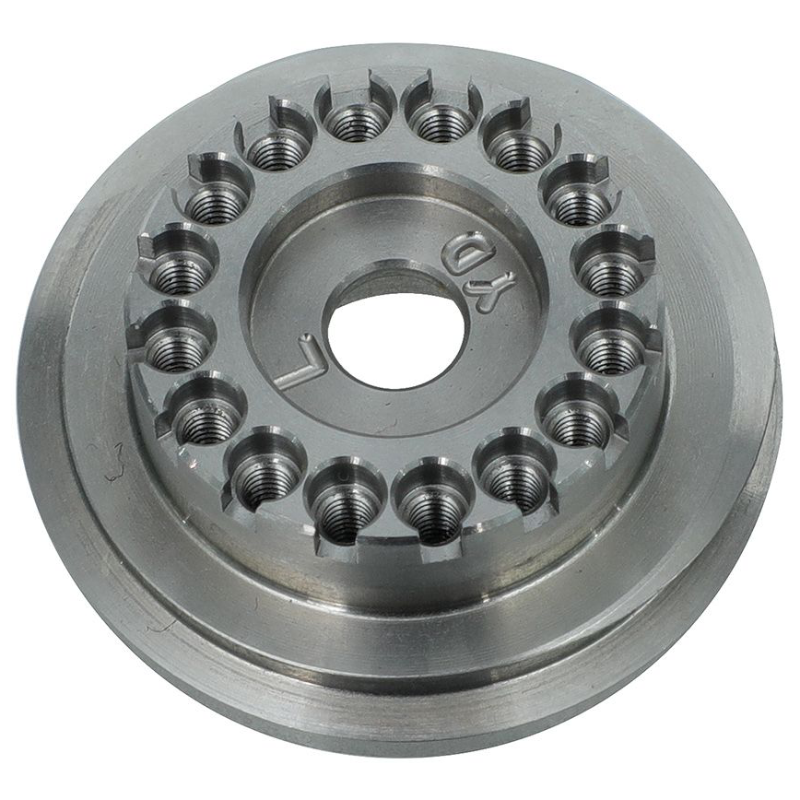
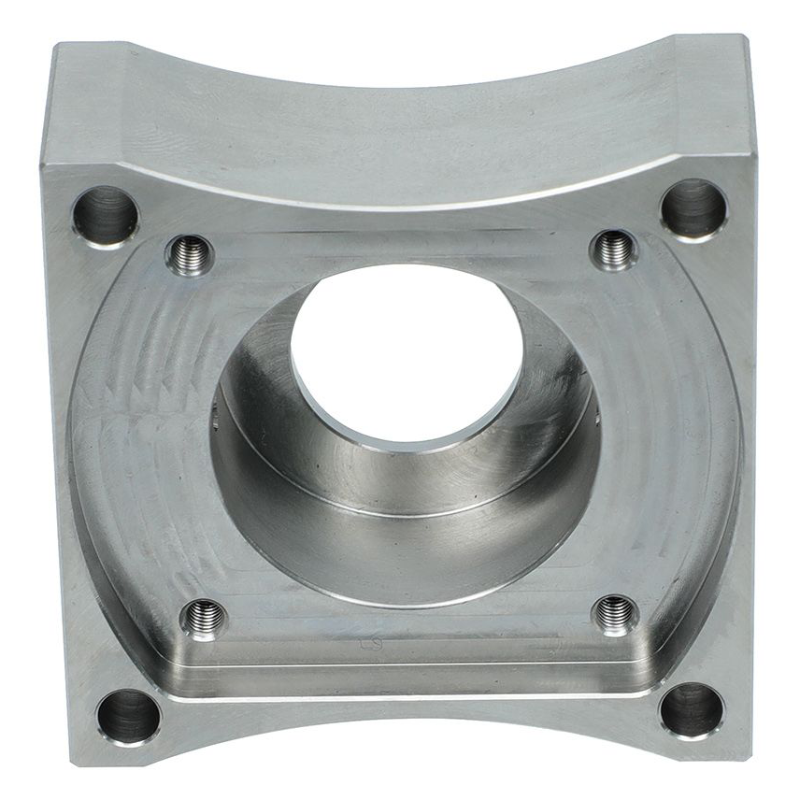

Custom Machining Bearing Housing for Ball Screw Support with Grease Port and Mounting Flange
Description
Custom CNC Machining Bearing Housing with Grease Port and Mounting Flange
Product Overview
XINQIDA provides custom machining bearing housing solutions for industrial automation equipment, ball screw assemblies, and precision mechanical systems. This steel bearing housing is designed to support a bearing, maintain the required alignment within a mechanical assembly, and provide a secure mounting interface through its integrated flange.
The housing features a central bearing seat, a mounting flange, threaded holes for bearing cover installation, and a side grease port for lubrication access. These functional features must be machined to the requirements of the engineering drawing to support accurate assembly and reliable operation.
As a custom CNC machining manufacturer in China, XINQIDA manufactures non-standard bearing housings based on customer-supplied 2D drawings or 3D CAD models. We support prototype development, low-volume production, and repeat orders for OEM equipment manufacturers.
Looking for a custom steel bearing housing manufacturer? Send us your drawings for a manufacturing review, DFM feedback, and a quotation tailored to your specifications.
1. Machining Bearing Housing: CNC Services and Technical Parameters
Manufacturing a precision bearing housing involves more than machining the outer profile. The bearing seat, mounting flange, bolt pattern, lubrication port, and cover-mounting features must work together as an integrated component.
Our CNC machining services include milling, precision boring, drilling, tapping, and multi-sided machining. The manufacturing process is selected according to the part geometry, tolerance requirements, material, and production quantity.
| Parameter | CNC Machining Capability |
|---|---|
| Product Type | Custom Steel Bearing Housing / Ball Screw Support Housing |
| Primary Material | Carbon Steel and Alloy Steel |
| Alternative Materials | Stainless Steel and Aluminum Alloys, subject to application requirements |
| CNC Processes | 3-Axis, 4-Axis and 5-Axis CNC Milling, Precision Boring, Drilling and Tapping |
| Standard Machining Tolerance | Typically ±0.05 mm, subject to part geometry |
| Precision Tolerance | Down to ±0.005 mm on suitable features, subject to drawing review |
| Bearing Seat | Custom bore dimensions and fit requirements according to the approved drawing |
| Surface Roughness | Ra 0.4–1.6 μm on selected surfaces, where specified and achievable |
| Surface Treatment | Black Oxide, Zinc Plating, Nickel Plating or Phosphating, subject to material and requirements |
| Quality Inspection | Dimensional Inspection, Bore Measurement, and CMM Inspection where required |
| Order Quantity | Prototype, Small Batch and Production Orders |
| Manufacturing Basis | Customer Drawings, 3D CAD Models and Approved Specifications |
The values above are indicative manufacturing capabilities, not universal specifications for every bearing housing. Final tolerances, surface finishes, material grades, and lead times are confirmed during drawing review and quotation.
2. Material Selection for Custom Bearing Housing Machining
Material selection affects housing stiffness, load capacity, wear resistance, machinability, corrosion resistance, and total manufacturing cost. The correct material should be selected according to the bearing arrangement and operating conditions.
Carbon Steel and Alloy Steel
Carbon steel and alloy steel are suitable choices for bearing housings used in machinery that requires structural rigidity and dependable bearing support.
- Carbon steel: A practical option for general-purpose machinery and industrial automation components.
- 4140 / 42CrMo alloy steel: May be selected for applications requiring higher strength or additional wear resistance, depending on the specified heat treatment.
- Heat-treated steel: Can provide enhanced mechanical properties when the application requires them. The machining sequence must account for dimensional changes caused by heat treatment.
For this steel bearing housing, the final material grade should be confirmed against the customer’s drawing and operating requirements.
Stainless Steel
Stainless steel may be appropriate when corrosion resistance, cleaning requirements, or exposure to moisture and certain chemicals are important.
Grades such as 303, 304, or 316 offer different combinations of machinability and corrosion resistance. The grade should be selected according to the working environment rather than assumed to be interchangeable with carbon steel.
Aluminum Alloy
Aluminum alloys such as 6061-T6 may be considered when reducing component mass is a priority and the required stiffness and bearing-seat stability can be maintained.
For heavily loaded ball screw support applications, steel may be preferable. The final decision depends on the load, support arrangement, operating speed, and structural design.
3. Bearing Housing Tolerance and Quality Inspection
The performance of a machined bearing housing depends on the relationship between its functional features, not simply on whether individual dimensions fall within tolerance.
Bearing Seat Accuracy
The central bore locates the bearing outer ring. Its diameter, roundness, cylindricity, and surface finish can influence bearing fit and operating performance.
An H7 fit may be appropriate for some bearing arrangements, but it should not be applied automatically. The required fit depends on the bearing type, loading conditions, housing material, temperature, and assembly requirements.
Mounting Face Flatness and Alignment
The mounting flange connects the housing to the machine frame or mating component. Its flatness and orientation relative to the bearing seat can affect alignment after installation.
The flange face, bearing bore, and mounting-hole pattern should therefore be inspected against the drawing’s specified datums and geometric tolerances.
Hole Position and Thread Quality
Mounting holes and bearing-cover threads must match the mating components. The side grease port must also be positioned correctly to provide access for the intended lubrication arrangement.
Depending on the drawing, inspection may include bore gauges, calibrated dimensional instruments, thread gauges, and coordinate measuring machine (CMM) measurements.
XINQIDA can review critical dimensions and inspection requirements before production to help establish a suitable manufacturing and quality-control plan.
4. Applications of Custom Machining Bearing Housing
Custom bearing housings are used in mechanical assemblies where a bearing must be supported and accurately located relative to a mounting structure.
Potential applications include:
- Ball Screw Support Units: Supporting bearing arrangements in linear motion systems and CNC equipment.
- Industrial Automation Machinery: Providing bearing support for positioning mechanisms, automated assembly equipment, and precision motion systems.
- Robotics and Motion Control: Serving as a mounting and support component in selected robotic mechanisms and automated equipment.
- CNC Machine Tools: Supporting precision transmission assemblies where alignment and structural rigidity are important.
- Semiconductor and Electronics Equipment: Used in selected positioning and material-handling systems that require accurate mechanical interfaces.
- Custom OEM Machinery: Manufactured to non-standard dimensions for specialized equipment designs.
The exact application and performance requirements should be confirmed from the customer’s assembly drawings and operating conditions.
5. Manufacturing Challenges in CNC Bearing Housing Machining
Challenge 1: Maintaining Bearing Seat Accuracy
A bearing bore can meet its diameter tolerance while still having unacceptable form or alignment errors. Roundness, cylindricity, shoulder geometry, and the relationship between the bore and mounting face may all affect assembly.
Our approach: We review the functional dimensions and datum structure before machining, select suitable boring and finishing operations, and inspect the critical features according to the approved drawing.
Challenge 2: Keeping the Mounting Flange and Bearing Bore Aligned
Machining the flange, central bore, and mounting holes in separate setups can introduce accumulated positioning errors.
Our approach: Where the geometry permits, we machine related features in a common setup or use a controlled datum-based sequence to maintain positional relationships between operations.
Challenge 3: Machining Multiple Sides and Internal Features
The grease port, bearing-cover holes, recessed areas, and flange features may require machining from different directions. Tool access and workpiece positioning can affect accuracy and production efficiency.
Our approach: We select an appropriate 3-axis, 4-axis, or 5-axis machining strategy based on the part geometry and drawing requirements. Five-axis machining is not automatically necessary for every bearing housing.
Challenge 4: Managing Heat Treatment and Surface Finishing
Heat treatment and coating processes can affect dimensions, surface condition, and final fit. Finishing a bearing seat to its required size before an additional process may create problems if the process changes that dimension.
Our approach: We review the process sequence and specify which dimensions must be verified after heat treatment or surface finishing. Critical bearing seats and mounting interfaces receive particular attention.
Challenge 5: Preventing Burrs and Surface Damage
Burrs, scratches, and machining debris around bearing seats, threaded holes, and lubrication passages can interfere with installation or contaminate an assembly.
Our approach: We include appropriate deburring, cleaning, and final inspection steps according to the part’s functional requirements.
6. Why Choose XINQIDA for Custom Bearing Housing Machining?
XINQIDA focuses on made-to-drawing CNC machining for industrial and OEM customers who need components that match their specific designs.
- Drawing-Based Manufacturing: Custom bearing housings manufactured from customer-supplied 2D drawings and 3D CAD files.
- Multi-Axis CNC Capability: 3-axis, 4-axis, and 5-axis machining options selected according to component geometry.
- Engineering and DFM Support: Early review of manufacturability, critical tolerances, machining access, and potential cost drivers.
- Material and Finishing Options: Support for steel and other suitable engineering materials, with compatible finishing processes.
- Flexible Production Quantities: Prototype parts, small batches, and repeat OEM production.
- Inspection Based on Requirements: Dimensional verification focused on specified bearing seats, mounting interfaces, and other critical features.
Our objective is to help customers manufacture custom mechanical components with a practical balance of dimensional accuracy, manufacturability, and cost.
7. Frequently Asked Questions About Machining Bearing Housing
Q1: What is a machining bearing housing?
A machining bearing housing is a bearing-support component manufactured or finished through machining processes such as CNC milling, boring, drilling, and tapping. It locates and supports a bearing within a mechanical assembly and connects the assembly to its mounting structure.
Q2: Can XINQIDA manufacture a custom steel bearing housing from drawings?
Yes. XINQIDA supports non-standard bearing housing manufacturing based on customer-provided engineering drawings or 3D CAD models. Customers can submit STEP, IGES, or other mutually agreed file formats for review.
Q3: What material is best for a ball screw support bearing housing?
Carbon steel and alloy steel are common choices when stiffness and load-bearing capability are important. Stainless steel may be appropriate for corrosion-sensitive environments, while aluminum can be considered for lightweight designs. The final selection should reflect the load, bearing arrangement, environment, and design requirements.
Q4: What tolerance can you achieve when machining a bearing housing?
Typical general machining tolerances may be around ±0.05 mm, while selected features can potentially be machined to ±0.01 mm or ±0.005 mm after technical review. The achievable tolerance depends on the feature geometry, material, dimensions, machining process, and inspection method.
The bearing-seat fit and geometric tolerances should always be specified according to the actual bearing arrangement rather than inferred from a general tolerance figure.
Q5: Does this bearing housing require 5-axis CNC machining?
Not necessarily. A 3-axis machining center may be sufficient when the required features are accessible through conventional setups. Four-axis or five-axis machining may improve access, reduce repositioning, or help control the relationship between features on multiple faces. The appropriate process depends on the actual drawing.
Q6: Can you provide heat treatment and surface finishing?
Heat treatment and compatible surface treatments can be discussed during quotation. Available options depend on the material grade, specified hardness, corrosion requirements, and dimensional tolerances. Critical dimensions should be verified at the appropriate stage of manufacturing.
Q7: What information is needed for a bearing housing quotation?
For an accurate quotation, please provide:
- 2D engineering drawing with dimensions and tolerances.
- 3D CAD model, if available.
- Required material grade and heat-treatment specifications.
- Surface finish and coating requirements.
- Prototype or production quantity.
- Any critical inspection or documentation requirements.
Q8: Can you manufacture prototypes and small batches?
Yes. XINQIDA supports prototype and small-batch CNC machining as well as repeat production. Order quantity, delivery time, and inspection requirements are confirmed after reviewing the drawing and manufacturing scope.
Request a Quote for Custom Machining Bearing Housing
Need a custom steel bearing housing for a ball screw support unit, industrial automation system, or specialized OEM machine?
Send your 2D drawing or 3D CAD model to XINQIDA. Our team can review the material, bearing-seat requirements, mounting interfaces, machining process, and finishing specifications before preparing a quotation.
Get a Custom CNC Machining Quote
- Submit your part drawing or CAD file.
- Specify material, quantity, and critical tolerances.
- Receive a manufacturing review and quotation based on your requirements.
Additional information
| material |
|---|


Reviews
There are no reviews yet.