
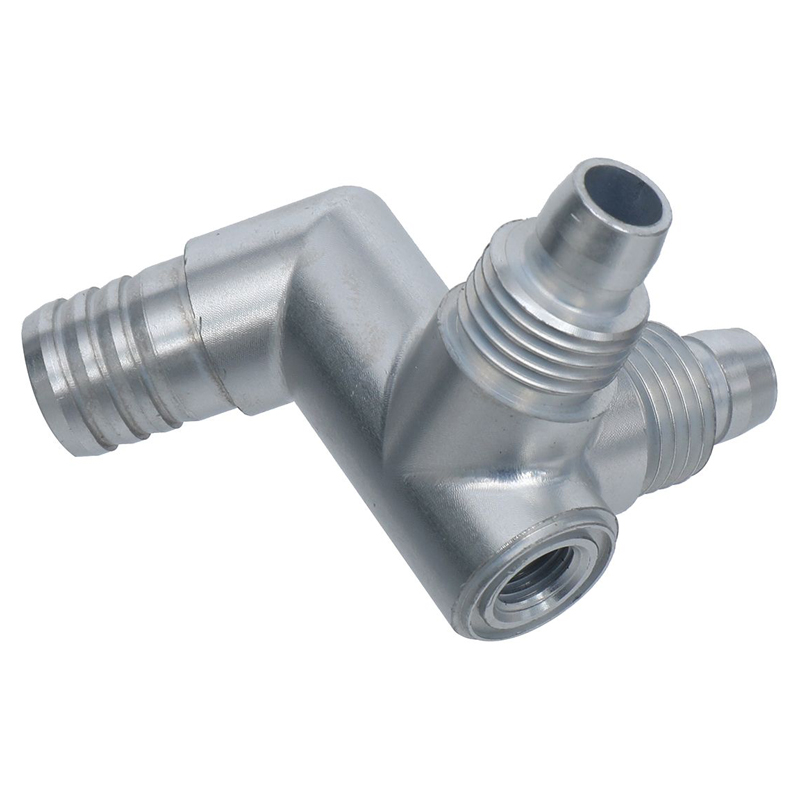
Precision CNC Machined Cross Adapter Fitting with Hybrid AN Male, ORB Female & Hose Barb Ports
Description
Product Overview
Our hybrid‑port CNC‑machined cross adapter fitting is purpose‑built for high‑performance automotive and motorsport fluid distribution systems that demand zero‑leak sealing, compact footprint, lightweight construction and accurate fluid routing. Manufactured on multi‑axis CNC turning & milling centers, this multi‑port fluid connector merges AN male thread, ORB female port and hose barb connections within one single compact body, eliminating the need for multiple separate adapters and reducing potential leak joints in your fluid plumbing loop.
Engineered for harsh fuel, engine oil, coolant and turbo oil feed‑return circuits, this cross adapter features precision‑intersecting internal flow channels, high‑accuracy threaded ports and fully deburred internal passages. It maintains stable flow performance and reliable leak‑free sealing under cyclic high‑pressure operating conditions. Lightweight metallic body delivers balanced thermal performance and corrosion resistance, widely adopted for racing builds, performance vehicle upgrades, oil cooler setups and custom fluid manifold projects.
We deliver full OEM / ODM customization based on customer 2D/3D drawings or technical specifications, including custom AN sizes, hose barb diameters, ORB thread specs, surface finishing, laser marking and anodized coloring. Prototyping, low‑volume batch and mass‑production orders are all supported.
CNC Machining Services — Technical Parameter Table
| Item | Specification |
|---|---|
| Product Name | Precision CNC Machined Cross Adapter Fitting (AN Male + ORB Female + Hose Barb Hybrid Ports) |
| Product Category | CNC‑machined fluid fitting, automotive performance fluid connector, multi‑port cross adapter |
| Manufacturing Process | CNC turning, 3‑4‑5‑axis multi‑directional milling, cross‑hole drilling, thread machining, internal deburring |
| Available Materials | Aluminum 6061‑T6, Aluminum 7075‑T6, Stainless Steel 304 / 316, Brass |
| Surface Treatment | Natural machined finish, hard / decorative anodizing, sandblasting, polishing, nickel plating |
| Port Configuration | AN Male Thread, ORB Female Thread, Hose Barb Port (custom port layout available) |
| Supported Thread Standards | AN/JIC, ORB(SAE J1926), NPT, BSP, Metric threads |
| Internal Flow Structure | Precision intersecting cross‑hole internal flow passages |
| Key Machining Features | Multi‑directional cross‑holes, precision bore, multi‑port threading, angled hole machining, O‑ring sealing faces |
| Dimensional Tolerance | ±0.01 mm critical feature tolerance |
| Surface Roughness | Ra 0.8 ~ 1.6 μm for sealing surfaces |
| Sealing Solutions | O‑ring face seal, flare seal, hose‑clamp barb seal |
| CNC Equipment Capacity | 3‑axis / 4‑axis / 5‑axis CNC machining centers |
| Production Scale | Prototype (1‑5 pcs), low‑volume batch, high‑volume mass‑production |
| Quality Inspection | CMM coordinate measuring inspection, thread‑gauge verification, pressure leak‑testing, visual internal burr inspection |
| Custom Drawing Formats Accepted | STEP, STP, IGS, XT, DWG, PDF |
| Customization Scope | Port layout, thread size, barb dimension, material, finish, laser engraving, anodized color |
| Typical Lead Time | Prototype: 7‑12 days; mass‑production: 15‑25 days (depends on complexity & quantity) |
Material Analysis
Each material option is selected according to working‑pressure, media compatibility, weight target and corrosion environment of your fluid system:
- Aluminum 6061‑T6 (Default for motorsport) Excellent strength‑to‑weight ratio, low density for weight‑sensitive racing applications. Good machinability for complex cross‑hole geometry; anodizing greatly improves surface hardness and anti‑corrosion performance. Best for fuel, coolant and moderate‑pressure oil circuits. Not ideal for long‑term exposure to highly corrosive chemical fuels without protective coating.
- Aluminum 7075‑T6 Higher tensile strength than 6061‑T6 for higher‑pressure fluid loops. Slightly heavier; preferred for competitive motorsport under elevated working pressure. Anodization is strongly recommended for surface protection.
- Stainless Steel 304 / 316 Superior corrosion resistance for ethanol‑blended fuels, salt‑spray / coastal environment and long service‑life requirements. 316 offers enhanced chloride‑resistance. Higher material cost and machining difficulty; higher component weight, suitable for industrial hydraulic and heavy‑duty automotive systems where weight reduction is secondary.
- Brass Good machinability, decent corrosion resistance for low‑pressure coolant and fuel circuits. Lower mechanical strength compared with aluminum alloys and stainless steel; commonly used for general‑purpose low‑pressure fluid adapters.
Tolerance Capability
- Critical sealing faces, thread datum and intersecting bore features maintain ±0.01 mm dimensional tolerance, guaranteeing concentricity between mating port axes to prevent partial‑contact‑caused leakage under pressure cycles.
- Sealing‑surface roughness controlled within Ra 0.8‑1.6 μm to minimize micro‑leak risk for O‑ring and flare‑type sealing.
- Threads are machined to AN/JIC, ORB‑SAE J1926 standard gauges; every thread port passes thread‑gauge inspection.
- Cross‑hole intersection position tolerance is strictly controlled to maintain uniform wall‑thickness and avoid stress‑concentration under fluid pressure shock.
- For custom projects, we accept your drawing tolerance requirements and perform First‑Article‑Inspection (FAI) report upon request.
Manufacturing Difficulties
This hybrid‑port cross adapter presents several well‑known CNC machining challenges for fluid‑power components:
- Multi‑directional cross‑hole intersecting machining When drilling cross‑holes, cutting tool suffers intermittent cutting force and tool deflection risk, which may create elliptical bore geometry and position deviation. Uncontrolled position error will reduce local wall‑thickness and weaken pressure‑bearing capacity of the fitting body. Multiple‑setup re‑positioning on CNC machines is required to guarantee angular accuracy of every port.
- Internal cross‑hole burr removal (most critical risk point) Drill breakout at internal hole intersections creates hidden internal roll‑over burrs that cannot be seen from external openings. Residual burrs inside flow channels may detach under fluid flow, scratching O‑rings, blocking small orifices and triggering system contamination or seal failure. Manual surface deburring is insufficient; dedicated internal deburring processes are mandatory for fluid fittings.
- High‑concentricity requirement for multi‑port sealing faces Mis‑alignment among AN male flare seat, ORB O‑ring face and barb axis will cause uneven compression of seals, resulting in intermittent leaks under vibration and pressure cycling (common on turbo and racing vehicles). Fixture design and multi‑axis machining strategy are essential to keep good concentricity across all ports.
- Thread‑to‑bore alignment consistency Mis‑match between thread pitch diameter and internal flow bore creates sharp transition edges, causing turbulence, flow‑loss and potential flow‑induced cavitation inside fuel / oil lines.
Our solution: 4‑/5‑axis CNC multi‑orientation machining, specialized internal cross‑hole deburring process, CMM dimension validation and finished‑part pressure leak‑testing for critical‑order batches.
Typical Applications & Use‑Cases
- High‑performance automotive fuel delivery distribution circuits
- Oil cooler, engine lubrication and turbocharger oil feed / return plumbing
- Motorsport, drag racing, track‑day custom fluid system builds
- Coolant thermal‑management systems for modified performance vehicles
- Fluid‑pressure sensor mounting adapter points
- Custom manifold plumbing combining AN, ORB and hose‑barb connection standards
- Aftermarket turbo kit fluid routing assemblies
FAQ
Q1: What information should I submit for custom quotation?
Please provide 2D drawings (PDF/DWG), 3D files (STEP / STP / IGS), material grade, surface‑finish requirement, quantity, target working‑pressure and your main application scenario. If you modify an existing fitting, photos and key dimension measurements will also help our engineering review.
Q2: Can you modify port layout, AN sizes or barb diameters for this cross adapter?
Yes. This cross‑adapter fitting supports full custom port‑configuration: different AN sizes (‑4AN,‑6AN,‑8AN,‑10AN etc.), customized hose‑barb OD, additional sensor‑ports or change of thread‑standards (NPT / BSP / Metric). OEM / ODM service is available.
Q3: What causes leaking on multi‑port cross‑adapters?
Common leak sources include: insufficient sealing‑surface finish, bad thread fit, internal burr scratching O‑rings during assembly, mis‑alignment caused by poor concentricity, or over‑/under‑torque during installation. Our leak‑tested fittings minimize manufacturing‑origin leakage risk; proper assembly torque and correct O‑ring material matching remain essential on‑site.
Q4: What pressure rating can these cross adapters handle?
Working‑pressure heavily depends on selected material, wall‑thickness design, thread‑specification and hose‑barb assembly. Please share your target working‑pressure with our engineers; we will verify wall‑thickness safety margin during drawing review. The hose‑barb connection pressure limit is also restricted by your hose material and hose‑clamp quality.
Q5: Do you offer prototype samples before mass‑production?
Yes, single‑piece prototyping is supported. We produce prototype parts for validation, then move to batch manufacturing after sample approval.
Q6: Which material should I choose for ethanol‑mixed racing‑fuel applications?
For ethanol‑blended fuels, aluminum with good‑quality anodizing works for many builds; stainless steel 316 is recommended for long‑term high‑corrosion‑risk conditions. Our engineers can give material suggestion once you provide your fluid‑media specification.
Q7: What quality reports can you provide?
We support CMM inspection reports, thread‑gauge records, leak‑test logs and material‑certificate documents for batch orders.
Additional information
| material |
|---|
You must be logged in to post a review.
Reviews
There are no reviews yet.