
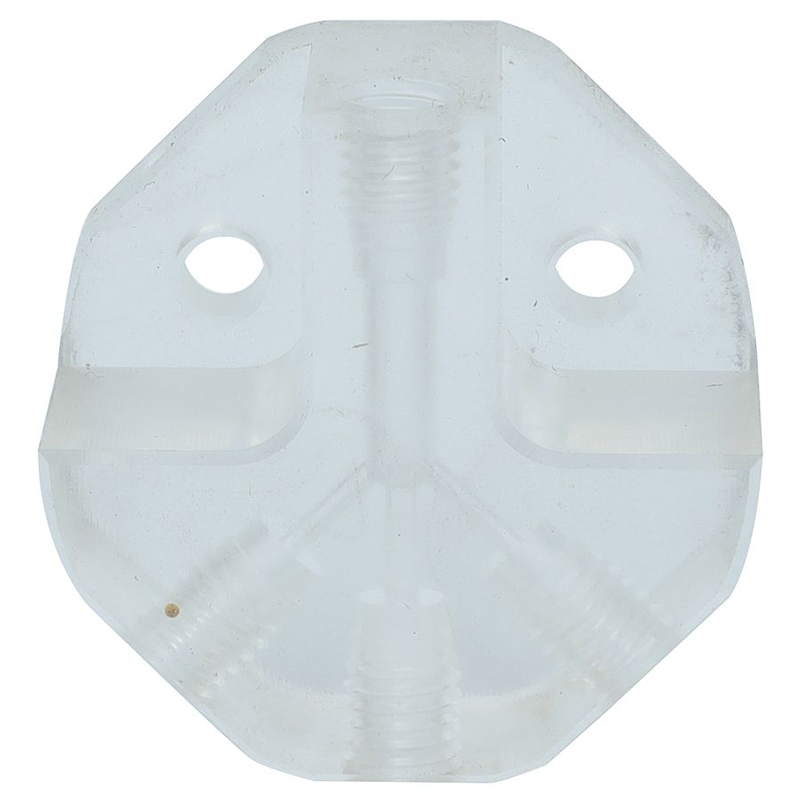
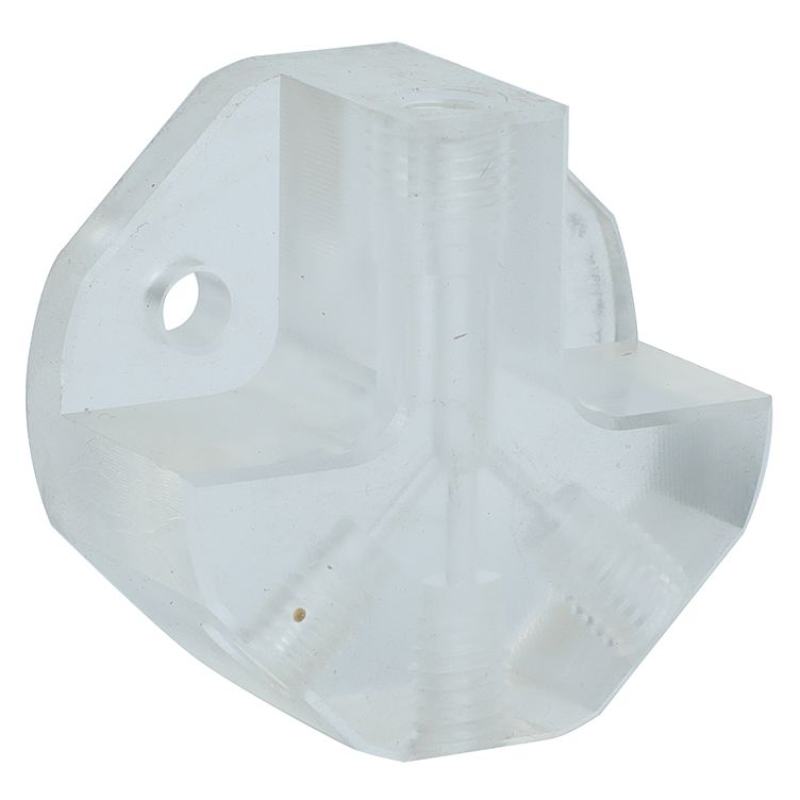
CNC machined transparent PMMA fluid manifold block with multi-threaded ports
Description
Overview
Engineered for critical fluid handling in analytical and life science instruments, our CNC machined transparent PMMA fluid manifold block features a multi-port, cross-drilled internal fluid distribution channel. Combining the superior optical clarity of acrylic with the precision of advanced CNC machining, this distribution block offers leak-proof sealing via multi-threaded ports, allowing for effortless installation of standard fluid connectors. Whether you need a prototype for microfluidics or a bulk production run for IVD analyzers, our CNC machining services guarantee precision, cleanliness, and competitive pricing.
1. Material Analysis: Why Transparent PMMA?
Selecting the right material is vital for flow visualization. Here is a breakdown of why PMMA (Polymethyl Methacrylate) is the preferred choice for this custom plastic manifold:
| Property | PMMA (Acrylic) Analysis |
|---|---|
| Optical Transparency | >92% light transmittance. Allows operators to visually inspect fluid flow, detect micro-bubbles, and spot blockages in real-time. |
| Chemical Resistance | Excellent resistance to diluted acids, alkalis, water, and common laboratory reagents. (Note: Not suitable for strong solvents like acetone or benzene). |
| CNC Machinability | High rigidity allows for tight tolerance machining, but requires specific tooling to prevent melting and chipping. |
| Biocompatibility | Non-toxic and biologically inert, making it safe for IVD and medical reagent contact. |
| Pressure Limitations | Suitable for low to medium pressure applications (typically < 1.0 MPa / 145 PSI). |
2. CNC Machining Specifications & Parameter Table
We provide comprehensive CNC machining services tailored to your custom manifold requirements.
| Parameter | Specifications & Capabilities |
|---|---|
| Processing Equipment | 3-Axis, 4-Axis, and 5-Axis High-Speed CNC Milling Centers. |
| Material Standard | Extruded or Cast PMMA (Acrylic). Alternative options (PC, PSU, PEEK, PTFE) available upon request. |
| Threaded Ports | Custom threads (M3, M4, M5, M6, 1/4-28 UNF, G1/8, NPT). Precision tapped for leak-proof sealing. |
| Max Machining Dimensions | Up to 1000mm x 800mm x 500mm (customized per 3D drawing). |
| Surface Finish Options | High-transparency diamond polishing, flame polishing, mechanical polishing (Ra 0.2~0.4 µm), or frosted matte finish. |
| Standard Tolerances | ±0.05 mm to ±0.1 mm (depending on overall part size). |
| Precision Tolerances | ±0.01 mm to ±0.02 mm for critical sealing surfaces and cross-hole intersection depths. |
| MOQ (Minimum Order Quantity) | 1 piece (Prototyping) to mass production (10,000+ pcs). |
| Quality Control | 100% dimensional inspection (CMM), 100% leak/pressure test, no-burr passivation. |
3. Primary Application Scenarios
The unique structure and transparency of this multi-port manifold make it an indispensable component in various industries:
-
Analytical Instruments & HPLC: Used as a solvent distributor or reagent mixer in liquid chromatography systems where visual flow monitoring is essential.
-
IVD & Clinical Diagnostics: Acts as a fluidic hub in biochemical analyzers and blood test equipment to handle micro-volume reagents safely and cleanly.
-
Microfluidics & Life Sciences: Perfect for chip-to-pump connections, cell culture perfusion systems, and sample dilution circuits.
-
Semiconductor Wet Processing: Distributes high-purity chemicals or DI water in etching and cleaning equipment with high corrosion requirements.
-
Industrial Fluid Control & Cooling: Serves as a visual flow splitter for cooling circulation systems and lubrication oil distribution in precision machinery.
4. Tolerance Capabilities
At our facility, we adhere strictly to ISO 2768-mK general tolerances, with the capability to tighten to specific critical features:
-
Hole-to-Hole Center Distance: Maintained within ±0.02 mm to ensure perfectly matched connector alignment.
-
Thread Fit Accuracy: 6H (internal) / 6g (external) thread classes, ensuring smooth turning without jamming or leakage.
-
Perpendicularity & Flatness: Machined flatness within 0.05 mm on the mounting surface to ensure no mechanical stress when bolted onto the instrument chassis.
-
Internal Channel Cross-Point Accuracy: Precise control over cross-drilling depth (within ±0.1 mm) to prevent channel perforation or thinning of the wall, ensuring structural integrity under pressure.
5. Manufacturing Difficulties & Our Solutions
Producing a highly transparent PMMA fluid manifold is challenging. Here’s how we overcome common manufacturing pitfalls:
| Manufacturing Challenge | Our Professional Solutions |
|---|---|
| Internal Cross-Drilling Deviation | Long drill bits tend to wander during deep cross-drilling. We use precise CNC coordinate alignment and specialized micro-drill bits with optimized feed rates to ensure perfect intersection of the flow channels. |
| Surface Scratches & Milling Marks | PMMA is easily scored. We implement high-speed, low-feed machining with ultra-sharp single-crystal diamond cutters, followed by controlled flame polishing to achieve optical clarity without melting the edges. |
| Thread Chipping (Tapping) | PMMA is brittle. We utilize form tapping (cold forming) rather than traditional cutting taps to produce clean, strong threads without causing internal micro-cracks. |
| Stress Cracking | During clamping, PMMA can develop stress cracks. We use custom soft-jaws and vacuum fixtures to clamp the part gently, avoiding physical stress concentration. |
| Internal Burrs & Contamination | Cross-drilled holes leave internal burrs that can clog flow. We perform ultrasonic cleaning and high-pressure air/water purging to guarantee totally clear and particle-free internal channels. |
6. Frequently Asked Questions (FAQ)
Q1: Can this PMMA manifold handle high pressure?
A: PMMA has a relatively low mechanical strength compared to metals. We recommend it for low to medium pressures (< 1 MPa / 145 PSI). For higher pressure applications, we recommend materials like polycarbonate (PC) or PEEK, which we can also CNC machine.
Q2: Is the surface completely transparent, or does it look frosted?
A: We offer different finishes. By default, after CNC machining, we apply diamond polishing and flame polishing to achieve a highly transparent, glass-like surface that allows clear visual flow observation.
Q3: How do you ensure the threaded ports don’t leak?
A: Leakage is prevented through two methods: 1) Precise thread machining (using 6H standard gauge inspection). 2) We highly recommend using O-rings or PTFE seal tape on the male connectors during assembly. Our factory performs a 100% leakage test with air or water before shipping.
Q4: Do you provide customized designs based on our 2D/3D CAD files?
A: Absolutely. We accept both 2D (DXF, PDF) and 3D (STEP, IGES) files. Our engineering team will review your design and provide a free DFM (Design for Manufacturability) report to suggest improvements for cost reduction and structural stability.
Q5: What is the lead time for prototyping vs. mass production?
A: For small prototypes (1–5 pcs), lead time is typically 5 to 7 working days. For mass production (100+ pcs), it ranges from 15 to 25 working days, depending on the complexity and quantity.
Additional information
| material |
|---|
Reviews
There are no reviews yet.