
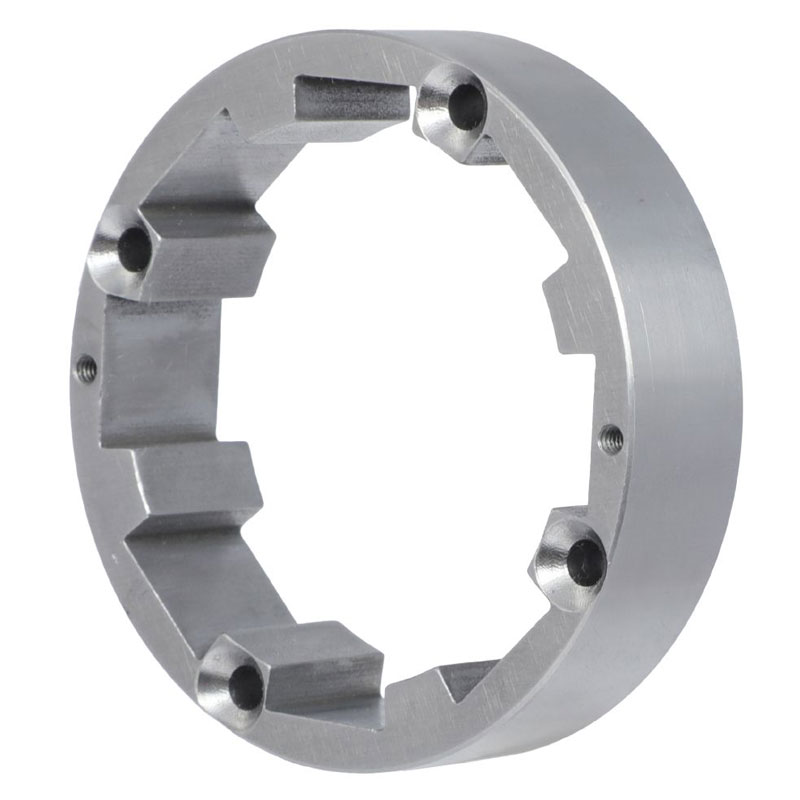
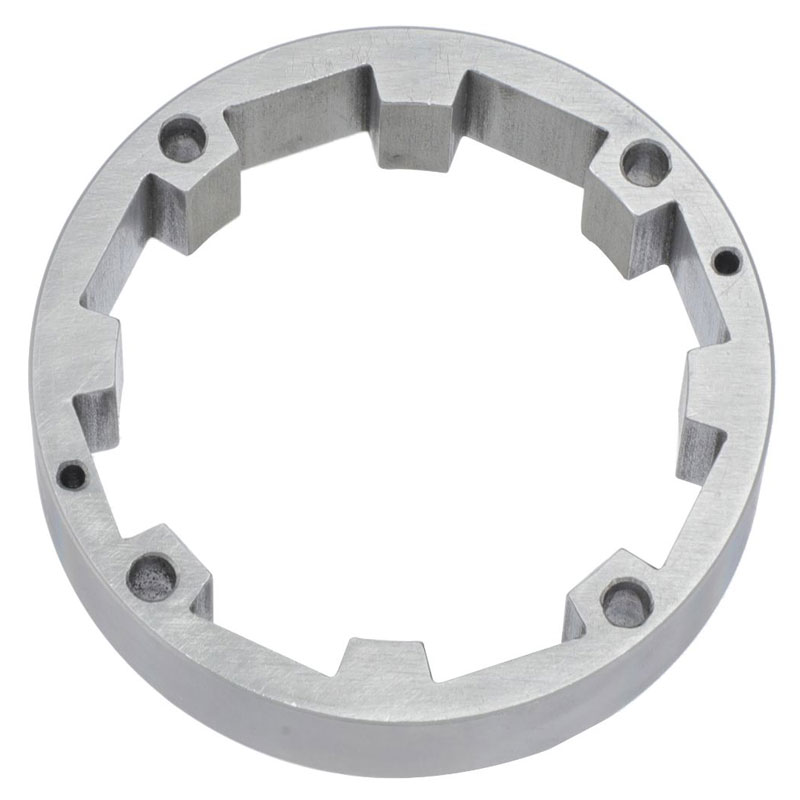
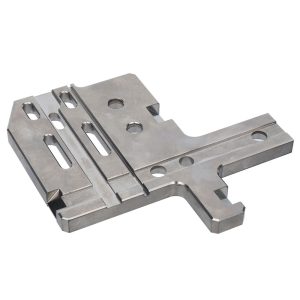
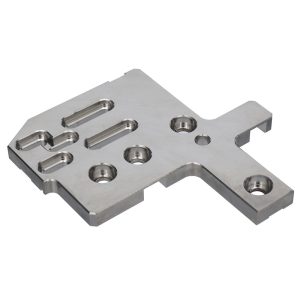
CNC Machined Alloy Steel Locating Ring with 4 Internal Locking Teeth, Through Holes & Side Threaded Holes
Description
Product Overview
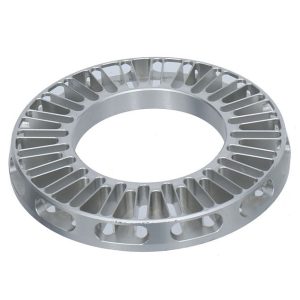
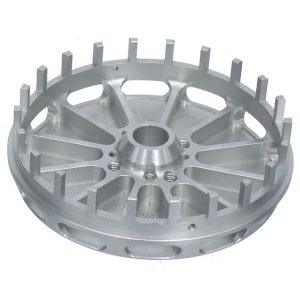
This custom CNC machined Alloy Steel Locating Ring is a precision mechanical component designed for accurate positioning, alignment, and secure engagement in industrial machinery and mechanical assemblies.
Manufactured using precision CNC turning and multi-axis milling, this locating ring features four internal locking teeth, countersunk through-holes for flush mounting, and side threaded holes for additional fastening or auxiliary component integration.
Made from alloy steel, this component offers high mechanical strength, structural rigidity, and the potential for enhanced hardness and wear resistance through appropriate heat treatment. Its compact design, with an outer diameter of less than 80 mm, makes it suitable for applications where precise component location and reliable mechanical connections are essential.
At XINQIDA, we specialize in custom CNC machined locating rings manufactured to customer drawings. From prototype development to small-batch and repeat production, we provide customized machining solutions for demanding industrial applications.
CNC Machining Services Parameter Table
| Parameter | Specification / Capability |
|---|---|
| Product Name | Custom CNC Machined Alloy Steel Locating Ring |
| Primary Material | Alloy Steel |
| Material Grade | Customized according to customer requirements and engineering drawings |
| Processing Method | CNC Turning + CNC Milling |
| Machining Capabilities | 3-Axis, 4-Axis, and 5-Axis CNC Machining |
| Main Features | 4 Internal Locking Teeth, Countersunk Through-Holes, Side Threaded Holes |
| Outer Diameter | Less than 80 mm for this design; customized dimensions available |
| Inner Diameter | Manufactured according to customer drawings |
| Standard Tolerance | ±0.05 mm |
| Precision Tolerance | ±0.01 mm to ±0.005 mm on selected features, subject to geometry |
| Surface Roughness | Standard Ra 3.2–1.6 μm; finer finishes available upon request |
| Surface Treatment | Black Oxide, Phosphate Coating, Zinc Plating, and other suitable treatments |
| Heat Treatment | Available according to alloy steel grade and required hardness |
| Quality Inspection | Dimensional Inspection, CMM Measurement Reports Available |
| Lead Time | Samples: Approximately 5–7 Working Days; Production: Approximately 15–25 Working Days |
| MOQ | From 1 Piece; Prototype and Volume Production Supported |
| Drawing Formats | PDF, DWG, STEP, IGES, SolidWorks |
Final specifications, material grade, heat treatment, surface finish, and tolerances are confirmed according to the approved engineering drawings.
Applications of Custom Alloy Steel Locating Rings
Locating rings are used in mechanical assemblies where accurate positioning, concentric alignment, and reliable component engagement are required. With its internal locking teeth and multiple mounting features, this custom design can be adapted for several industrial applications.
1. Industrial Automation Equipment
In automated machinery, locating rings help establish accurate positioning between mechanical components and mounting structures. Their rigid alloy steel construction is suitable for assemblies exposed to mechanical loads, repeated operation, and vibration.
2. Robotics and Motion Control Systems
Custom alloy steel locating rings can be integrated into robotic joints, actuator assemblies, and motion transmission mechanisms. Their internal locking features can provide positive mechanical engagement with matching components, helping maintain assembly alignment.
3. Automotive Mechanical Assemblies
Locating rings can be used in automotive powertrain components, transmission mechanisms, and other mechanical assemblies requiring accurate component positioning. Alloy steel provides the mechanical strength needed for applications involving contact loads and repeated mechanical movement.
4. Servo Motors and Precision Machinery
In servo motor assemblies and precision equipment, locating rings can help align connected components and maintain their relative positions. Accurate concentricity and mounting-hole locations are important for reducing assembly errors and ensuring consistent mechanical performance.
5. Industrial Instrumentation and Equipment
Custom locating rings can also serve as mechanical locating and mounting components in specialized instruments and industrial equipment where compact dimensions and precise interfaces are required.
Material Analysis: Why Choose Alloy Steel for a Locating Ring?
Material selection directly affects the strength, wear resistance, dimensional stability, and service life of a locating ring.
For this application, alloy steel offers several advantages over conventional aluminum alloys, particularly when the component must withstand mechanical loads or repeated contact with mating parts.
1. High Mechanical Strength
Alloy steel generally offers higher mechanical strength and stiffness than common aluminum alloys. This makes it suitable for locating rings used in load-bearing mechanical assemblies, fastening structures, and precision transmission components.
The actual tensile strength and yield strength depend on the selected alloy grade and heat treatment condition.
2. Improved Wear Resistance
Locating rings with internal locking teeth may experience repeated contact with mating components.
Depending on the alloy composition and heat treatment, alloy steel can achieve increased hardness and improved resistance to surface wear, helping maintain the dimensional accuracy of functional engagement features.
3. Excellent Heat Treatment Potential
Many alloy steel grades can undergo quenching and tempering to achieve specific mechanical properties.
Heat treatment can improve hardness, strength, and wear resistance, depending on the material grade and required operating conditions.
For locating rings with tight dimensional requirements, the machining sequence should account for possible distortion during heat treatment.
4. High Rigidity and Structural Stability
Compared with aluminum alloys, steel has a significantly higher elastic modulus. This provides greater resistance to elastic deformation under equivalent loading conditions.
For locating rings used in precision mechanical assemblies, this characteristic helps maintain structural rigidity and reliable component positioning.
5. Flexible Surface Protection Options
Conventional alloy steel does not provide the same natural corrosion resistance as stainless steel. Depending on the working environment, protective surface treatments may be necessary.
Available options include:
- Black Oxide: Provides a dark appearance and moderate corrosion protection when properly oiled or sealed.
- Phosphate Coating: Provides a protective conversion layer and can support oil retention.
- Zinc Plating: Offers additional corrosion protection for suitable alloy steel components.
- Custom Surface Finishing: Selected according to dimensional tolerances, operating conditions, and customer specifications.
Precision CNC Machining Tolerance Capabilities
A locating ring often serves as an important interface between multiple mechanical components. Dimensional accuracy is therefore essential for proper assembly, concentric alignment, and functional engagement.
XINQIDA provides customized CNC machining solutions for the following critical features.
1. Inner and Outer Diameter Concentricity
The concentric relationship between the inner diameter (ID) and outer diameter (OD) is important for locating rings used in rotating or precision mechanical assemblies.
For suitable geometries, we can target radial runout or concentricity requirements around 0.02 mm, depending on the specified datum and inspection method.
2. Mounting Hole Position Accuracy
The four countersunk through-holes require accurate positioning to match the mating assembly.
We can manufacture the hole pattern and pitch circle diameter (PCD) according to customer drawings, with ±0.01 mm available as a target for suitable designs.
3. Internal Locking Tooth Accuracy
The four internal locking teeth are critical functional features of this locating ring.
Their width, depth, spacing, and profile must be accurately controlled to ensure proper engagement with mating components.
For suitable geometries, selected tooth dimensions can be machined to approximately ±0.02 mm.
4. Surface Roughness Control
Surface finish requirements depend on the contact conditions and assembly function.
Standard CNC machining can typically achieve Ra 3.2 μm, while finer finishes down to Ra 0.8 μm can be considered for suitable surfaces.
Actual tolerances and surface roughness depend on the material grade, hardness, part geometry, machining process, and inspection requirements.
Manufacturing Challenges and CNC Machining Solutions
Although a locating ring appears to be a relatively simple circular component, its internal locking teeth, countersunk holes, and side threaded features require careful machining and process planning.
1. Precision Machining of Internal Locking Teeth
The four internal locking teeth require accurate control of their geometry, spacing, and engagement surfaces.
Limited tool access and internal corner geometry can make these features challenging to machine, especially when narrow grooves or sharp internal profiles are involved.
Our Solution:
We evaluate the internal geometry through DFM analysis and select appropriate CNC milling strategies and cutting tools. Depending on the design, 4-axis or 5-axis CNC milling can be used to improve tool accessibility and machining accuracy.
2. Controlling Heat Treatment Distortion
Alloy steel may experience dimensional changes and residual stress during heat treatment. These changes can affect the inner diameter, outer diameter, concentricity, and internal tooth profiles.
Our Solution:
We consider the heat treatment process during manufacturing planning. Where necessary, machining allowances are reserved for subsequent finishing operations. Critical dimensions are verified after heat treatment to ensure compliance with drawing requirements.
3. Maintaining Concentricity Between Multiple Features
The locating ring includes several functional features that must maintain accurate geometric relationships.
Repeated clamping or incorrect datum selection can introduce positioning errors and affect assembly accuracy.
Our Solution:
We establish appropriate machining datums and use suitable workholding methods to maintain positioning consistency. Where the design allows, related features are machined in fewer setups to minimize accumulated machining errors.
4. Burr Removal and Edge Finishing
Burrs around internal locking teeth, countersunk holes, and threaded holes may interfere with assembly or damage mating components.
Our Solution:
We apply controlled deburring and edge-finishing procedures, including precision manual deburring and suitable mechanical finishing methods. Critical functional surfaces receive additional inspection to ensure proper assembly conditions.
Frequently Asked Questions (FAQ)
Q1: What is an alloy steel locating ring used for?
A: An alloy steel locating ring is used to establish accurate positioning, alignment, or mechanical engagement between connected components. Depending on its design, it can be incorporated into industrial automation equipment, robotics, automotive assemblies, and precision machinery.
Q2: Can you manufacture custom locating rings according to our drawings?
A: Yes. XINQIDA specializes in non-standard CNC machined components. We manufacture custom locating rings according to 2D engineering drawings, 3D CAD files, or physical samples, supporting prototypes and production orders.
Q3: What alloy steel grades are available for locating rings?
A: We can work with different alloy steel grades according to the required strength, hardness, wear resistance, and heat treatment specifications. The final material is selected based on your application and engineering requirements.
Q4: Can the locating ring undergo heat treatment?
A: Yes. Many alloy steel grades support heat treatment processes such as quenching and tempering. We can coordinate the machining sequence with the required heat treatment to control dimensional changes and maintain critical tolerances.
Q5: Can you machine the internal locking teeth and threaded holes?
A: Yes. Our CNC turning and multi-axis milling capabilities support complex locating ring geometries, including internal locking teeth, countersunk mounting holes, and side threaded holes. The exact process depends on the component geometry and drawing requirements.
**Q6: What tolerances can you achieve for custom locating
Additional information
| material |
|---|
You must be logged in to post a review.
Reviews
There are no reviews yet.