
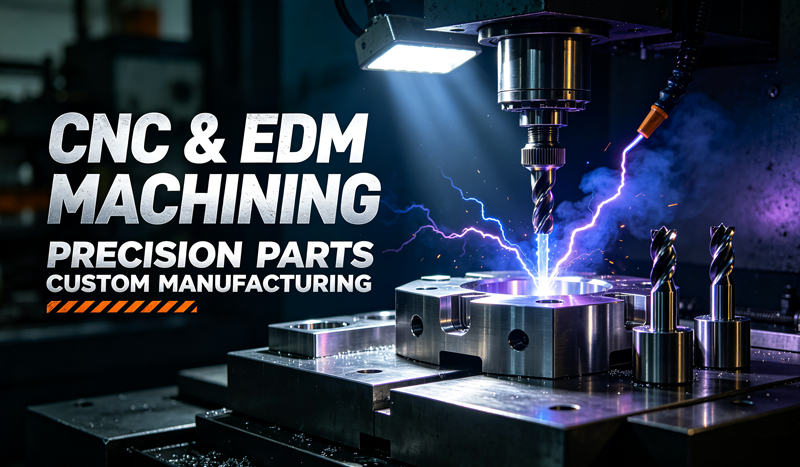
In the landscape of precision manufacturing, Computer Numerical Control (CNC) machining and Electrical Discharge Machining (EDM) stand as two foundational pillars. While both are subtractive processes capable of achieving tight tolerances and complex geometries, they operate on fundamentally different physical principles. Choosing between them—or combining them strategically—is a critical decision that directly impacts part quality, production lead times, and overall project budgets.
This comprehensive guide integrates technical depth with practical cost analysis, helping engineers, procurement specialists, and product designers navigate the CNC vs. EDM dilemma with confidence.
1. Core Working Principles: Mechanical Force vs. Thermal Erosion
The fundamental distinction between these technologies lies in their material removal mechanisms.
CNC Machining is a contact-based mechanical process. Driven by pre-programmed computer instructions, rotating cutting tools (end mills, drills, lathe tools) physically shear and scrape material from the workpiece. It relies on rigid cutting forces and is suitable for high-volume material removal across a wide spectrum of materials.
EDM Machining is a non-contact thermal process. Often called spark machining, it generates high-frequency pulsed electrical discharges between an electrode (tool) and a conductive workpiece. The instantaneous spark temperature reaches several thousand degrees Celsius, melting and vaporizing microscopic particles from the workpiece surface. Because there is no physical tool-to-workpiece contact, mechanical cutting forces are entirely eliminated.
2. Key Technical Differences at a Glance
| Factor | CNC Machining | EDM Machining |
|---|---|---|
| Working Principle | Mechanical shearing & cutting | Electrical spark thermal erosion |
| Material Requirement | Metals, plastics, wood, composites (broad compatibility) | Electrically conductive materials only (steel, titanium, carbides) |
| Hardness Limitation | Limited by tool hardness (difficult above HRC 50) | No hardness limitation (machines hardened steel effortlessly) |
| Cutting Force | High mechanical force | Nearly zero (no deformation) |
| Internal Sharp Corners | Difficult (limited by tool radius) | Excellent (near-zero radius achievable) |
| Deep Cavities/Narrow Slots | Challenging (tool deflection/poor chip evacuation) | Ideal (no tool geometry constraints) |
| Thin-Wall Machining | High risk of deformation | Ideal (no stress) |
| Surface Finish (Ra) | 0.8 – 3.2 μm (standard) | 0.2 – 0.8 μm (superior, no burrs) |
| Typical Tolerance | ±0.01 mm to ±0.005 mm | ±0.005 mm to ±0.002 mm (ultra-precision) |
| Heat-Affected Zone (HAZ) | None (mechanical only) | Present (recast layer requires consideration for fatigue parts) |
| Processing Speed | Fast (high material removal rate) | Slow (arithmetic erosion) |
3. Material Compatibility and Structural Feasibility
Material Adaptability:
CNC offers unparalleled material flexibility. It handles aluminum alloys (6061, 7075), stainless steels (304, 316), titanium, brass, copper, engineering plastics (POM, PTFE, ABS, Nylon), and composites. If it can be cut, CNC can likely process it.
EDM is strictly confined to conductive materials. However, it excels precisely where CNC struggles: hardened tool steels (HRC 60+), tungsten carbide, Inconel, and heat-treated mold steels. For these materials, EDM is often the only viable option.
Structural Feasibility:
CNC dominates large-volume material removal, regular contours, and 3D curved surfaces. However, it is inherently limited by tool geometry. Narrow deep grooves, micro internal corners, and ultra-thin walls often cause tool breakage, poor chip evacuation, or workpiece deformation.
EDM breaks through these structural limitations. It can produce ultra-narrow slits, deep closed cavities, sharp internal angles, and micro-holes that are physically impossible for rotating cutters to achieve.
4. Application Scenarios: Where Each Technology Excels
In practice, CNC and EDM serve distinct, often complementary, roles.
When to Choose CNC Machining
CNC is the workhorse for general manufacturing due to its speed and cost-efficiency. Choose CNC for:
Automotive & General Machinery: Engine blocks, transmission housings, shafts, and structural brackets.
Consumer Electronics: Metal housings, frames, and heat sinks.
Prototyping & Low-to-Medium Volumes: Rapid turnaround and low setup costs for most designs.
Plastic & Non-Conductive Parts: The only practical choice for polymers and composites.
When to Choose EDM Machining
EDM is the specialist for missions where CNC cannot go. Choose EDM for:
Mold & Die Manufacturing: Complex cavities, narrow exhaust grooves, and sharp-corner inserts in injection molds, die-casting molds, and stamping dies.
Aerospace Components: Turbine blade cooling holes, fir-tree slots, and intricate fuel system parts (often 70% of critical aerospace parts rely on EDM).
Precision Medical Devices: Ultra-precision surgical instruments and implants requiring mirror finishes and zero deformation.
Special Structures: Closed deep cavities, micro-features, and high-aspect-ratio thin walls.
5. In-Depth Cost Considerations: Speed Dictates the Bottom Line
Cost analysis goes far beyond comparing hourly shop rates. Understanding the total cost of ownership is crucial.
Equipment & Setup Costs
CNC has a lower entry barrier. Standard 3-axis mills are moderately priced, setup is straightforward, and no auxiliary tooling (like electrodes) is required. Setup costs are low.
EDM involves higher equipment investment. Crucially, sinker EDM requires custom-shaped electrodes (copper or graphite), which adds significant upfront design and manufacturing costs. Setup and parameter debugging are more complex.
Hourly Rates vs. Cycle Time
CNC Hourly Rate: Typically $50–$150/hour. With high material removal rates, the per-unit time is short, making it highly economical for medium-to-large batches.
EDM Hourly Rate: Typically $75–$130/hour. Despite a similar hourly rate, EDM is much slower. A CNC roughing pass might take minutes, while EDM could take hours for the same volume. This dramatically increases the per-part cost.
The Counter-Intuitive Total Cost Scenario
Although EDM has a higher cost coefficient, it can sometimes reduce overall project costs. For example, when machining hardened tool steels (H13, S7, D2), EDM can finish the part directly from the heat-treated state. This eliminates the conventional sequence of “rough machining → heat treatment → finish grinding.” By skipping secondary operations, a medical manufacturer once saved 18% total cost on titanium bone screws by switching to EDM.
The “Hidden” Costs
CNC Hidden Costs: Tool wear/replacement, deburring, deformation correction for thin walls, and scrap risk from poor parameter control.
EDM Hidden Costs: Electrode wear, high electricity consumption, dielectric fluid maintenance, and lengthy cycle times. Additionally, changing materials or processes is costly.
The Industry Golden Rule (Cost Coefficient Guide)
A practical industry maxim holds true:
“If you can mill it, do not grind it. If you can grind it, do not EDM it. Each step up in precision roughly doubles or triples the cost.”
As a cost coefficient reference:
Standard CNC Machining: 1x (baseline)
Precision CNC / Grinding: 1.5 – 2.5x
EDM Machining: 3 – 8x
6. Hybrid Manufacturing: The Ultimate Synergy
In most high-end mold and precision component projects, CNC and EDM are not competitors—they are collaborative partners.
A typical optimized workflow is:
Step 1 – CNC Roughing: Remove the bulk of the material quickly to establish the basic geometry.
Step 2 – Heat Treatment: Harden the component (if required).
Step 3 – EDM Finishing: Machine the sharp corners, intricate details, and ultra-precise features that CNC cannot reach.
This “CNC for mass removal + EDM for detail finishing” combination is the industry standard for injection molds, aerospace structural parts, and high-end medical fixtures.
7. How to Make the Right Choice: A Practical Checklist
Before placing an order, ask these critical questions:
✅ Is the material electrically conductive? (If No → CNC only).
✅ Is the material hardness above HRC 50? (If Yes → EDM becomes highly attractive).
✅ Does the design require sharp internal corners or deep narrow cavities? (If Yes → EDM is likely the only way).
✅ What is the production batch size? (High volume simple parts → CNC; Low volume complex parts → evaluate EDM).
✅ Are there thin walls or low rigidity structures? (If Yes → EDM prevents deformation).
✅ What is the absolute tolerance? (Micron-level precision → EDM; Standard precision → CNC).
8. Conclusion
CNC machining and EDM machining are not mutually exclusive alternatives but complementary pillars of modern precision manufacturing. CNC delivers speed, versatility, and cost-effectiveness for the vast majority of parts, handling everything from aluminum to plastics with high efficiency. EDM provides unmatched capability for high-hardness materials, complex internal geometries, and zero-force finishing, solving the problems that mechanical cutting cannot.
In practice, the wisest approach is rarely choosing one over the other—it is leveraging the strengths of both in a synergistic workflow. By carefully evaluating material properties, structural complexity, precision requirements, and total cost (not just hourly rate), manufacturers can make informed decisions that optimize quality, lead time, and profitability.


Gracias por compartir.
Great article, thanks for sharing!
Great article, thanks for sharing!