
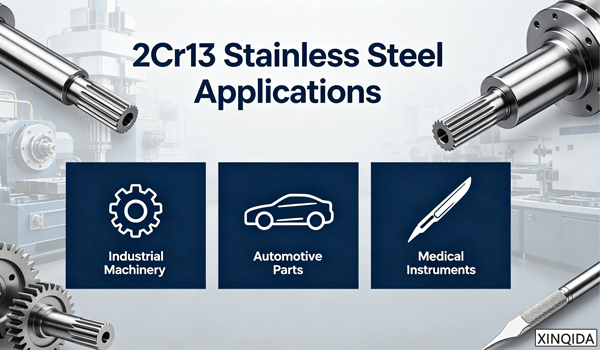
2Cr13 stainless steel (also known as 20Cr13, equivalent to 1.4021, SUS420J1, and AISI 420) is a widely used martensitic stainless steel in precision manufacturing industries.
It is designed for engineering applications that require a balance of:
- High mechanical strength
- Heat treatable hardness
- Moderate corrosion resistance
- Good machinability (especially in annealed condition)
- Cost-effective production for CNC machining
Because of this balanced performance, 2Cr13 is commonly used in CNC machined components across medical, industrial, and automotive sectors.
Table of Contents
ToggleOverview of 2Cr13 Stainless Steel Material Properties
2Cr13 contains approximately:
- Carbon (C): ~0.2%
- Chromium (Cr): ~13%
This composition allows it to form a protective chromium oxide layer while still enabling heat treatment hardening.
Key Engineering Characteristics:
- Heat treatable (quenching + tempering)
- High hardness after processing
- Magnetic stainless steel
- Moderate corrosion resistance
- Good strength-to-cost ratio
Engineering Limitation:
2Cr13 is not suitable for:
- Strong acids
- High chloride seawater environments
- Long-term marine immersion
In such environments, 316L or duplex stainless steels are preferred.
Why 2Cr13 Is Widely Used in CNC Machining
2Cr13 is highly suitable for CNC machining of precision parts, especially when components require post-processing heat treatment.
CNC Manufacturing Advantages:
- Good machinability in annealed state
- Suitable for CNC turning, milling, drilling
- Stable dimensional control after heat treatment
- Good surface finish after polishing
- Cost-efficient for mass production
Typical CNC applications:
- Shafts
- Valve cores
- Fasteners
- Precision mechanical connectors
- Wear-resistant structural parts
Medical Applications of 2Cr13 Stainless Steel
In the medical industry, 2Cr13 is mainly used for non-implantable precision instruments.
Common Medical CNC Parts:
- Surgical forceps and clamps
- Scissors and cutting tools
- Dental instruments
- Reusable surgical tool components
- Medical device structural parts
Why It Is Used:
- Can be polished to high surface finish
- Resistant to repeated sterilization cycles
- Maintains sharp cutting edges after heat treatment
- Suitable for precision CNC machining
Note: Not suitable for implants (316L or titanium is required for biocompatibility).
Industrial Applications of 2Cr13 Stainless Steel
Industrial equipment is the largest application field of 2Cr13 stainless steel.
Common CNC Machined Industrial Parts:
- Pump shafts
- Valve stems and valve cores
- Mechanical seals and sleeves
- Gear and transmission components
- Mold inserts and tooling parts
- Industrial fasteners
Application Advantages:
- Excellent wear resistance under friction
- Stable mechanical strength under load
- Good corrosion resistance in humid environments
- Cost-effective alternative to high-alloy stainless steels
2Cr13 is widely used in fluid control systems, machinery equipment, and general industrial automation parts.
Automotive Applications of 2Cr13 Stainless Steel
In the automotive industry, 2Cr13 is used for medium-load functional components requiring durability and corrosion resistance.
Typical Automotive CNC Parts:
- Brake system pins and sleeves
- Exhaust system brackets and connectors
- Transmission control components
- Door lock and latch mechanisms
- Seat adjustment and linkage parts
- Sensor and electromechanical housings
Why Automotive Engineers Use 2Cr13:
- Good fatigue resistance after heat treatment
- Stable performance under vibration
- Resistant to road moisture and corrosion
- Suitable for high-volume CNC production
- Balanced cost and durability
Heat Treatment and CNC Machining Considerations
Heat treatment is critical to unlocking the full performance of 2Cr13.
Standard Process:
- Annealing → improves machinability
- Quenching → increases hardness
- Tempering → improves toughness
CNC Machining Best Practices:
- Machine in annealed condition whenever possible
- Use carbide cutting tools
- Apply proper coolant to reduce tool wear
- Allow machining allowance for post-heat-treatment deformation
- Avoid overheating during cutting to prevent work hardening
2Cr13 vs Other Stainless Steels
| Material | Hardness | Corrosion Resistance | Machinability | Typical Use |
|---|---|---|---|---|
| 1Cr13 | Medium | Moderate | Easy | Basic mechanical parts |
| 2Cr13 | High (after HT) | Medium | Medium | Industrial & precision parts |
| 3Cr13 | Medium | Lower | Easy | Cutlery & low-cost tools |
| 304 | Low | High | Good | Food & chemical industry |
| 316L | Low | Very High | Medium | Medical implants / marine |
👉 2Cr13 is the best choice for heat-treated CNC mechanical parts requiring strength + cost efficiency.
Conclusion
2Cr13 stainless steel is a highly practical martensitic material widely used in CNC machined precision components across medical, industrial, and automotive industries.
Its main advantage lies in its ability to combine:
- Heat treatable strength
- Wear resistance
- Machinability
- Cost efficiency
For manufacturers and engineers, 2Cr13 provides an ideal solution for medium-corrosion, high-strength mechanical parts where performance and cost must be balanced.


