
In CNC machining and mechanical manufacturing, selecting the right stainless steel grade directly affects machining efficiency, tool life, cost, and final part performance.
Among martensitic stainless steels, 1Cr13, 2Cr13, and 3Cr13 are widely used due to their balance of strength and corrosion resistance. However, their machinability differs significantly, making material selection critical for engineers and buyers.
This guide compares these three materials from a CNC machining perspective and helps you choose the most suitable grade for your project.
Table of Contents
ToggleWhat Are 1Cr13, 2Cr13, and 3Cr13 Stainless Steels?
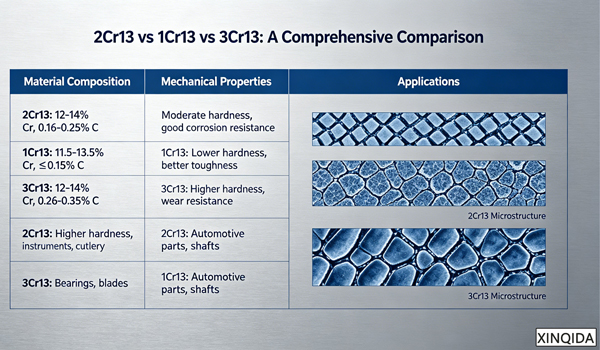
These three materials belong to the Cr13 martensitic stainless steel family, with chromium content around 11.5%–14%, providing basic corrosion resistance.
The main difference is carbon content, which directly determines hardness and machinability.
| Grade | Carbon Content | Characteristics |
|---|---|---|
| 1Cr13 | 0.08–0.15% | Softest, best machinability |
| 2Cr13 | 0.16–0.25% | Balanced performance |
| 3Cr13 | 0.26–0.35% | Highest hardness, hardest to machine |
Higher carbon = higher hardness = lower machinability.
Machinability Comparison for CNC Machining
1Cr13 – Best Machinability
1Cr13 has the lowest hardness and excellent machinability.
Low cutting resistance
Low tool wear
Easy chip breaking
Suitable for complex CNC parts
Best for:
Low-load mechanical parts
Structural components
High-efficiency machining projects
2Cr13 – Best Balanced Choice (Most Popular)
2Cr13 provides a balance between machinability and mechanical strength.
Medium hardness
Stable cutting performance
Moderate tool wear
Can be heat treated for higher strength
Best for:
Shafts
Valve components
Pump parts
General industrial CNC parts
2Cr13 is the most commonly used grade in CNC machining production.
3Cr13 – Hardest to Machine
3Cr13 has the highest hardness and wear resistance.
High cutting resistance
Fast tool wear
Requires carbide or coated tools
Lower machining efficiency
Best for:
Knives and blades
Wear-resistant parts
High-hardness industrial components
Tool Wear and Machining Cost Comparison
From a CNC manufacturing perspective:
1Cr13 → Lowest machining cost
2Cr13 → Medium cost (best balance)
3Cr13 → Highest cost
Higher carbon content increases hardness, which leads to faster tool wear and slower machining speed.
Heat Treatment Impact on Machinability
Machinability is strongly affected by heat treatment condition.
Annealed state:
Lower hardness
Better machinability
Preferred for CNC rough machining
Hardened state:
Higher strength
Lower machinability
Higher tool wear
Notes:
1Cr13 is easy to machine in most conditions
2Cr13 is usually machined in annealed state before heat treatment
3Cr13 often requires pre-annealing before machining
Drilling, Tapping & Grinding Performance
Drilling and tapping require good plasticity and toughness.
1Cr13:
Excellent drilling and tapping performance
Low tool breakage risk
2Cr13:
Moderate difficulty
Requires proper tool selection
3Cr13:
Difficult machining
High risk of drill and tap failure
Grinding:
1Cr13: easy, high surface finish
2Cr13: balanced performance
3Cr13: difficult but high wear resistance after grinding
Application Differences
1Cr13 applications:
Low-stress mechanical parts
Structural components
Cost-sensitive CNC parts
2Cr13 applications:
Pump shafts
Valve parts
Fasteners
Industrial machinery components
3Cr13 applications:
Cutting tools
Wear-resistant components
High-hardness industrial parts
Which Stainless Steel Is Best for Machining?
Best machinability: 1Cr13
Easiest cutting
Lowest tool wear
Best balance: 2Cr13
Stable machining performance
Best overall industrial choice
Highest hardness: 3Cr13
Best wear resistance
Most difficult to machine
Final Recommendation for CNC Buyers
From a real CNC machining perspective, 2Cr13 is the most practical and widely used material.
It offers:
Good machinability in annealed state
Strong mechanical properties after heat treatment
Stable production cost
Wide industrial applications
Conclusion
There is no single “best” material among 1Cr13, 2Cr13, and 3Cr13. The correct choice depends on application requirements.
Choose 1Cr13 for lowest machining cost and easiest processing
Choose 2Cr13 for balanced performance and general CNC use
Choose 3Cr13 for high hardness and wear resistance applications
For most CNC machining projects, 2Cr13 provides the best overall balance between performance and cost.


