
Precision CNC Turning Parts: Diamond Knurled Threaded Sleeve / Coupling Nut with Internal Thread
Description
1. Product Overview
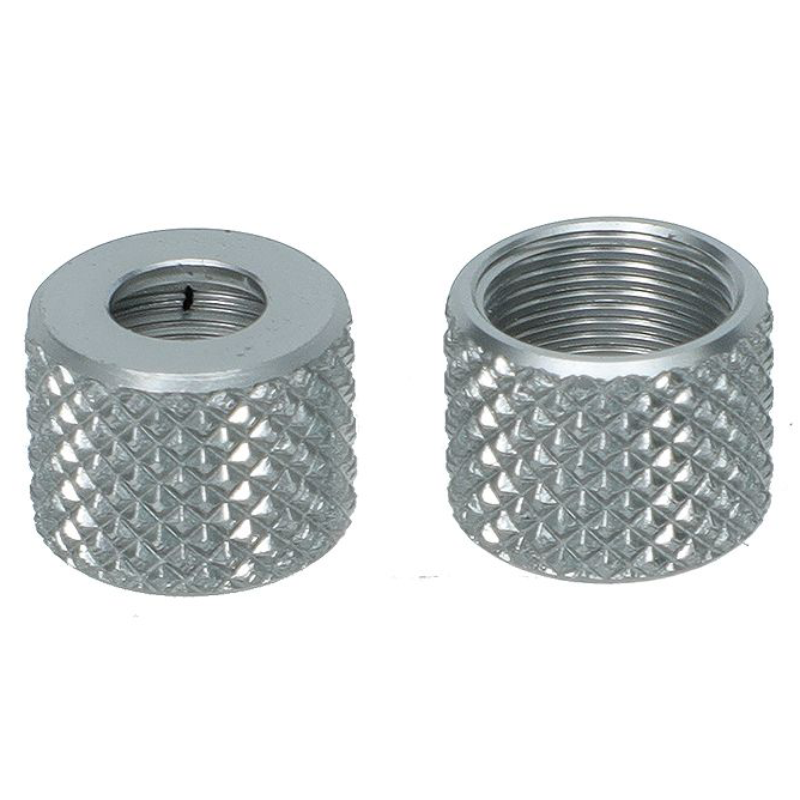
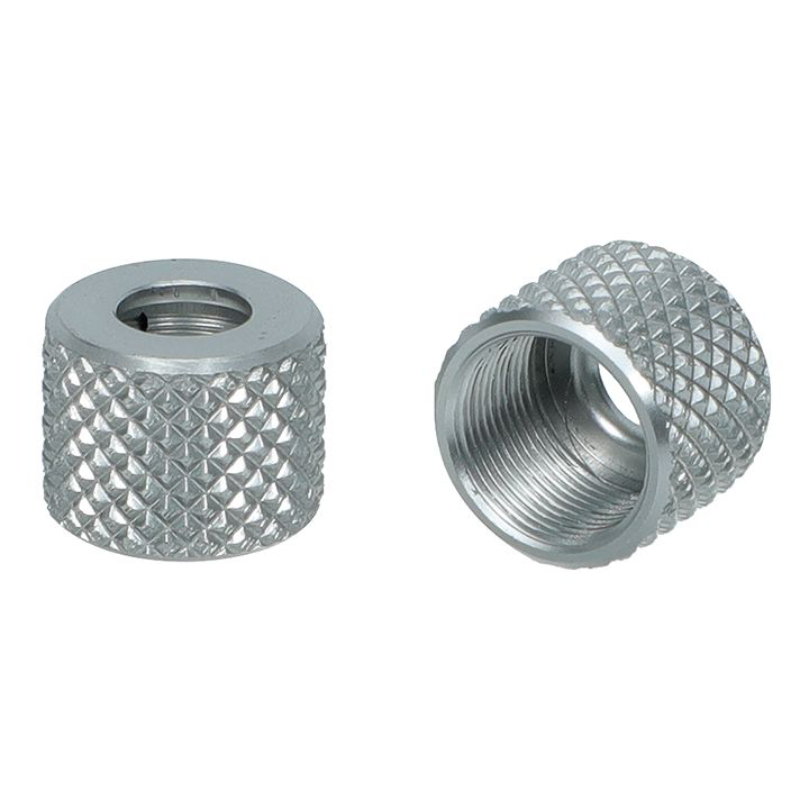
This custom-machined Diamond Knurled Threaded Sleeve (also known as a Knurled Coupling Nut or Thumb Nut) is a high-precision cylindrical fastener manufactured via advanced CNC Turning processes. Characterized by its external diamond knurling and full internal threading, this component provides an excellent, tool-free grip for manual tightening and secure fastening.
Whether used as a 3D printer heatbed leveling nut, a panel-mounting adjuster, or a mechanical coupling sleeve, our precision CNC turning services ensure consistent geometry, tight tolerances, and superior surface finishes in both Aluminum and Stainless Steel. Browse our full range of custom CNC machined fastener parts for more threaded sleeves, nuts, and precision fastening solutions.
2. CNC Machining Parameters (Technical Specification Table)
To help you evaluate our manufacturing capabilities, we provide a standard reference table for this type of CNC turning component. Please note that tight tolerances are achievable based on your specific drawings.
| Parameter Category | Specification Details | Capability / Tolerance |
|---|---|---|
| Primary Process | CNC Turning (CNC Lathe) + CNC Knurling | Multi-axis lathe available for complex features |
| Available Materials | Aluminum: 6061, 6063, 7075 Stainless Steel: 304, 316, 303 Brass / Copper: C36000, C110 Carbon Steel: 1045, 12L14 |
Material certification (EN 10204 3.1) available upon request |
| Standard Thread Types | Metric (M2 – M30), UNC, UNF, BSPP, BSPT, NPT | Threads inspected with Go/No-Go gauges |
| Dimensional Tolerance | General +/- 0.01mm to +/- 0.05mm (based on size) | Precision class: Up to +/- 0.005mm on critical O.D. and I.D. |
| Knurling Type | Diamond Knurling (Standard); Straight Knurling optional | Pitch: 0.5mm – 1.5mm (customized to hand-grip needs) |
| Surface Finish Options | Aluminum: Clear/Color Anodizing, Sandblasting Stainless: Electropolishing, Passivation Steel: Zinc/Nickel Plating, Black Oxide |
Ra 0.8μm – 3.2μm (Standard) / Ra 0.4μm (Fine turning) |
| Max. Outer Diameter | Up to 200mm (depending on lathe chuck size) | – |
| Packaging | Anti-rust paper, Bubble wrap, Cartons, or Custom blister tray | Guaranteed no scratches on knurling tips |
3. Key Materials & Analysis
Choosing the right material for your threaded sleeve depends on its operating environment and mechanical requirements.
| Material | Primary Advantage | Typical Application |
|---|---|---|
| Aluminum 6061-T6 | Lightweight, excellent machinability, moderate strength, cost-effective. | 3D printer parts, consumer electronics housing, lightweight automated machinery. |
| Stainless Steel 304 / 316 | Superior corrosion resistance, high durability, withstands high temperatures. | Medical devices, outdoor equipment, food processing machinery, marine applications. |
| Brass C36000 | High machinability, excellent electrical conductivity, anti-sparking. | Electrical connectors, pneumatic valves, decorative hardware. |
| Alloy Steel 4140 | High tensile strength and wear resistance, ideal for heavy load. | Heavy industrial coupling, automotive suspension components. |
4. Manufacturing Challenges & Solutions
While this part appears simple, mass-producing a Diamond Knurled Threaded Sleeve with precision presents several engineering hurdles. Here is how we overcome them:
Challenge 1: Knurling Quality & Burrs
-
The Issue: The diamond knurling process exerts significant radial pressure. If not controlled, it can distort thin-walled sleeves or leave sharp metal burrs on the tooth tips, making the part dangerous to handle.
-
Our Solution: We use form knurling tools with precise feed rates and multi-pass cycles. After knurling, we perform a secondary deburring operation (vibratory finishing or manual polishing) to ensure the grip is comfortable and safe.
Challenge 2: Concentricity between Outer Diameter and Internal Thread
-
The Issue: If the internal thread is cut after the outer knurling is done, misalignment can cause the sleeve to wobble when screwed onto a rod.
-
Our Solution: We employ single-setup turning on advanced CNC lathes where the outer OD, knurling, and internal threading are completed in a single clamping operation, ensuring perfect concentricity within 0.01mm.
Challenge 3: Thread Breakage in Thin-Walled Designs
-
The Issue: When the sleeve has a thin wall, the cutting force from tapping can cause thread tear or deformation.
-
Our Solution: We use form taps instead of cut taps for specific materials, and we design custom holding fixtures to prevent flexing during the tapping process.
5. Tight Tolerance Capabilities (Quality Assurance)
We understand that a threaded insert is a critical connecting component. Our quality management system ensures:
-
Standard Tolerance: ISO 2768-mK (General precision)
-
High-Precision Requirements: We can hold I.D. and O.D. concentricity to 0.005mm and thread pitch diameter to Class 2B (Metric 6H) accuracy.
-
Inspection Tools: Our quality team utilizes digital micrometers, height gauges, thread ring/plug gauges, and CMM (Coordinate Measuring Machine) for a full inspection report per batch.
-
Certification: Available parts include Material Test Reports and PPAP (for automotive/medical clients).
6. Typical Application Scenarios
Due to its “tool-free” operation and versatile shape, this product is widely adopted across diverse industries:
-
3D Printing & Additive Manufacturing: Used as a manually adjusted heatbed leveling nut and for extruder tension adjustments.
-
Industrial Automation: Serves as a positioning locking sleeve on sensor brackets, camera mounts, and adjustment knobs.
-
Medical & Laboratory Equipment: Utilized as hand-tightened screw sleeves for microscope adjustment and test tube racks, where easy cleaning and sterilization are required (using 316SS).
-
Consumer Electronics & Furniture: Used as threaded inserts embedded into plastic or wood casings to create a durable, metallic thread for screws.
-
Pneumatic/Hydraulic Systems: Functions as a crossover connection sleeve for quick-disconnect hose fittings.
7. Frequently Asked Questions (FAQ)
Q1: Is this a standard stock item, or can it be customized?
A: We specialize in custom CNC machining. While we keep some standard sizes in stock for sampling, the vast majority of our production is customized per your engineering drawing (2D/3D). We can tailor the diameter, thread pitch, knurling pitch, height, and material to your exact specifications.
Q2: What is your typical lead time for a prototype and mass production?
A: For a standard sample/prototype, we usually require 3-5 working days. Mass production lead time is 15-20 working days, depending on the order quantity and complexity of the surface treatment (e.g., anodizing or plating).
Q3: Can you machine threads that are not metric, like NPT or BSP?
A: Absolutely. Our CNC lathes are equipped with a wide range of threading tools. We frequently machine UNC, UNF, NPT (National Pipe Thread), BSPP, BSPT, and custom ACME threads to support global clients.
Q4: How do you ensure the knurling does not peel or wear off over time?
A: We use a cold-forming knurling process that displaces the metal rather than cutting it. This work-hardens the top layer of the material, making the diamond knurling extremely durable and resistant to flattening, even under heavy hand-tightening over its lifespan.
Q5: How do you handle shipping to avoid surface scratches on the delicate knurling?
A: We take packaging very seriously. The knurled parts are separated using soft foam partitions or individual plastic bags, ensuring the diamond peaks do not rub against each other during vibration in transit. We also use double-walled corrugated cartons for international shipping.
Additional information
| material |
|---|
Reviews
There are no reviews yet.