
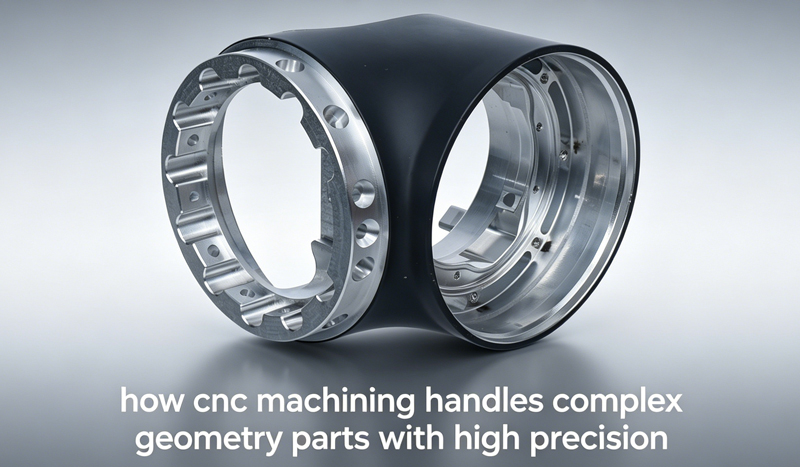
In modern manufacturing, complex geometry parts are becoming increasingly common across industries such as aerospace, robotics, medical devices, semiconductor equipment, automotive, and industrial automation. These components often include deep cavities, freeform curved surfaces, thin walls, undercuts, precision bores, and multi-axis features that are difficult or impossible to manufacture using traditional machining methods.
To meet the growing demand for tight tolerances and sophisticated structures, manufacturers rely on advanced CNC machining technologies — especially multi-axis CNC machining, intelligent CAD/CAM programming, and precision inspection systems. With the combination of digital manufacturing and high-performance machine tools, CNC machining has become the most effective solution for producing complex geometry parts with exceptional accuracy, repeatability, and efficiency.
Table of Contents
ToggleWhat Are Complex Geometry CNC Parts?
Complex geometry parts refer to components with intricate shapes, irregular contours, or difficult-to-machine structural features. These parts usually require advanced machining strategies and precision control throughout the manufacturing process.
Common features include:
Freeform curved surfaces
Deep cavities and pockets
Thin-wall structures
Undercuts and complex contours
Multi-axis holes
Internal grooves and channels
Precision bores and threaded features
Tight tolerance requirements
Multi-sided machining surfaces
These components are widely used in industries where dimensional accuracy and structural reliability are critical.
Main Challenges in Machining Complex Geometry Parts
Tool Accessibility
Deep cavities, narrow slots, and complex internal structures can be difficult for standard cutting tools to reach. Conventional 3-axis machining often cannot achieve the required cutting angles for these features.
Tight Tolerance Requirements
Complex geometry components frequently require tolerances as tight as ±0.005 mm or better. Maintaining such accuracy over multiple surfaces and features is extremely challenging.
Thin Wall Deformation
Thin-wall parts can easily deform during machining due to cutting force, heat accumulation, or vibration. Material distortion directly affects dimensional accuracy and surface quality.
Surface Finish Control
Complex curved surfaces require smooth and continuous tool movement. Poor toolpaths or unstable cutting conditions may cause chatter marks, profile distortion, or rough surface finishes.
Multi-Surface Positioning Errors
Complex parts often require machining on multiple sides. Repeated repositioning and manual clamping can introduce cumulative alignment errors that reduce assembly precision.
How CNC Machining Solves Complex Geometry Challenges
1. 5-Axis CNC Machining Technology
5-axis CNC machining is one of the most important technologies for manufacturing complex geometry parts with high precision.
Unlike traditional 3-axis machines, 5-axis machining centers allow the cutting tool to approach the workpiece from multiple directions simultaneously. This makes it possible to machine highly complex surfaces, angled features, undercuts, and deep cavities in a single setup.
Key advantages include:
Reduced repositioning errors
Higher dimensional accuracy
Improved surface finish
Better tool accessibility
Faster production cycles
Greater machining flexibility
5-axis CNC machining is widely used for aerospace blades, robotic components, medical implants, impellers, and semiconductor equipment parts.
2. Advanced CAD/CAM Programming
Modern CAD/CAM software plays a critical role in complex geometry machining.
CAD software creates accurate 3D digital models of the component, while CAM software generates optimized machining toolpaths based on the model geometry.
Advanced CAM systems can:
Optimize cutting trajectories
Minimize tool vibration
Maintain constant cutting loads
Prevent tool collisions
Improve machining efficiency
Enhance curved surface consistency
Simulation technology also allows engineers to detect machining issues before actual production begins, reducing trial-and-error costs.
3. Adaptive Toolpath and High-Speed Machining
Complex geometry machining often requires intelligent machining strategies such as:
Adaptive clearing
Trochoidal milling
High-speed machining (HSM)
Constant-load cutting
Dynamic toolpath optimization
These strategies reduce cutting pressure and heat generation while improving machining stability and tool life.
They are especially effective for machining aluminum, titanium, stainless steel, and hardened steel components with intricate geometries.
4. Precision Tooling and Fixturing
Specialized cutting tools are essential for machining complex structures.
Common tooling solutions include:
Ball nose end mills
Long-reach cutters
Tapered tools
Micro-diameter tools
Custom form cutters
At the same time, custom fixtures and precision clamping systems help minimize vibration and maintain stable positioning throughout the machining process.
Machine-mounted probing systems can also automatically measure positioning errors and apply real-time compensation.
5. Closed-Loop Precision Control Systems
High-end CNC machining centers use closed-loop servo control systems equipped with high-precision encoders and linear scales.
These systems continuously monitor:
Spindle movement
Tool position
Thermal variation
Mechanical deviation
Real-time feedback allows the CNC controller to automatically compensate for dynamic errors caused by vibration, thermal expansion, or machine movement.
This is essential for maintaining micron-level precision during long machining cycles.
6. In-Process Inspection and Quality Control
Modern CNC factories use advanced inspection systems to ensure the dimensional consistency of complex geometry parts.
Typical inspection equipment includes:
Coordinate Measuring Machines (CMM)
Laser measurement systems
Optical inspection devices
On-machine probing systems
Inspection data can be fed back into the machining system for continuous process optimization and accuracy improvement.
Industries That Depend on Complex Geometry CNC Machining
Aerospace
Aircraft engine components, turbine blades, and structural housings often feature highly complex curved surfaces and extremely tight tolerances.
Medical Devices
Artificial joints, surgical instruments, and implant components require precision machining with excellent surface finish and biocompatibility.
Robotics and Automation
Robot joints, EOAT components, and motion control systems rely heavily on multi-axis CNC machining and precision bores.
Semiconductor Equipment
Semiconductor manufacturing components require micron-level accuracy, contamination-free surfaces, and highly complex internal structures.
Automotive and EV Components
High-performance automotive parts, turbocharger housings, and EV precision components increasingly depend on advanced CNC machining technologies.
Key Precision Control Strategies in Complex Geometry Machining
Manufacturing high-precision complex geometry parts requires systematic process control throughout the entire production cycle.
Key strategies include:
Separating rough machining and finish machining
Optimizing cutting parameters for different materials
Controlling spindle and ambient temperature
Reducing vibration and cutting stress
Monitoring tool wear
Performing real-time process compensation
Conducting full-dimensional inspection
These methods help manufacturers achieve excellent dimensional stability, surface quality, and repeatability.
Future Trends in Complex Geometry CNC Machining
As manufacturing technology continues to evolve, complex geometry machining is moving toward:
AI-assisted toolpath optimization
Digital twin simulation
Intelligent adaptive machining
Automated inspection systems
Hybrid manufacturing technologies
Smart factory integration
Unmanned CNC production
These innovations will further improve machining precision, production efficiency, and manufacturing flexibility.
Conclusion
Complex geometry parts represent one of the highest levels of modern precision manufacturing. Producing these components requires far more than basic machining capability — it demands advanced CNC equipment, multi-axis motion control, intelligent CAM programming, precision tooling, stable fixturing, and strict quality management.
With the rapid development of 5-axis CNC machining, adaptive machining strategies, and intelligent inspection systems, manufacturers can now produce highly sophisticated components with exceptional precision, consistency, and efficiency.
For industries requiring advanced structural performance and tight tolerance manufacturing, CNC machining remains one of the most powerful and reliable production solutions available today.


