
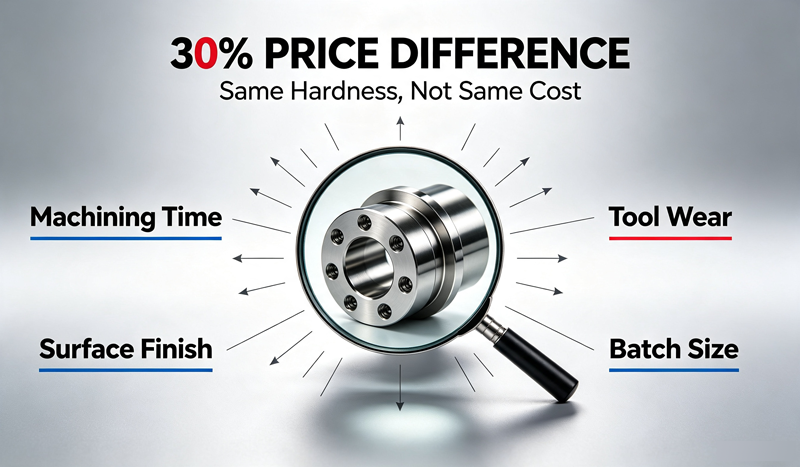
In the world of precision CNC machining, few things confuse procurement teams more than receiving completely different quotes for what appears to be the exact same stainless steel part.
Same material.
Same hardness requirement.
Same engineering drawing.
Yet Supplier A quotes $8 per piece, while Supplier B quotes $11 per piece — nearly a 30% price difference.
Consider this common scenario:
| Requirement | Specification |
|---|---|
| Material | 17-4PH Stainless Steel |
| Heat Treatment | Required |
| Hardness Requirement | HRC 38–42 |
| Dimensional Tolerance | ±0.02 mm |
On paper, the requirements look identical.
So why does one supplier charge significantly more?
Is Supplier B simply adding unnecessary margin?
The answer is usually no.
The real difference comes from metallurgy, heat treatment strategy, machining sequence, equipment selection, quality control, and risk management.
A reliable stainless steel CNC machining supplier does not only deliver the required hardness value — they control the entire process chain to ensure dimensional stability, corrosion resistance, and long-term performance.
Table of Contents
Toggle1. Same Hardness Does Not Mean Same Heat Treatment Process
The biggest reason behind quote differences is often the heat treatment route.
For precipitation-hardening stainless steel such as 17-4PH, achieving HRC 38–42 can be achieved through different manufacturing strategies.
Although the final hardness is similar, the cost structure can be completely different.
Option A: Pre-Hardened Material + CNC Machining
Process flow:
Aged 17-4PH material → CNC machining → Inspection → Shipment
Advantages:
- Shorter production cycle
- No additional heat treatment processing
- Lower risk of heat treatment distortion
- Suitable for general precision components
Disadvantages:
- Higher raw material cost
- Harder material increases machining difficulty
- Limited ability to adjust mechanical properties after machining
Option B: Solution Treatment → Rough Machining → Aging → Finish Machining
Process flow:
Solution-treated material → Rough CNC machining → Aging treatment → Finish machining → Final inspection
Advantages:
- Better control of mechanical properties
- Improved dimensional stability
- Suitable for critical precision components
- Better control over final hardness distribution
Disadvantages:
- More processing steps
- Longer lead time
- Higher heat treatment and inspection cost
Both methods can achieve HRC 38–42.
However, the manufacturing cost difference can be significant — and this difference appears directly in supplier quotations.
2. Machining Sequence Around Heat Treatment Directly Affects CNC Cost
For stainless steel CNC parts, the order of machining and heat treatment has a major impact on cost.
Machining Before Heat Treatment
Process:
Soft material machining → Heat treatment → Final inspection
Advantages:
- Easier cutting
- Higher cutting speed
- Longer tool life
- Lower CNC machining cost
Disadvantages:
- Heat treatment may cause:
- Distortion
- Internal stress release
- Dimensional changes
For parts requiring:
- ±0.01 mm tolerance
- High concentricity
- Tight flatness requirements
additional finishing operations may become necessary.
Machining After Heat Treatment
Process:
Heat-treated material → Hard machining → Final finishing
Advantages:
- More stable final dimensions
- Reduced distortion risk
- Better control of final geometry
Disadvantages:
- Lower cutting speed
- Higher tool wear
- Longer machining cycle time
The CNC machining cost difference between soft and hardened stainless steel machining can easily reach:
20%–40%
This alone can explain a large portion of the 30% quotation gap.
3. Different Stainless Steel Grades Require Different Hardening Methods
Many buyers compare only the hardness value and overlook the stainless steel family.
Different grades achieve hardness through completely different mechanisms.
| Stainless Steel Grade | Hardening Mechanism | Cost Impact |
|---|---|---|
| 17-4PH | Precipitation hardening (solution + aging) | Moderate |
| 440C | Quenching + tempering | Higher due to distortion risk |
| 420 | Quenching + tempering | Moderate |
| 304 / 316 | Cannot be hardened by conventional heat treatment | Additional surface treatment required |
For example:
304 and 316 stainless steel cannot achieve high hardness through traditional heat treatment.
If higher surface hardness is required, processes such as:
- Nitriding
- Surface hardening treatment
may be required.
These additional processes can increase the total cost by 20% or more.
4. Furnace Type and Atmosphere Create a Hidden Cost Difference
Not all heat treatment equipment provides the same results.
The furnace type directly affects:
- Surface quality
- Hardness consistency
- Oxidation control
- Dimensional stability
Air Furnace (Lower Cost Approach)
Characteristics:
- No vacuum environment
- Lower operating cost
- Lower energy consumption
Potential disadvantages:
- Oxidation
- Surface discoloration
- Scale formation
- Reduced surface quality
- Less hardness uniformity
Suitable for:
- General industrial parts
- Non-critical components
Vacuum Heat Treatment Furnace (Precision Approach)
Characteristics:
- Vacuum environment
- Protective inert gas atmosphere
- Better surface protection
Advantages:
- No oxidation
- Cleaner surface
- Better hardness consistency
- Improved process control
Common applications:
- Medical equipment
- Semiconductor components
- Automation precision parts
- Aerospace components
The equipment and operating cost difference can contribute:
10%–18% additional cost
5. Post-Heat-Treatment Finishing: The Cost of Distortion Control
Heat treatment creates internal stress.
Internal stress can lead to:
- Warping
- Dimensional change
- Roundness issues
- Flatness deviation
Example:
A thin-wall stainless steel sleeve requires:
- Outer diameter tolerance: ±0.01 mm
- Roundness: ≤0.01 mm
Two suppliers may choose completely different approaches.
Low-Cost Approach
Heat treatment → Measure distortion → Correct defects afterward
Risk:
- Higher rejection probability
- Additional grinding cost
- Longer delivery time
High-Reliability Approach
Rough machining → Heat treatment → Stress control → Finish grinding → Final inspection
Advantages:
- Better dimensional stability
- Lower scrap rate
- Higher consistency
For materials like 440C, quenching creates higher thermal stress and often requires additional grinding.
By comparison, 17-4PH aging usually produces less distortion and requires less corrective machining.
Post-treatment finishing differences can contribute:
7%–10% additional cost
6. Number of Heat Treatment Cycles Changes the Total Cost
There is no single heat treatment route for achieving the same hardness.
Different suppliers may use different process chains.
Basic Process
Rough machining → Quench + temper
Lower cost, but higher distortion risk.
Standard Precision Process
Rough machining → Solution treatment → Aging → Finish machining
Better control for precision parts.
High-End Precision Process
Rough machining → Stress relief → Semi-finishing → Solution treatment → Aging → Final machining
Highest stability, but more expensive.
Each additional furnace cycle increases:
- Energy consumption
- Handling cost
- Inspection requirements
- Production time
7. Quality Control Standards and Scrap Allowance Affect Pricing
Lower-cost suppliers may reduce expenses by simplifying process control.
Examples:
- Shorter heat treatment holding time
- Less frequent hardness testing
- Limited dimensional inspection
- Reduced documentation
This may reduce the initial quotation but increases production risk.
A professional stainless steel CNC machining supplier typically provides:
- Controlled heating curves
- Batch hardness verification
- Metallographic analysis when required
- Dimensional inspection after treatment
- Material traceability
- Heat treatment records
These quality controls increase cost but reduce:
- Batch rejection
- Assembly problems
- Field failures
8. Batch Size and Documentation Requirements Influence Heat Treatment Cost
Heat treatment furnaces have fixed setup costs.
A large production batch can distribute furnace costs across many parts.
A small batch or prototype order carries a higher cost per piece.
Additional requirements also increase pricing:
- Heat treatment charts
- Material certificates
- 100% hardness inspection
- CMM inspection reports
- Full traceability documents
Case Study: Stainless Steel Precision Shaft HRC 38–42
| Cost Factor | Low-Cost Approach | Premium Approach | Cost Difference |
|---|---|---|---|
| Material | 420 Stainless Steel | 17-4PH Stainless Steel | ~13% |
| Heat Treatment | Air furnace, single cycle | Vacuum furnace, controlled aging | ~10% |
| Post-HT Machining | Grinding after distortion | Stable finishing process | ~5% |
| Quality Control | Limited inspection | Full inspection & documentation | ~2% |
| Total Cost Difference | ≈30% |
What Procurement Teams Should Ask Before Comparing CNC Quotes
Do not compare suppliers only by:
“Can you achieve HRC 38–42?”
Instead, ask for:
Material Information
- Exact stainless steel grade
- Material certificate
- Mechanical property requirements
Heat Treatment Information
- Complete process flow
- Furnace type
- Heat treatment standard
- Expected distortion range
Production Information
- Machining sequence
- Post-treatment finishing method
- Inspection process
Cost Structure
- Batch production price
- Prototype/sample price
- Documentation requirements
What Engineers Should Consider
Hardness is only one performance factor.
For precision stainless steel CNC components, engineers should also evaluate:
- Corrosion resistance
- Dimensional stability
- Fatigue performance
- Wear resistance
- Operating environment
For high-precision parts:
17-4PH precipitation hardening stainless steel is often preferred over quench-hardening grades because it provides:
- Good strength
- Lower distortion
- Better dimensional control
Conclusion: The Real Reason Behind a 30% CNC Quote Difference
A 30% price difference between stainless steel CNC machining suppliers does not necessarily mean one supplier is overcharging.
The difference usually comes from:
- Stainless steel grade selection
- Heat treatment method
- Furnace equipment
- Machining sequence
- Distortion control strategy
- Quality inspection level
- Documentation requirements
- Production batch size
The cheapest quotation may reduce initial cost but can create hidden expenses through:
- Higher scrap rates
- Dimensional failures
- Rework
- Delayed assembly
- Field reliability issues
For critical stainless steel precision components, selecting the right heat treatment strategy is often more important than selecting the lowest initial price.
A reliable CNC machining supplier delivers not only the required hardness value — but also consistent performance, stable dimensions, and predictable production quality.
Frequently Asked Questions (FAQ)
Why do two CNC suppliers quote different prices for the same stainless steel part?
Because the quotation depends on more than material and hardness. Heat treatment method, machining sequence, furnace type, inspection requirements, and scrap control all influence the final cost.
Is 17-4PH more expensive than 420 stainless steel?
Generally yes. 17-4PH has higher material cost, but it offers better dimensional stability and lower distortion risk after heat treatment.
Can 304 stainless steel reach HRC 40 hardness?
Not through conventional heat treatment. Additional surface hardening processes such as nitriding may be required.
Does vacuum heat treatment improve CNC part quality?
For precision stainless steel components, vacuum heat treatment can reduce oxidation, improve surface quality, and provide better process consistency.


Interessante. Estúdio de transcrição: Gem Transcribe . Gem Transcribe
Great article, thanks for sharing! For cinematic AI video I recommend MiniMax H3 Video Generator: /. MiniMax H3 Video Generator