
Table of Contents
ToggleIntroduction
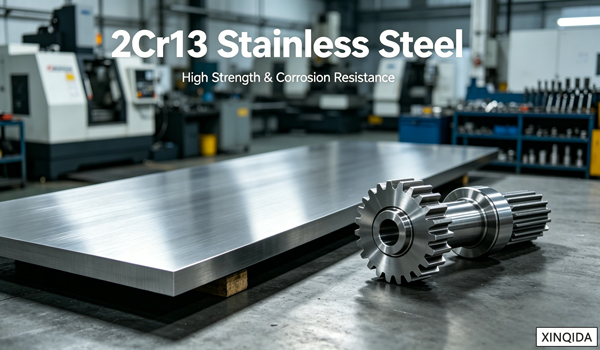
2Cr13 Stainless Steel (also known as 20Cr13 under the updated Chinese standard) is a martensitic stainless steel widely used in industrial manufacturing due to its excellent combination of strength, hardness, and wear resistance. It is commonly applied in CNC machined parts such as pump shafts, valve components, mold inserts, medical tools, and mechanical wear parts.
However, from a CNC machining perspective, 2Cr13 is not an easy material. Its high hardness after heat treatment, tendency toward work hardening, and relatively poor thermal conductivity often lead to tool wear, surface quality issues, and dimensional instability.
This article provides a complete engineering guide to 2Cr13 stainless steel CNC machining, covering material behavior, machining challenges, engineering solutions, and best practices—helping procurement teams and engineers select the right machining strategy and reliable CNC suppliers.
1. Material Overview: What Makes 2Cr13 Unique in CNC Machining?
1.1 Chemical Composition
| Element | Content (%) |
|---|---|
| Carbon (C) | 0.16 – 0.25 |
| Chromium (Cr) | 12.0 – 14.0 |
| Manganese (Mn) | ≤1.0 |
| Silicon (Si) | ≤1.0 |
| Phosphorus (P) | ≤0.04 |
| Sulfur (S) | ≤0.03 |
1.2 Mechanical Properties
After quenching and tempering:
- Tensile strength: ≥ 635 MPa
- Hardness: ~40–48 HRC
- High wear resistance
- Moderate toughness compared with austenitic stainless steels (such as 304/316)
1.3 Key Machining Characteristics
- Martensitic structure → high hardness & brittleness
- Easy work hardening during cutting
- Moderate corrosion resistance
- Medium machinability (more difficult than carbon steel or alloy steel)
These characteristics directly determine the CNC machining difficulty level.
2. Why 2Cr13 Is Widely Used in CNC Machining
Despite machining challenges, 2Cr13 remains a popular engineering material due to its balanced performance and cost efficiency.
Typical Applications
- Pump shafts and hydraulic components
- Valve stems and sealing parts
- Mold components and wear inserts
- Medical and cutting tools
- Mechanical transmission parts
Key Advantages
- Lower cost than 316 stainless steel
- Good hardness after heat treatment
- Excellent wear resistance
- Suitable for medium-load industrial environments
3. Key Challenges in 2Cr13 CNC Machining
In real CNC production environments, 2Cr13 machining often faces four major engineering challenges.
3.1 Severe Tool Wear and Short Tool Life
2Cr13’s hardness and abrasive martensitic structure significantly accelerate tool wear, especially after heat treatment.
Root Causes:
- High cutting resistance
- Elevated cutting temperature
- Friction between tool and hardened surface
- Improper cutting parameters
Impact:
- Frequent tool replacement
- Increased machining cost
- Reduced production efficiency
3.2 Work Hardening During Machining
One of the most critical issues in stainless steel machining.
Mechanism:
During cutting, the surface layer hardens by 30%–50%, forming a hardened “barrier layer”.
Consequences:
- Increased tool load in subsequent cuts
- Accelerated tool wear
- Dimensional deviation risk
- Possible part rejection
3.3 Chip Control Difficulties
2Cr13 tends to produce continuous and tough chips.
Problems:
- Chip wrapping around tool or workpiece
- Surface scratches
- Poor automation performance
3.4 Heat Treatment Deformation
Heat treatment is essential for performance but introduces dimensional instability.
Causes:
- Martensitic phase transformation
- Internal stress release
- Volume change during quenching
Risk:
- Out-of-tolerance final dimensions
- Rework or scrap parts
4. Engineering Solutions for CNC Machining 2Cr13
4.1 Tool Selection Strategy
Tool selection is the most important factor in machining success.
Recommended Tools:
- Carbide tools (preferred)
- High hardness
- Good heat resistance
- Stable performance
- Coated tools (TiAlN / TiN / AlTiN)
- Reduce friction
- Improve tool life
- CBN tools (for hardened condition ≥45 HRC)
- High-end finishing applications
- Expensive but extremely durable
4.2 Cutting Parameter Optimization
Proper machining parameters help reduce work hardening and extend tool life.
Rough Machining:
- Cutting speed: 80–120 m/min
- Feed: 0.15–0.35 mm/rev
- Depth of cut: 2–5 mm
Finish Machining:
- Cutting speed: 120–180 m/min
- Feed: 0.05–0.15 mm/rev
- Depth of cut: 0.1–0.5 mm
Key principle: avoid shallow “rubbing cuts” which increase work hardening.
4.3 Chip Control & Cooling Strategy
Effective Methods:
- High-performance cutting fluid (emulsion or oil-based)
- High-pressure coolant systems
- Chip breaker tool geometry
- Frequent chip removal in production
Goal: prevent chip accumulation and surface damage.
4.4 Heat Treatment & Process Planning
A proper process route is essential for dimensional accuracy.
Recommended Process Flow:
Raw Material→Rough Machining→Heat Treatment→Semi-Finishing→Finishing→Surface Treatment→Inspection\text{Raw Material} \rightarrow \text{Rough Machining} \rightarrow \text{Heat Treatment} \rightarrow \text{Semi-Finishing} \rightarrow \text{Finishing} \rightarrow \text{Surface Treatment} \rightarrow \text{Inspection}Raw Material→Rough Machining→Heat Treatment→Semi-Finishing→Finishing→Surface Treatment→Inspection
Key Principles:
- Annealing before machining reduces hardness
- Rough machining before heat treatment reduces deformation risk
- Finish machining after heat treatment ensures accuracy
5. Surface Treatment Options
To improve durability and corrosion resistance, post-processing is often required.
Common Treatments:
- Polishing → smooth surface finish
- Passivation → improved corrosion resistance
- Grinding → tight tolerance control
- Sandblasting → matte texture
- Black oxide → improved wear resistance
6. Best Practices for Stable CNC Production
6.1 Choose an Experienced CNC Supplier
A professional CNC machining factory should have:
- Proven experience in stainless steel machining
- Stable tooling systems
- Heat treatment coordination capability
- Quality inspection systems (CMM, hardness testing)
6.2 Material Certification Control
Always require:
- Material certificate (chemical composition compliance)
- Compliance with GB/T 1220-2019
- Incoming inspection (hardness + surface quality)
6.3 Quality Control During Production
- First article inspection (FAI)
- In-process dimensional checks
- Surface roughness verification
- Final inspection reports
6.4 Communication Between Customer and Supplier
Clear communication reduces production risks:
- 3D drawings and tolerance requirements
- Heat treatment expectations
- Surface finish requirements
- Application environment
7. Engineering Summary: Why 2Cr13 Machining Requires Experience
2Cr13 Stainless Steel is a cost-effective but technically demanding material in CNC machining. Its performance advantages only fully appear when:
- Cutting tools are properly selected
- Machining parameters are optimized
- Heat treatment process is well controlled
- Supplier has real stainless steel experience
Without proper engineering control, issues such as tool failure, deformation, and poor surface finish can significantly increase production cost.
Conclusion
2Cr13 stainless steel CNC machining is a balance between performance and manufacturability. While it presents challenges such as tool wear, work hardening, chip control difficulties, and heat treatment deformation, these problems can be effectively managed through proper engineering strategies and experienced manufacturing practices.
For procurement teams and engineers, selecting a capable CNC machining partner is the key to ensuring:
- Stable quality
- Controlled cost
- Reliable delivery time
- Long-term performance of parts


Pingback: 440B Vs 2Cr13 Stainless Steel Machinability Comparison | XINQIDA