
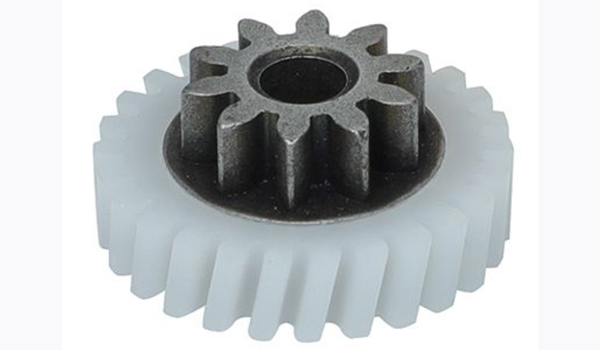
In industries such as industrial automation, precision motion control, and smart equipment, gears play a critical role in power transmission. Increasingly demanding requirements for accuracy, noise reduction, weight optimization, and service life have exposed the limitations of traditional single-material gears.
To address these challenges, hybrid gears combining a metal core, overmolded engineering plastic, and integrated bearing support have emerged as a preferred solution for high-performance transmission systems. By integrating CNC machining with precision injection molding, these gears deliver a balanced combination of strength, precision, and quiet operation.
Table of Contents
Toggle1. Core Structure: Multi-Material Integrated Design
This type of gear adopts a multi-layer hybrid structure, where each material is optimized for its specific function.
Metal Core (Load-Bearing Structure)
The inner core is typically made from high-strength metals such as:
- Aluminum alloys (e.g., 6061, 7075)
- Stainless steel (e.g., 304, 316)
Manufactured via CNC machining, the metal core:
- Handles torque and mechanical loads
- Ensures structural rigidity and deformation resistance
- Provides precise mounting references and concentricity control
Overmolded Plastic Gear Layer
The արտաքին gear teeth are formed using engineering plastics through injection overmolding onto the metal core.
Common materials include:
- POM (low friction, high dimensional stability)
- PA (impact resistance)
- PEEK (high-performance, high-temperature applications)
Key benefits:
- Self-lubricating properties reduce friction
- Significantly lower operating noise
- Reduced overall weight
- Improved wear resistance
Integrated Bearing Seat
A precision-machined bearing seat is incorporated into the gear body using CNC machining, allowing integration with standard bearings.
This design provides:
- High concentricity during rotation
- Stable radial and axial positioning
- Reduced assembly-induced misalignment
Note: Bearings themselves are standard components and are typically press-fitted or pre-assembled, not machined directly.
2. Manufacturing Process: CNC Machining + Injection Overmolding
Hybrid gears are produced using a multi-stage manufacturing process to ensure both structural integrity and dimensional accuracy.
CNC Machining of Metal Core
- Multi-axis CNC machining (3-axis, 4-axis, or 5-axis)
- Single setup machining of critical features (bore, bearing seat, datum surfaces)
- Tight tolerance control for concentricity and fit
Injection Overmolding of Gear Teeth
- Precision molds used for plastic gear formation
- Strong bonding between metal and plastic (mechanical interlock or chemical adhesion)
- Cost-effective for medium to high production volumes
Secondary Finishing (Optional)
Depending on application requirements:
- Gear tooth finishing or refinement
- Deburring and surface treatment
- Dynamic balancing
Quality Inspection
Comprehensive inspection ensures consistency and performance:
- Coordinate Measuring Machine (CMM)
- Gear measurement systems
- Runout and concentricity testing
3. Key Performance Advantages
Compared to traditional gear designs, hybrid gears offer a well-balanced set of performance benefits:
High Precision Transmission
- CNC-machined critical features ensure accuracy
- Excellent concentricity between gear and bearing seat
- Suitable for medium-to-high precision applications (e.g., ISO 7–9, depending on design)
Lightweight Yet Strong
- Metal core handles structural loads
- Plastic layer reduces overall weight
- Ideal for robotics and compact automation systems
Low Noise and Self-Lubrication
- Plastic tooth engagement reduces friction
- Quieter operation compared to metal gears
- Reduced lubrication requirements
Enhanced Wear and Impact Resistance
- Plastic layer absorbs shock loads
- Reduced tooth wear
- Improved durability compared to all-plastic gears
Flexible Customization
CNC machining allows full customization, including:
- Gear type (spur, helical, custom profiles)
- Module and tooth count
- Bore design (keyway, spline, interference fit)
- Material combinations tailored to application needs
4. Typical Applications
High-precision hybrid gears are widely used in applications where performance, noise control, and weight are critical:
Industrial Automation
- Robotic arms
- Linear motion modules
- Precision drive systems
Precision Instruments
- Optical equipment
- Testing and measurement devices
- Medical systems
Smart Equipment
- Service robots
- Camera gimbals and stabilization systems
Automotive Systems
- Seat adjustment mechanisms
- Mirror actuators
- Micro drive units
Smart Home Devices
- Motorized curtains
- Smart locks
- Compact actuation systems
5. Hybrid vs. Traditional Gears
| Type | Advantages | Limitations |
|---|---|---|
| All-Metal Gears | High strength, high temperature resistance | Noisy, heavier |
| Plastic Gears | Quiet, lightweight | Limited load capacity |
| Hybrid Gears | Balanced strength, low noise, lightweight | More complex manufacturing |
6. Conclusion
Hybrid gears featuring a metal core, overmolded plastic teeth, and integrated bearing support represent a modern solution for advanced transmission systems. By combining CNC precision machining with injection molding, these gears achieve an optimal balance of strength, accuracy, noise reduction, and durability.
With flexible customization capabilities, hybrid gears are well-suited for a wide range of industries and applications, making them a key component in next-generation precision engineering systems.


