Properties of Different Aluminum Grades

Different aluminum grades offer distinct mechanical and physical properties, all CNC machining-optimized to meet your application’s specific strength, corrosion resistance, or durability needs.

Aluminum Grade Density (g/cm³) Tensile Strength (MPa) [T6 Temper] Yield Strength (MPa) [T6 Temper] Elongation at Break (%) Max Service Temp (℃) Hardness (HB) Corrosion Resistance
1100 2.71 110-130 35-50 20-25 150 23-28 Good
Key Features: High purity, easy machining, no stress cracking risk
5052 2.68 230-260 190-210 12-15 175 60-70 Excellent (Seawater resistant)
Key Features: Medium strength, fatigue-resistant, minimal weld distortion
6061 2.70 290-310 240-260 10-12 200 75-85 Good
Key Features: Balanced performance, high dimensional stability, strength adjustable
6063 2.70 240-260 200-220 12-14 180 65-75 Good
Key Features: Low impurity, high surface finish, ideal for anodizing
7075 2.81 540-580 480-510 8-10 120 150-160 Moderate (Requires corrosion protection)
Key Features: Aerospace-grade strength, controlled cutting speed required
2024 2.78 470-500 320-350 10-12 120 120-130 Poor (Requires protection)
Key Features: High shear strength, post-machining stress relief needed
5083 2.66 300-330 210-240 15-18 175 80-90 Excellent
Key Features: High corrosion resistance, suitable for marine applications

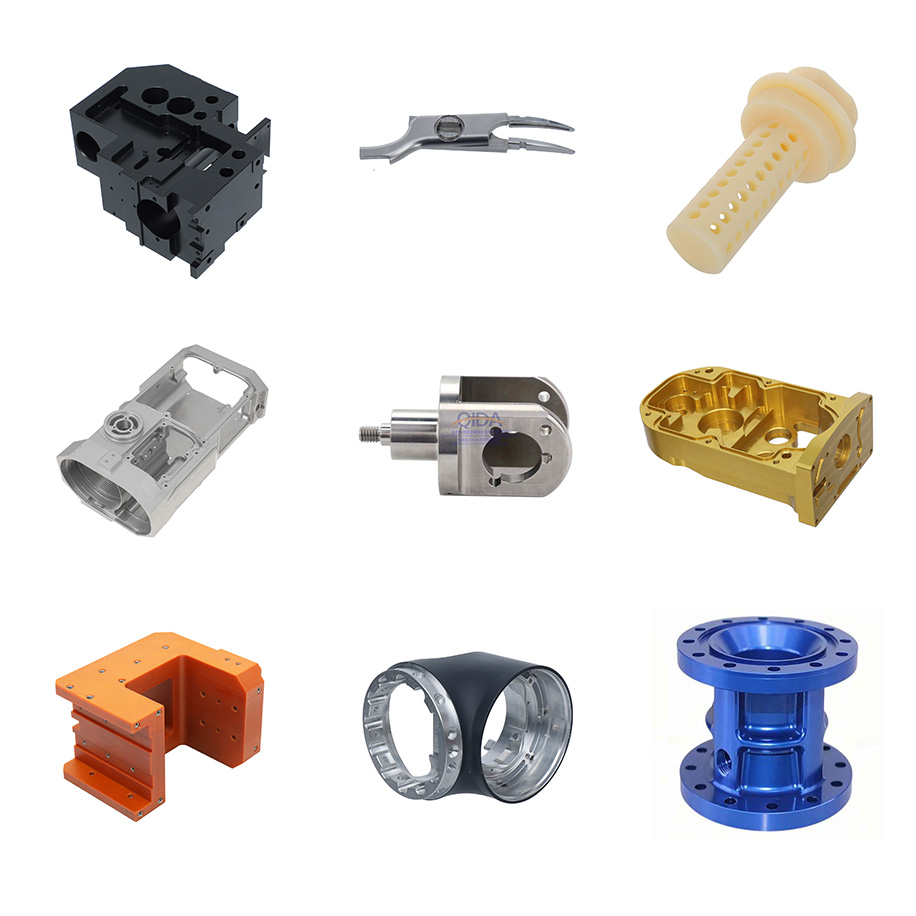
Applications of CNC Machined Aluminum Parts

Aerospace

Automotive

Electronic

Medical

Industrial Machinery

Optics

Robot

Semiconductor

Surface Finishing Options for Aluminum

Anodizing

Applicable to aluminum and aluminum alloys, the anodizing process significantly enhances the surface hardness (HV300-800) and salt spray resistance of components, while being dyeable to meet aesthetic requirements across multiple industries.

Powder Coating

Powder coating for aluminum, boasting core advantages of over 95% paint utilization rate and exceptional weather resistance (with an outdoor service life of more than 15 years), delivers dual decorative and protective functions through a straightforward process, making it the preferred choice for both commercial and industrial applications.

Electrophoretic Coating

Aluminum electrophoretic coating, catering to high-end requirements across diverse industries, combines decorative and protective properties with a coating that bonds tightly to the substrate and resists peeling, making it widely utilized in bathroom hardware, mid-frames for electronic devices, and other products.

Passivation

The passivation technology suitable for precision CNC aluminum components enhances corrosion resistance without compromising dimensional accuracy or appearance, and is widely utilized in high-end sectors such as electronics and automotive.

Cost-saving Design Tips

To cut costs while making aluminum alloy parts, first use DFM principles—don’t add features that are hard to machine.