
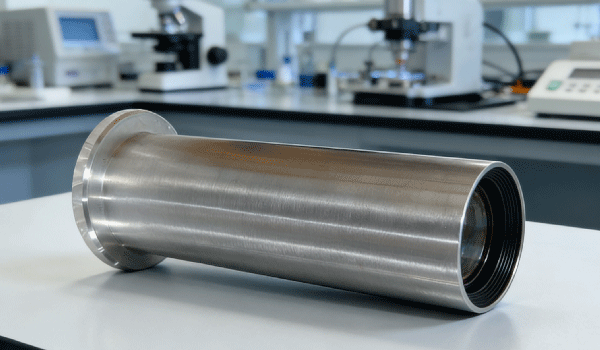
In high-end sectors such as infrared optical equipment, security surveillance, and industrial inspection, lens barrels serve as critical structural components—their precision, stability, and adaptability directly determine the imaging quality and operational reliability of optical systems. Particularly for core components of infrared zoom lenses, including focusing barrels and zoom cams, stringent requirements must be met: micron-level accuracy for internal curved grooves, smooth compatibility of zoom profiles, wear resistance through surface hardening, and a balance between lightweight design and structural rigidity. By integrating key technologies like multi-aging treatment of 6061-T6 aluminum alloy, 5-axis mill-turn machining, and PVD coating, custom optical lens barrels are transitioning from “functional adequacy” to “performance optimization,” becoming a cornerstone for advancing high-end optical devices.
Table of Contents
ToggleI. Material Selection: Multi-Aged 6061-T6 Aluminum Alloy—Laying the Foundation for Precision Manufacturing
The material choice for optical lens barrels hinges on three core demands: rigidity, lightweight construction, and stability. 6061-T6 aluminum alloy stands out as the preferred substrate for infrared zoom lens barrels due to its exceptional comprehensive properties, while multi-aging treatment further enhances its performance:
- Core Substrate Advantages: 6061-T6 aluminum alloy offers moderate strength (tensile strength ≥276MPa), excellent machinability, and weldability. With a density of only 2.7g/cm³, it effectively reduces the overall weight of infrared lenses, making it ideal for lightweight applications such as handheld devices and drone-mounted systems. Additionally, its superior thermal conductivity dissipates heat generated by optical components during operation, preventing temperature drift that could compromise imaging accuracy.
- Critical Role of Multi-Aging Treatment: To address residual stress-induced deformation in lens barrel machining, multi-stage aging treatment (2-3 cycles of artificial aging post-solution heat treatment) fully eliminates internal residual stresses, improving dimensional stability by over 30%. Multi-aged 6061-T6 aluminum alloy resists warping during subsequent 5-axis machining and PVD coating processes, ensuring long-term precision retention for critical structures like internal curved grooves and zoom cams—meeting the “smooth, repeatable focusing” requirement of infrared lenses.
- Structural Benefits of Seamless Aluminum Tubes: Utilizing one-piece seamless aluminum tubes as the base material eliminates stress concentration and dimensional deviations at joints (common in assembled structures), achieving an inner bore roundness tolerance of ±0.002mm. The seamless design not only enhances impact resistance and sealing performance but also minimizes refractive interference during infrared light transmission, safeguarding imaging clarity.
II. Machining Technology: 5-Axis Mill-Turn Machining—Overcoming Complex Structural Challenges
The core technical hurdles in infrared zoom lens barrel manufacturing lie in the precision machining of internal curved grooves, zoom cams, and zoom profiles—all requiring tight synergy between groove accuracy, profile conformity, and motion smoothness. 5-axis mill-turn machining emerges as the definitive solution to these challenges:
- Precision Breakthroughs with 5-Axis Interpolation: Unlike traditional 3-axis/4-axis machining, 5-axis mill-turn centers enable simultaneous X, Y, Z, A, and C axis movement, completing multiple processes (e.g., internal curved groove milling, zoom cam shaping, and zoom profile turning) in a single setup. This eliminates cumulative positioning errors from repeated clamping, reducing tolerances to within ±0.005mm. For internal curved grooves (typically 1-3mm wide with a depth tolerance of ±0.003mm), the 5-axis tool path dynamically adapts to curvature changes, ensuring a groove wall finish of Ra ≤0.02μm—laying the groundwork for smooth zoom mechanism operation.
- Balancing Efficiency and Quality with Integrated Mill-Turn: Combining turning (for precision finishing of outer diameters and end faces) and milling (for complex features like internal curved grooves and cam profiles) in one machine reduces production cycles by over 40% compared to sequential processing. Additionally, integrated machining minimizes damage risks during workpiece handling—critical for high-precision seamless aluminum substrates—preventing surface scratches that could impair subsequent coating adhesion.
- Customized Adaptation of Zoom Profiles and Cams: Variations in focal length ranges and focusing strokes across infrared zoom lenses demand tailored zoom profiles and cam geometries. 5-axis machining systems accurately replicate non-circular curves (e.g., sine curves, polynomial curves) from CAD/CAM designs, with real-time inspection feedback adjusting parameters to maintain a mesh clearance of 0.01-0.02mm between zoom cams and focusing barrels—delivering “backlash-free focusing and smooth zooming.”
III. Surface Enhancement: PVD Coating—Boosting Durability and Environmental Resilience
Infrared lens barrels operate in harsh environments (outdoor settings, industrial workshops) and require wear resistance, corrosion resistance, and scratch resistance. Physical Vapor Deposition (PVD) coating technology provides comprehensive surface hardening protection:
- Core Performance of PVD Coatings: Depositing hard coatings (e.g., TiN, TiCN) via PVD increases surface hardness to HV1800-2200—5-6 times that of raw 6061-T6 aluminum—significantly enhancing wear resistance. The coating can withstand tens of thousands of reciprocating cycles of the zoom mechanism without noticeable abrasion. With a thickness of only 2-5μm, it does not compromise the fit precision of critical structures like internal curved grooves and cams.
- Optimization for Infrared Optical Compatibility: PVD coatings exhibit excellent infrared transmittance, avoiding absorption or refraction of infrared light that could degrade imaging quality. Furthermore, the coatings offer superior corrosion resistance, withstanding moisture, dust, and mild chemical exposure while operating within a wide temperature range (-40℃ to 85℃)—suitable for outdoor security, industrial inspection, and other demanding applications.
- Synergistic Coating and Machining Quality Assurance: Post 5-axis machining, precision cleaning and vacuum coating ensure uniform PVD coverage. For complex features like internal curved grooves, ion-assisted deposition technology guarantees coating adhesion of ≥50N on hidden surfaces (e.g., groove walls, cam contact points), preventing peeling during use.
IV. Customization Capabilities: End-to-End Adaptation for Infrared Zoom Applications
The diversity of high-end infrared optical equipment necessitates highly customized lens barrels. Leveraging full-chain technical expertise in material selection, 5-axis machining, and surface treatment, end-to-end customization is delivered from design to delivery:
- Personalized Focusing Barrel Adaptation: Based on customer-specified parameters (focal length range, mounting dimensions, focusing stroke), custom focusing barrels are engineered with outer diameters (typically φ15-φ50mm), inner bore precision, and thread specifications tailored to exact requirements. Internal curved groove quantity, curvature, and zoom profile dynamics are matched to ensure seamless integration with the customer’s optical system.
- Scenario-Specific Custom Solutions: Differentiated designs address unique application needs:
- Security Surveillance Lens Barrels: Optimized zoom cam self-locking performance prevents focal drift from vibration; PVD coatings prioritize scratch resistance and weatherability.
- Industrial Inspection Lens Barrels: Tighter internal curved groove tolerance control (±0.002mm) for high-speed focusing; enhanced dimensional stability via advanced multi-aging treatment.
- Infrared Thermal Imaging Lens Barrels: Lightweight design with thin-walled seamless aluminum tubes (minimum wall thickness 1.2mm) maintaining structural rigidity; PVD coatings with infrared reflection suppression.
- Full-Process Quality Control: Adhering to ISO 9001/13485 quality standards, each production stage undergoes rigorous testing—from hardness verification of multi-aged 6061-T6 aluminum to real-time CMM (Coordinate Measuring Machine) sampling during 5-axis machining, and wear/adhesion testing post-PVD coating—ensuring consistency and reliability of custom products.
V. Technological Trends: Future Advancements in Infrared Zoom Lens Barrels
As infrared optical technology evolves toward “high resolution, miniaturization, and long service life,” lens barrel manufacturing will see three key advancements:
- Material Innovation: Exploring composite substrates like carbon fiber-reinforced aluminum to further balance lightweight design and rigidity.
- Precision Breakthroughs: Integrating 5-axis machining with AI-powered visual inspection to reduce internal curved groove tolerances to ±0.001mm.
- Surface Treatment Upgrades: Developing multi-functional PVD coatings combining wear resistance, stain resistance, and anti-static properties.
As core structural components of infrared zoom lenses, optical lens barrels directly define the performance limits of optical systems. By leveraging multi-aged 6061-T6 aluminum alloy, 5-axis mill-turn machining, PVD coating, and end-to-end customization, manufacturers can meet the stringent demands of high-end infrared equipment—supporting technological advancements in security, industrial, aerospace, and other sectors. Looking ahead, continuous innovation in manufacturing processes will drive further improvements in precision, stability, and adaptability, expanding the application scope of infrared optical devices worldwide.


