
Table of Contents
ToggleThe Key Significance of Process Selection and Discussion on CNC Machining Applicability
In the field of custom metal processing, the choice of technology directly determines product quality, cost, and delivery efficiency, and even affects the subsequent assembly compatibility and service life of products. For the same baffle, both laser cutting and CNC machining can complete basic hole-drilling and cutting operations, but there is a world of difference in the final product precision, surface texture, and overall cost. So, what kind of products are more suitable for CNC machining? We can find the answer from practical production cases and process characteristics.
Thickness Threshold: One of the Core Selection Criteria for CNC Machining
Thickness is an important consideration when choosing CNC machining. Take common products such as chassis panels as an example—when the plate thickness exceeds 5mm, laser cutting is no longer an ideal option. As a hot working method, laser cutting uses a high-temperature beam that alters the metal structure around the cut edge when penetrating thick plates. This not only easily leaves rough, burr-covered cross-sections that are hard to smooth through conventional grinding, but also seriously impairs product appearance and subsequent assembly precision. In addition, thermal stress from hot working may cause slight deformation of thick plates, posing hidden risks for subsequent processing and use.
Cold Working Advantage: CNC Ensures Precision and Texture of Thick Plates
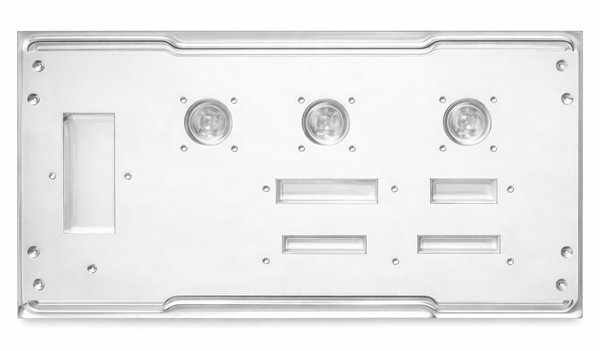
By contrast, CNC machining adopts a cold working mechanical cutting method, enabling refined processing of thick plates through precise tool setting control and CNC program configuration. A whole aluminum plate to be processed first undergoes surface milling, using the “one-time splitting into two” process. This not only reduces material waste but also ensures consistent processing parameters for both panels. After completing surface milling, hole-drilling, chamfering, and other processes, the plate is cut, followed by milling and polishing the reverse side. This double-sided processing mode maximizes the flatness and precision of thick-plate products, completely avoiding deformation and cross-section defects caused by hot working.
Complex, High-Demand Parts: Core Application Scenarios for CNC Machining
Products with complex structures and high requirements are the core targets for CNC machining. For custom parts with intricate shapes, special-shaped grooves, precision holes, and strict demands on dimensional accuracy and surface finish, CNC machining shows outstanding advantages. It can complete integrated processing of multiple operations—including milling, drilling, tapping, and engraving—in a single clamping, eliminating the need for repeated workpiece position adjustments. This effectively reduces error accumulation between processes, achieving precision control within ±0.02mm. Products such as precision connectors for automation equipment, metal components for medical devices, and casings for high-end instruments all rely on the high-precision support of CNC machining.
Surface Treatment Compatibility: CNC Enhances the Final Texture of Finished Products
Products processed by CNC machining feature higher surface flatness and finish. When subjected to subsequent surface treatments such as sandblasting, anodizing, and electroplating, the coating or oxide film adheres more evenly, avoiding local color differences or coating peeling. Whether it is a high-gloss chamfered frame or a panel with precision threaded holes, CNC machining fully meets design requirements, resulting in a finished product texture far superior to other processes.
Production Batch Trade-Off: CNC vs. Mold-Based Processes
Of course, CNC machining is not a one-size-fits-all solution. Production batch is a critical factor to consider when selecting a processing technology. For products with extremely high demand—tens of thousands or even hundreds of thousands of units—molding, stamping, or forging processes offer greater cost advantages. Stamping is suitable for mass rapid forming of thin plates, boasting high production efficiency and extremely low unit cost. Forging compacts the metal grain structure through external pressure, improving mechanical properties, and is ideal for high-strength load-bearing components. However, these two processes require high upfront mold investment; once the mold is finalized, modifying product designs becomes difficult and costly, making them more suitable for large-scale standardized production.
First Choice for Small-Batch Customization: The Flexibility Advantage of CNC Machining
In contrast, although the unit cost of CNC machining is relatively higher, it offers strong flexibility—no high mold investment is required, and product designs can be adjusted or modified at any time. This makes it highly suitable for small-batch, multi-variety custom production. For instance, for experimental equipment parts in research institutions, small-batch custom instrument casings, and personalized metal accessories, choosing CNC machining ensures quality while effectively controlling development costs.
Process Selection Principles: Applicable Boundaries and Optimal Solutions for CNC Machining
Among numerous metal processing technologies, there is no absolutely optimal choice—only the most suitable one. CNC machining is preferred for plates over 5mm thick, complex high-demand custom parts, and small-batch personalized products. For mass production of thin plates, laser cutting or stamping can be considered. Only by comprehensively evaluating factors such as product thickness, complexity, batch demand, and core quality requirements can we balance cost and efficiency while ensuring quality.


