
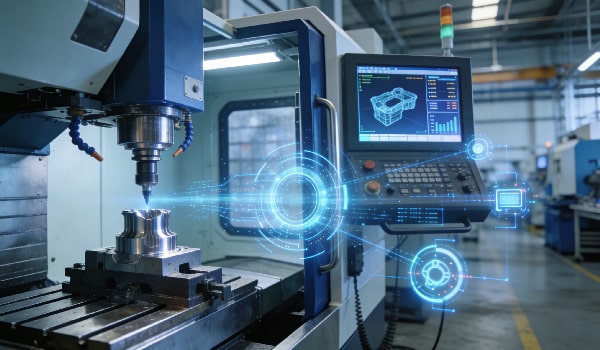
Recently, China’s CNC machining services industry has exhibited distinct characteristics of accelerated digital transformation, breakthroughs in niche segments, and upgraded talent demand. The industry as a whole is showing a significant trend of transforming from “batch OEM” to “technology-enabled services”. Below is a summary of key developments:
Table of Contents
ToggleI. Upgraded Talent Demand: Salaries for High-End CNC Machining Professionals on the Rise
With the transformation of CNC machining services towards precision and digitalization, the demand for high-end skilled talents in the industry has continued to surge. As a major cluster of machining services, the Pearl River Delta region has seen a general increase in salaries for related positions. According to the latest recruitment data from Zhaopin in December 2025, salaries for CNC machining-related positions in Dongguan show a clear gradient: CNC technicians/operators with 5-10 years of experience earn 8K-12K RMB; CNC production supervisors/material controllers with 3-5 years of experience earn 7K-8K RMB; while CNC programming and operation positions with 1-3 years of experience have reached as high as 12K-15K RMB, an increase of about 15% compared with the same period in 2024.
Enterprise recruitment demands focus more on “composite skills”. In addition to traditional machine operation and programming capabilities, talents with 5-axis CNC machining experience, digital production system operation capabilities, and precision material processing experience are more favored. A recruitment director of a Dongguan precision hardware machining enterprise stated that the core of current industry competition lies in technology and efficiency. Talents with high-end machining skills can help enterprises undertake higher-value-added orders, so enterprises are willing to pay premium salaries to attract them.
II. Trends in Service Model Upgrading: Digitalization and One-Stop Services Become Industry Mainstream
Judging from recent industry dynamics, CNC machining service enterprises are accelerating their departure from the traditional “single processing OEM” model and transitioning to a “digital + one-stop” service model. On the one hand, digital tools such as online ERP systems, real-time progress tracking, and remote process communication are widely used. Many leading machining service enterprises have realized the ability to allow customers to check production progress online and quickly obtain process plans, which greatly reduces customer communication costs and improves service transparency. On the other hand, “multi-process collaborative” one-stop service has become a core competitive advantage. Enterprises integrate various processes such as CNC machining, sheet metal manufacturing, surface treatment, and prototype duplication to provide customers with full-process services from design optimization to small-batch trial production.
This transformation trend is particularly prominent in niche segments: in the medical field, machining service enterprises need to cooperate with R&D enterprises to complete multiple rounds of prototype iteration and provide technical support for material selection and process optimization; in the new energy vehicle field, it is necessary to realize synchronous processing and precise matching of different components; in the intelligent hardware field, it is necessary to balance processing precision, cost and delivery cycle to help start-ups quickly realize product launch.
III. Regional Industry Dynamics: The Pearl River Delta Machining Service Cluster Continues to Lead
Centered on Dongguan and Huizhou, the Pearl River Delta region, with its complete industrial chain supporting facilities and mature skilled talent reserve, remains the core agglomeration area of China’s CNC machining services. Local machining service enterprises generally focus on the high-end precision machining field, with services covering multiple high-value-added industries such as electronics, medical care, and new energy. According to industry observations, the market demand for CNC machining services in Huizhou in 2025 has increased by 23% compared with the previous year, but the market differentiation is obvious: enterprises with digital service capabilities, high-end process reserves and complete quality control systems have full orders, while small and medium-sized enterprises with outdated equipment and single services are facing survival pressure.
Industry insiders stated that the CNC machining service industry will further develop towards “refinement, specialization and digitalization” in the future. Enterprises that can deeply integrate into customers’ R&D and production processes and provide customized technical solutions will occupy a dominant position in market competition.
IV. Policy-Driven Acceleration of Green Machining Transformation
With the in-depth implementation of the national Three-Year Action Plan for Green Manufacturing, the CNC machining service industry is accelerating its low-carbon transformation. Driven by both policy guidance and market demand, green machining has become an important part of enterprises’ core competitiveness. Machining service enterprises in various regions have actively responded to the formulation requirements of industrial product carbon footprint accounting standards and promoted green transformation throughout the entire process from process optimization, material selection to energy consumption: a Dongguan precision machining enterprise has introduced minimal quantity lubrication technology, reducing the traditional cutting fluid consumption from 5L/min to 0.05L/min, reducing pollution emissions by 90% and lowering processing energy consumption by 15% at the same time; a Shenzhen enterprise focusing on new energy component processing has established a recycling system for waste aluminum alloy processing scraps, which are reused for component processing after remelting and purification, increasing material utilization rate from 65% to 82% and reducing annual carbon emissions by more than 300 tons.
Policy support continues to increase. Local governments provide tax reductions and special subsidies to enterprises that adopt environmentally friendly processing technologies and achieve carbon emission reduction goals. For example, Huizhou has launched the “Green Process Upgrade Subsidy Program” for CNC machining enterprises, providing a maximum subsidy of 20% of the equipment investment for enterprises that purchase energy-saving CNC equipment and transform environmentally friendly processing production lines. Against this background, more and more machining service enterprises are incorporating green indicators into their service plans, providing “machining + carbon footprint management” integrated services for customers in industries with strict environmental requirements such as new energy and medical care, helping customers achieve low-carbon goals throughout the entire industrial chain.
V. In-depth Integration of AI and Large Models: Machining Services Enter a New Stage of Intelligent Decision-Making
The in-depth penetration of AI technology and large models is driving CNC machining services to leap from “digital response” to “intelligent decision-making”, breaking the industry’s reliance on manual experience in traditional machining services. Leading machining service enterprises have successively introduced intelligent processing systems with autonomous learning capabilities. By integrating AI chips and industry large models, they have realized the autonomous optimization of the entire machining process: a leading domestic machining service enterprise has upgraded and installed an intelligent process system on the basis of its original digital service system, which can independently match the optimal processing plan based on the 3D drawings uploaded by customers. The programming time for complex parts has been shortened from 30 minutes to 3 minutes, and the processing efficiency has been increased by more than 20%; a Dongguan machining enterprise has adopted AI predictive maintenance technology, which can predict tool wear, spindle failures and other problems 7 days in advance by collecting and intelligently analyzing equipment operation data in real time, reducing the equipment failure rate from 15% to 3% and ensuring that the stability of customer order delivery cycles is improved by 40%.
This integration of intelligent technology not only improves processing precision and efficiency but also expands the service boundary. Some enterprises have launched “AI process consulting” value-added services to provide customers with part design optimization suggestions. Through large models to simulate the effects of different processing technologies, potential processing risks are avoided in advance. For example, in the processing service of titanium alloy structural parts for an aerospace component R&D enterprise, the AI system found stress concentration problems in the original design through simulation analysis. After suggesting optimizing the structural fillet, the processing qualification rate increased from 78% to 99.2%, significantly reducing the customer’s R&D costs.
VI. Rise of Cross-Border Machining Services: Double Growth in Export Orders and Overseas Layout
The global competitiveness of China’s CNC machining services continues to improve, and cross-border machining services have become a new growth pole of the industry. Especially in high-end fields such as new energy vehicle components and precision medical equipment, export orders have increased significantly year-on-year. As the core area for machining service exports, the Pearl River Delta region has successfully entered the high-end European and American supply chains through technological upgrading and international certification breakthroughs: a Pearl River Delta precision machining enterprise has achieved bulk export of its laser galvanometer part processing services to European countries such as Germany and Switzerland after obtaining CE and TUV certifications, with cross-border service revenue increasing by 55% year-on-year from January to November 2025; a Shenzhen enterprise focusing on medical component processing has become a long-term cooperative partner of many European and American medical device manufacturers with its precision machining capabilities meeting FDA standards, and the order volume of artificial joint prosthesis blank processing has increased by 40% annually.
To improve the response efficiency of cross-border services, some enterprises have begun to layout overseas service networks. A large Dongguan machining service enterprise has established 2 overseas service centers in Southeast Asia, providing localized process docking, prototype trial production and after-sales support services, solving pain points such as communication time differences and logistics cycles in cross-border machining. The delivery cycle of its cross-border orders for new energy battery pack structural part processing has been shortened from 20 days to 8 days. Industry data shows that from January to October 2025, China’s CNC machining service export volume reached 5.1 billion US dollars, an increase of 13.6% year-on-year, of which the export share of high-end precision machining services has increased to 38%.
VII. Conclusion: A New Ecology of Machining Services Driven by Multiple Dimensions
At present, China’s CNC machining service industry has formed a multi-dimensional development ecology driven by “technological innovation, policy guidance, market expansion and talent support”. In addition to core dimensions such as talent, service model and regional clusters, green transformation, AI empowerment and cross-border expansion are becoming new engines driving the high-quality development of the industry. In the future, with the improvement of the carbon footprint management system, the in-depth application of intelligent technology and the restructuring of the global supply chain, enterprises with green machining capabilities, intelligent service levels and cross-border service experience will occupy a dominant position in market competition, promoting China’s CNC machining services to leap from a “manufacturing power” to a “service power”.


